

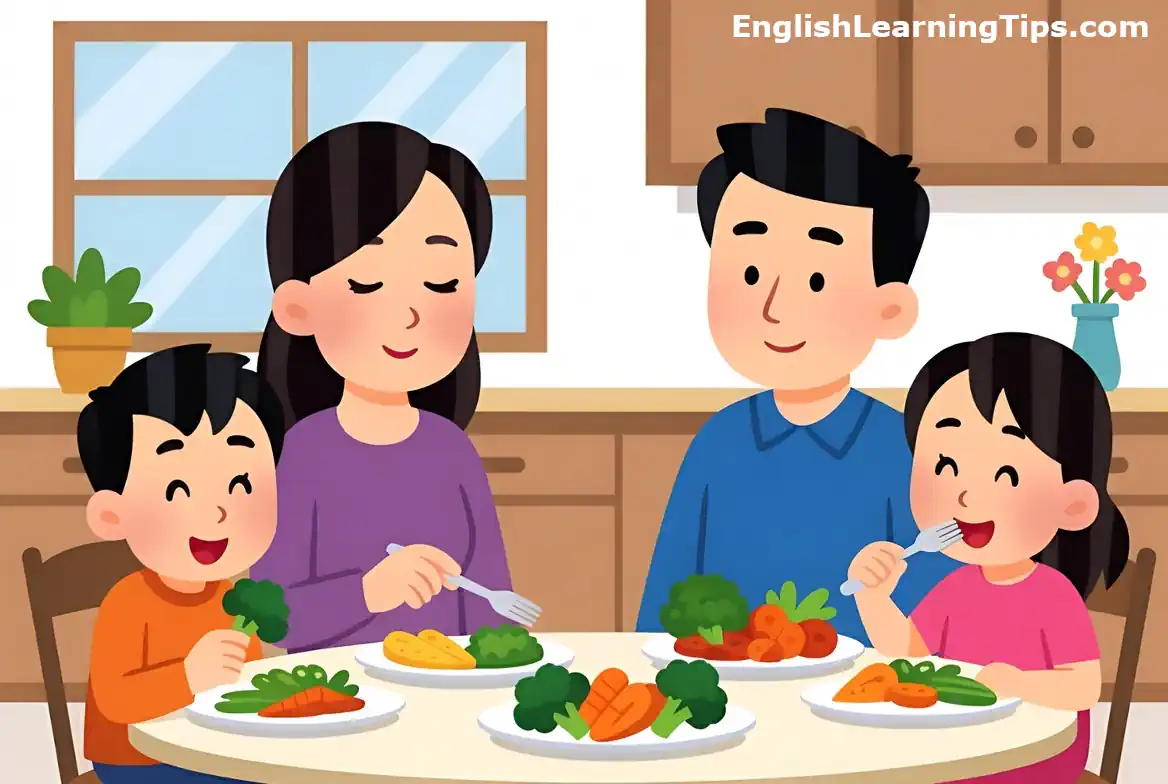
How to handle picky eaters: A guide for stress-free family mealtimes ESL lesson

Struggling with family dinner time? Learn helpful tips and vocabulary to deal with picky eaters and create a stress-free environment for everyone.
Teaching children to have healthy eating habits and managing family meals can be a challenge. In this English lesson about food and nutrition, we explore how parents can navigate the common struggle of feeding picky eaters. By understanding child nutrition and creating a positive atmosphere, you can turn mealtime into a pleasant bonding experience.
Lesson plan: Managing family mealtimes and picky eaters
Level: Intermediate (B1/B2)
Time: 45 minutes
Topic: Food, nutrition, and parenting strategies
Objectives: Students will learn vocabulary related to eating habits, discuss strategies for stress-free mealtimes, and practice using these phrases in realistic conversations.
Video: Stress-free family meals ⏲️ 6 Minute English
Background
Family dinner time is often viewed as a wonderful opportunity to reconnect, share stories about the day, and enjoy a meal together. However, for many parents, this time can quickly turn into a source of conflict when children refuse to eat, creating tension rather than fostering family fun. Nutrition experts often emphasize that these challenges are common and part of the normal development of children’s eating habits.
Understanding why children develop preferences—or dislikes—for certain foods is essential. Factors such as mood, daily activities, and even weather can impact a child’s appetite. By shifting the focus from forcing children to eat everything on their plate to creating a relaxed and supportive environment, parents can often reduce the stress surrounding family mealtimes.
Basic vocabulary
This section introduces essential terms for discussing eating habits and nutrition.
Vocabulary list
- Ups and downs (noun phrase): A mixture of good and bad things that happen over a period of time.
- Example: Parenting goes through many ups and downs, but it’s worth it.
- Mood (noun): The way someone is feeling at a particular time. (Adjective: moody).
- Example: My son is in a bad mood because he is hungry.
- Battleground (noun): A place or situation where an argument or conflict happens.
- Example: Dinner time shouldn’t be a battleground for parents and kids.
- Big deal (idiom/noun phrase): Something that is of special importance.
- Example: It’s a big deal for a child to have control over their dinner.
- Food allergy (noun phrase): A medical condition where the body reacts negatively (makes you sick) after eating certain foods.
- Example: My daughter has a severe food allergy to peanuts.
- Winning formula (noun phrase): A method or strategy that produces successful results.
- Example: Finding the right bedtime routine was our winning formula.
- Nutritionist (noun): A person who is an expert in the study of food and how it affects the body. (Verb: nourish).
- Example: The nutritionist suggested adding more vegetables to our diet.
- Appetite (noun): A natural desire or need to eat food. (Verb: appetize).
- Example: Playing outside gives the kids a big appetite.
- Conflict (noun): A serious disagreement or argument. (Verb: conflict).
- Example: We try to avoid conflict at the dinner table.
- Pressure (verb/noun): To try to force someone to do something. (Adjective: pressurized).
- Example: Don’t pressure your child to eat everything if they aren’t hungry.
Vocabulary for extension
- Healthy (adjective): Promoting good health. (Adverb: healthily).
- Flavor (noun): The distinctive taste of a food or drink. (Verb: flavor).
- Nutritious (adjective): Efficient, nourishing food. (Noun: nutrition).
- Picky (adjective): Very selective; fussy about what one eats.
- Variety (noun): A number of different things. (Verb: vary).
- Balanced (adjective): Containing a healthy mixture of different things. (Verb: balance).
- Digest (verb): To break down food in the stomach. (Noun: digestion).
- Ingredients (noun): The components used to make a dish.
- Preference (noun): A greater liking for one alternative over another. (Verb: prefer).
- Struggle (noun/verb): To have difficulty with something.
Teaching tips
- Use visual aids: Bring in pictures of different foods to encourage students to use the new vocabulary to describe their likes and dislikes.
- Personalization: Ask students to share a personal “winning formula” for a task they find difficult.
- Contextualize: Discuss the difference between a “food allergy” and a simple dislike to ensure they understand the medical implications.
Grammar spotlight
This lesson focuses on the use of phrasal verbs and idiomatic expressions related to daily routines. Focus on the structure of used to + infinitive (e.g., “I used to hate mushrooms”) to describe past habits that have changed. Also, practice the use of “it depends on” to discuss variables that affect behavior or outcomes.
Using “used to” for past habits
We use the phrase “used to” followed by the base form of a verb to talk about habits or states in the past that have changed in the present. For example, a student might say, “I used to hate vegetables, but now I love them”. This structure is particularly useful when discussing how eating preferences evolve as children grow into adults.
Expressing conditions with “it depends on”
The phrase “it depends on” is used to explain that an outcome is not fixed but changes based on specific factors. In the context of nutrition and family meals, we use this to describe how a child’s appetite or mood can fluctuate due to variables like the weather, their daily activities, or their emotional state. Encouraging students to use this phrase helps them provide more nuanced, detailed explanations during conversations.
Useful phrases
Key phrases
- “It depends on…”
- “Don’t pressure [someone] to…”
- “Create a stress-free atmosphere.”
- “Have you tried…?”
- “It’s a big deal to…”
Teaching tips
- Role-play: Set up a scenario where one student is a parent, and the other is a child to practice using “don’t pressure your child.”
- Sentence stems: Provide students with sentence stems like “The best way to encourage healthy eating is to…” to prompt longer answers.
Example conversations
Conversation 1: Basic description
Parent A: Did you like broccoli when you were young? Child B: No, I absolutely hated it. Parent A: What about now? Child B: Now I love it with a little garlic.
Conversation 2: Adding details
Parent A: Mealtime is becoming a real battleground. Child B: I know, he just won’t eat his vegetables. Parent A: I think he feels like he has no control over his day. Child B: That makes sense; maybe we should give him more choices.
Conversation 3: More advanced
Parent A: I’ve been struggling with my daughter’s food allergies lately. Child B: That sounds difficult. Have you found a winning formula yet? Parent A: We have found a few safe recipes, but it still takes a lot of effort. Child B: It’s a big deal for a child to feel safe while eating, so you’re doing a great job.
Teaching tips
- Encourage natural intonation.
- Ask students to expand on the dialogues by adding their own experiences.
Teaching strategy
Use the Communicative Approach. Focus on fluency over accuracy during the conversation practice. Allow students to discuss the topic in pairs before opening it to a group discussion to lower anxiety and increase participation.
Here’s a 45-minute lesson plan
Step 1: Warm-up (5 minutes)
Ask students to share one food they hated as a child but enjoy now. This breaks the ice and introduces the topic naturally.
Step 2: Vocabulary introduction (10 minutes)
Present the vocabulary list. Write the words on the board and have students match them to their definitions.
Step 3: Phrase practice (10 minutes)
Practice the key phrases. Use a “substitution drill” where students replace parts of the phrases to create new, relevant sentences.
Step 4: Conversation practice (15 minutes)
Pair students up. Assign them the example conversations to read aloud, then ask them to create their own dialogue based on a specific scenario (e.g., a picky eater at a restaurant).
Step 5: Wrap-up and personalization (5 minutes)
Review the quiz question from the original transcript and summarize the main takeaways. Ask students how they will apply these tips in their own lives.
Discussion questions
- Why do you think children often see mealtime as a battleground? (Answer: Because it is one of the few areas where they have control.)
- What is a “winning formula” for getting kids to try new foods? (Answer: Offering small healthy snacks and dips.)
- Is it ever okay to force a child to eat a certain food? (Answer: Experts generally advise against it to avoid stress.)
- How do you feel when you have to eat food you don’t like? (Answer: Open-ended; focus on expressing feelings.)
- What are some common causes of food-related stress in families? (Answer: Picky eating, allergies, time constraints.)
Additional tips
- Cultural sensitivity: Acknowledge that food is deeply tied to culture. What is considered a “healthy snack” varies significantly around the world.
- Visual aids: Use photos of colorful, healthy meals to spark interest and help build descriptive vocabulary.
- Adapt for level: For lower levels, focus on basic food items. For higher levels, focus on the psychological aspects of eating habits.
- Technology: Use online polls to ask students about their favorite healthy meals and display the results in real-time.
Common mistakes to address
- Grammar: Students often confuse “it depends” with “it depend.” Remind them of the third-person singular “s.”
- Word choice: Students may confuse “appetite” (the desire to eat) with “nutrition” (the substance/science of food).
Example activity
“The dinner party planning”: Divide the class into small groups. Give them a list of “restricted foods” (allergies) and ask them to plan a dinner menu that is inclusive, healthy, and stress-free for a family with a picky eater.
Homework or follow-up
- Writing: Write a short paragraph about your favorite family meal and why it is special to you.
- Speaking: Interview a family member or friend about their eating habits when they were a child.
- Research: Look up one healthy recipe and explain why it might be a “winning formula” for a family.
Faqs
- How do I get my child to eat more vegetables? Experts suggest offering dips or involving the child in the cooking process.
- Is it normal for a child to be a picky eater? Yes, it is very common and often a normal phase of development.
- What should I do if my child has a food allergy? Always consult a doctor or a registered nutritionist for a safe, personalized plan.
- Why is mealtime so stressful? It often becomes a battle of wills; focus on creating a positive atmosphere rather than the amount of food eaten.
Managing family meals can be challenging, but with the right approach and a bit of patience, you can create a happy, healthy environment. Do you have a “winning formula” for stress-free dinners, or perhaps a food you used to hate but now love? Leave a comment below and share your experiences—your tips might just help another parent in our community! If you found this lesson helpful, be sure to share it with friends and family.
Discover more from English Learning Tips
Subscribe to get the latest posts sent to your email.


