

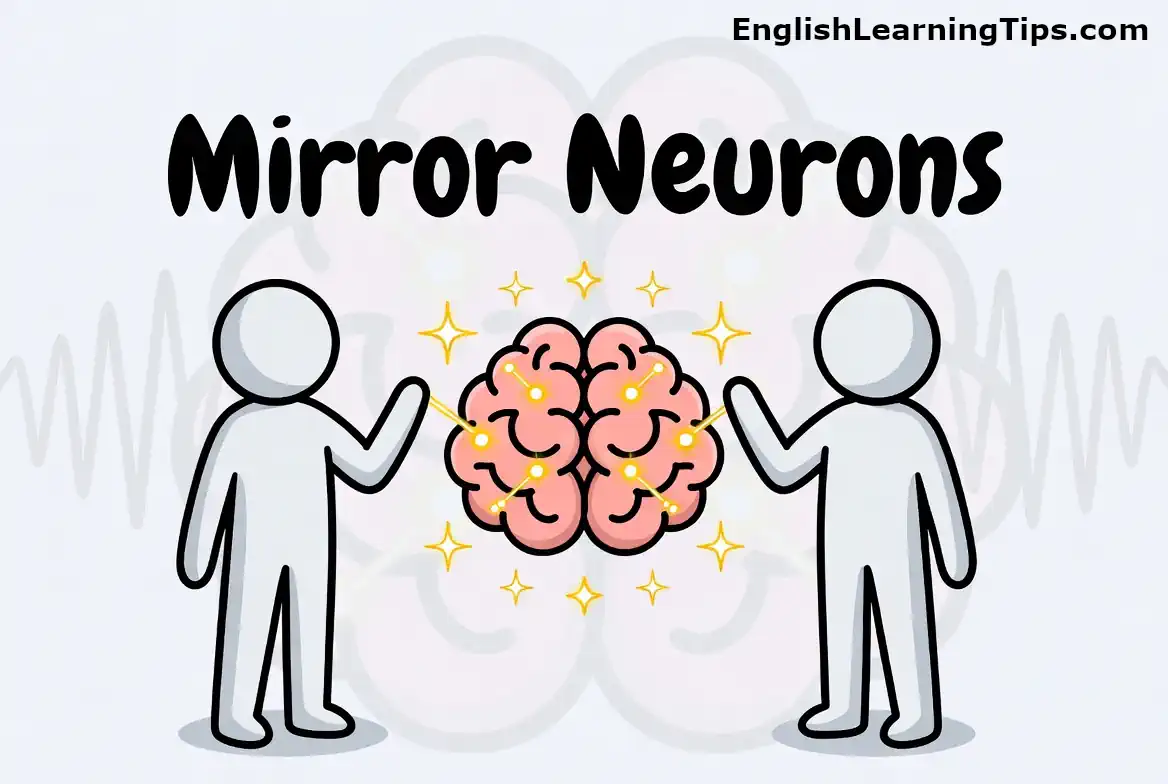
Understanding mirror neurons: The science of observation (ESL lesson)

Have you ever wondered why you instinctively mimic the hand gestures of a friend while they are telling a story, or how you seem to “pick up” a new physical skill just by watching someone else do it? The secret may lie in a specialized group of cells in your brain known as mirror neurons.
These fascinating neural structures fire not only when you perform an action but also when you observe someone else doing the same thing. In this lesson, we will explore the science of observational learning, unpack the neurological research surrounding how we share behaviors, and distinguish between scientific fact and popular myths—like the idea that these cells are the sole source of human empathy.
Whether you are a student of brain function or simply curious about human nature, this lesson will provide a clear, evidence-based look at one of the most intriguing topics in modern neuroscience.
Lesson plan: Exploring brain activity and observational learning
Level: Intermediate to advanced (B2-C1)
Time: 45 minutes
Topic: Neuroscience and the function of mirror neurons
Objectives: Students will be able to define mirror neurons, explain their role in observational learning, discuss the limitations of current research regarding empathy, and use new vocabulary in context.
Video: What do mirror neurons really do?
Background
Mirror neurons are a fascinating set of cells in the brain that fire both when an individual performs an action and when they observe someone else performing the same action. First discovered in macaque monkeys in the early 1990s, these neurons appear to create a neural “mirror” of the observed behavior. While initially thought to be the potential seat of human empathy and complex social behaviors, current research suggests their primary, proven role is in observational learning—helping us acquire skills by watching others.
However, the field of neuroscience is cautious about overstating its function. While studies show that mirror neuron networks are active during tasks like learning a dance or imitating hand motions, the link between these neurons and complex emotions like empathy remains correlational rather than causal. Because many studies have small sample sizes, scientists continue to investigate whether these neurons are fundamental to our social nature or simply one piece of a much larger neurological puzzle.
Basic vocabulary
This section introduces essential vocabulary related to neuroscience research and the study of brain function.
Vocabulary list
- Electrode (noun): A conductor used to make electrical contact with a non-metallic part of a circuit.
- Example: The researchers inserted an electrode into the monkey’s brain to monitor activity.
- Neural (adjective): Relating to a nerve or the nervous system.
- Example: The neural activity spiked when the subject reached for the object.
- Premotor (adjective): Related to the area of the cerebral cortex involved in planning movement.
- Example: The premotor cortex is essential for preparing the body to act.
- Cortex (noun): The outer layer of the cerebrum.
- Example: Different parts of the cortex are responsible for vision, movement, and focus.
- Observational (adjective): Relating to the action of observing something to gain information.
- Example: Much of human language acquisition is based on observational learning.
- Imitation (noun): The action of using someone or something as a model.
- Example: Children learn a great deal about social norms through the imitation of their parents.
- Correlational (adjective): Characterized by a mutual relationship or connection.
- Example: The study showed a correlational link between the two variables, not necessarily a causal one.
- Causality (noun): The relationship between cause and effect.
- Example: Scientists struggle to prove causality in complex brain studies.
- Infer (verb): To deduce or conclude information from evidence and reasoning.
- Example: We can infer that the subject is confused based on their hesitation.
- Empathy (noun): The ability to understand and share the feelings of another.
- Example: Empathy is often considered a cornerstone of healthy social interaction.
Vocabulary for extension
- Parietal (adjective): Relating to the parietal bones or the upper/back part of the skull.
- Temporal (adjective): Relating to the temples of the skull or the passage of time.
- Cognitive (adjective): Relating to the mental action or process of acquiring knowledge.
- Stimulus (noun): A thing or event that evokes a functional reaction.
- Neural plasticity (noun): The ability of the brain to form and reorganize synaptic connections.
- Hypothesis (noun): A proposed explanation made on the basis of limited evidence.
- Subject (noun): A person or thing that is being discussed, described, or dealt with.
- Motor skill (noun): A function that involves precise movement of muscles with the intent to perform a specific act.
- Interaction (noun): Communication or direct involvement with someone or something.
- Complex (adjective): Consisting of many different and connected parts.
Teaching tips
- Use visual diagrams of the brain to show the location of the frontal, parietal, and temporal lobes.
- Encourage students to create their own “pro-tip” flashcards using the spaced repetition method to improve long-term retention.
- Provide context by discussing the difference between “correlational” and “causal” in everyday scenarios (e.g., ice cream sales and sunburns) before applying it to neuroscience.
Grammar spotlight: Expressing scientific probability
This lesson focuses on the use of conditionals and modal verbs to discuss scientific theories. Since neuroscience often deals with possibilities rather than absolute facts, students must practice phrases such as “could be,” “might indicate,” and “if the theory is correct, then…”
Example: “If mirror neurons are responsible for imitation, we would expect to see activity in the motor cortex during observation.”
When discussing neuroscience and brain research, scientists rarely use absolute terms. Because research is often ongoing and subject to revision, we use specific language to express levels of certainty. This is known as “hedging,” and it is a vital skill for academic and professional communication in English.
Using modal verbs for hypothesis
Modal verbs allow us to discuss possibilities without claiming them as proven facts. In the context of mirror neurons, we use these to differentiate between what we know and what we suspect.
- Might/May: Used to show a possibility that is not yet fully confirmed.
- Example: These neurons might help us learn from others.
- Could: Used to suggest a potential ability or a theory that is plausible.
- Example: Mirror neurons could be involved in feeling empathy.
- Would/Would expect: Used to predict a result if a certain hypothesis is correct.
- Example: If the theory is accurate, we would expect to see activity in the motor cortex.
The difference between correlational and causal language
A common mistake in scientific discussion is confusing correlation with causality. Understanding how to structure these sentences helps learners avoid making unsupported claims.
- Correlational language: Use verbs like “are related to,” “are associated with,” or “correlate with.”
- Example: Activity in this region is associated with the observation of emotions.
- Causal language: Use verbs like “cause,” “lead to,” “trigger,” or “result in.”
- Caution: Use these only when there is definitive proof.
- Example: We do not know if these neurons cause empathy.
Pro-tip for learners
When you are writing or speaking about scientific topics, always ask yourself: “Do I have enough evidence to say this is a fact?” If you are not 100% sure, add a hedging phrase at the beginning of your sentence, such as: “Current research suggests that…” or “It is possible that…” This makes your English sound much more natural and professional.
Useful phrases
Key phrases
- “The research suggests that…”
- “There is a strong correlation between…”
- “It is important to distinguish between X and Y.”
- “This finding helps explain why…”
- “Further research is required to…”
Teaching tips
- Have students role-play as “skeptical scientists” and “enthusiastic researchers” to practice using modal verbs for hedging (e.g., “It might be,” “It could potentially”).
- Link these phrases to academic writing skills by having students draft a short paragraph summarizing the video.
Example conversations
Conversation 1: Basic description
Student A: Have you heard about mirror neurons before? Student B: I’ve heard the term, but I’m not really sure what they do. Student A: Basically, they are brain cells that fire when you do an action and when you watch someone else do it. Student B: So, they literally mirror the action in your brain? That sounds like a cool way to learn new things.
Conversation 2: Adding details
Student A: I read that mirror neurons might be why we are so good at observational learning. Student B: That makes sense, especially for skills like dancing or sports. Student A: Exactly, the study mentioned that watching a human model helps you learn steps better than just looking at symbols. Student B: It’s amazing how our motor cortex stays active even when we are just watching.
Conversation 3: More advanced
Student A: People often claim that mirror neurons are the biological basis for empathy. Student B: Is there actual evidence for that, or is it mostly speculation? Student A: The research is actually quite mixed; some studies show a correlation, but it’s hard to prove true causality. Student B: Right, and with such small sample sizes, we shouldn’t jump to conclusions about how the brain manages social interactions.
Teaching tips
- Ask students to summarize the main point of each conversation.
- Provide a glossary of terms to help students expand these dialogues.
Teaching strategy
Use the “See-Think-Wonder” strategy. Start by showing a video of a complex physical skill. Ask:
1. What do you see?
2. What do you think is happening in the brain?
3. What do you wonder about how we learn? This engages students’ prior knowledge before introducing the technical terminology.
Here’s a 45-minute lesson plan
Step 1: Warm-up (5 minutes)
Show a 30-second clip of someone learning a dance move. Ask students: “How did you learn to do things like this when you were a child?”
Step 2: Vocabulary introduction (10 minutes)
Go over the essential vocabulary list, emphasizing the difference between nouns and adjectives.
Step 3: Phrase practice (10 minutes)
Pair students to use the “Key phrases” to discuss a simple daily observation, such as someone making coffee or tying their shoes.
Step 4: Conversation practice (15 minutes)
Rotate partners using the conversation prompts above. Encourage students to add their own opinions about human behavior.
Step 5: Wrap-up and personalization (5 minutes)
Ask students to share one thing they learned and one question they still have about the brain.
Discussion questions
- Why do you think mirror neurons are more focused on movement meaning in monkeys but just the motion in humans? (Answer: It likely relates to our complex social and tool-use evolution.)
- Can you think of a skill you learned purely by watching? (Answers will vary: cooking, sports, gaming.)
- If mirror neurons are not the only cause of empathy, what else might be involved? (Answer: Prefrontal cortex, social conditioning, and emotional intelligence.)
- Why is it a problem if most brain research has small sample sizes? (Answer: Small samples lead to results that are harder to replicate and less generalizable.)
- How might this knowledge change the way teachers instruct students? (Answer: It emphasizes the importance of demonstration over abstract instruction.)
Additional tips
- Cultural sensitivity: Acknowledge that learning styles can vary across cultures; avoid assuming everyone learns the same way.
- Visual aids: Use high-quality brain scans or 3D animations of the frontal lobe to keep students engaged.
- Adapt for level: For lower levels, focus on the “imitation” aspect; for higher levels, delve into the “correlational vs. causal” debate.
- Technology: Utilize interactive brain mapping websites to show students real-time neuroimaging.
Common mistakes to address
- Grammar: Confusing “causal” (related to cause) with “casual” (relaxed).
- Word choice: Using “mirror neurons” to describe personality traits instead of specific brain activity.
Example activity
“The Mimic Game.” One student performs a series of silent, complex hand gestures. The partner must imitate them exactly. Then, they discuss which parts of the gesture were the hardest to copy and why they think their brain “mapped” the movement.
Homework or follow-up
- Writing: Write a 200-word essay explaining why science requires caution when interpreting brain studies.
- Speaking: Record a 1-minute video explaining the discovery of mirror neurons to a friend.
- Research: Find one other study about observational learning and report the findings in the next class.
FAQs
- Are mirror neurons actual “mirrors”? No, it is a metaphor for how they mimic the firing patterns of others.
- Do we have mirror neurons for emotions? Research suggests they might be involved, but it is not confirmed.
- Can mirror neurons be damaged? Like any brain region, they can be affected by injury, but research is limited.
- Why do we need more research? Most current studies are correlational; we need more evidence to prove they are necessary for social behavior.
Conclusion
Understanding mirror neurons offers a fascinating glimpse into the complex mechanics that make us a deeply social and observant species. While they may not grant us telepathy or superpowers, their role in learning and cultural transmission is undeniably significant. What do you think—could mirror neurons be the secret to human innovation, or are we just scratching the surface of brain science? Share your thoughts in the comments below, and don’t forget to share this article with a fellow science enthusiast!
Discover more from English Learning Tips
Subscribe to get the latest posts sent to your email.


