

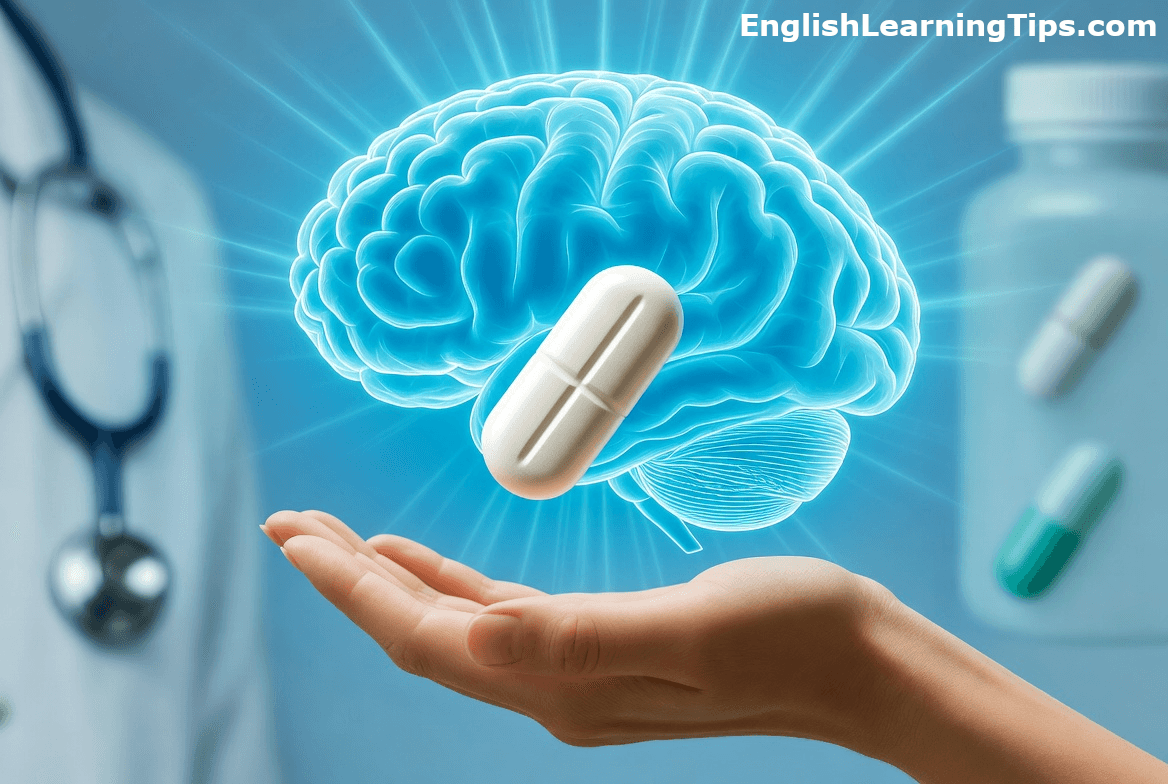
Exploring the power of the mind: Understanding the placebo effect (ESL lesson)

Understanding the placebo effect is a fascinating journey into the connection between the mind and the body. This ESL lesson plan helps students explore how expectations influence health, providing an engaging look at medical science vocabulary and psychological phenomena. Through interactive conversation practice and critical thinking questions, learners will improve their English fluency while diving into the mysterious world of “sugar pills” and therapeutic encounters.
Lesson plan: Investigating the placebo effect in medicine
Level: Intermediate (B1/B2)
Time: 45 minutes
Topic: The science and psychology of the placebo effect
Objectives: Students will learn key medical and psychological terminology, discuss the ethical implications of placebos, and practice expressing opinions on the mind-body connection.
Video: How the placebo effect tricks your brain
Background
The placebo effect is a phenomenon where a patient’s condition improves simply because they believe they are receiving a treatment. Although the substance or procedure—such as a “sugar pill” or saline injection—has no active medical ingredients, the brain’s expectation of relief can trigger real physiological changes, including the release of natural painkillers like endorphins or dopamine.
While often associated with “fake” medicine, the effect highlights the importance of the therapeutic encounter, including the trust and communication between a doctor and patient. Researchers study this effect to better understand how to maximize the efficacy of real drugs and why some treatments work better than others based on psychological framing.
Basic vocabulary
- Ailment (noun; pl. ailments): A minor illness or physical complaint. Example: He suffered from a common cold and other minor ailments.
- Placebo (noun; pl. placebos): A substance with no therapeutic value used in research or to satisfy a patient. Example: The study compared the new drug against a placebo.
- Therapeutic (adjective; adv. therapeutically): Having a healing effect. Example: The therapeutic benefits of talking to a doctor are significant.
- Effective (adjective; adv. effectively; noun. effectiveness): Successful in producing a desired result. Example: The new treatment is highly effective at reducing pain.
- Expectation (noun; verb. expect; adj. expectant): A strong belief that something will happen. Example: Her expectation of recovery helped her feel better faster.
- Active (adjective; noun. activity; adv. actively): Having an effect or being in operation. Example: This pill contains no active ingredients.
- Clinical (adjective; adv. clinically): Related to the observation and treatment of patients. Example: The drug failed its clinical trial.
- Inert (adjective; noun. inertness): Lacking the ability or strength to move or act; chemically inactive. Example: The capsule was inert and contained only sugar.
- Psychological (adjective; adv. psychologically): Related to the mind or mental state. Example: Many ailments have a psychological component.
- Administer (verb; noun. administration): To dispense or apply a treatment. Example: The nurse will administer the medicine at noon.
Vocabulary for extension
- Nocebo: A detrimental effect on health produced by psychological or psychosomatic factors.
- Sham: A thing that is not what it is purported to be; a deception.
- Hypochondriasis: A state of abnormal anxiety about one’s health.
- Endorphin: A hormone released in the brain that acts as a natural painkiller.
- Dopamine: A neurotransmitter that helps control the brain’s reward and pleasure centers.
- Stagnant: Showing no activity; dull and sluggish.
- Conditioning: The process of training or accustoming a person to behave in a certain way.
- Generic: A product without a brand name or trademark.
- Invasive: Tending to spread or intrude; involving entry into the body.
- Sophisticated: Having a high degree of complexity.
Teaching tips
Use realia by bringing in empty pill bottles or medical items to make the vocabulary more tangible. Encourage students to categorize these words into “medical” and “psychological” groups.
Grammar spotlight: The causative and the passive voice
When discussing the placebo effect, your students will often need to describe how a treatment influences a patient, or how a patient experiences a procedure. Two grammatical structures are essential for this: the causative and the passive voice.
The causative: Using make, have, and let
The causative is used to describe how one person or thing causes another to experience a specific outcome or action. Since the placebo effect is largely about expectations making us feel better, this is a perfect structural fit.
- Make + object + base verb: Use this to describe an effect that is forced or inevitable.
- Example: “The expectation of relief makes the brain release natural painkillers.”
- Have + object + base verb: Use this when someone is instructed or arranged to do something.
- Example: “The researcher had the participants take a sugar pill.”
- Let + object + base verb: Use this to describe allowing something to happen.
- Example: “The doctor let the patient describe their symptoms fully to build trust.”
The passive voice: Focusing on the action
In scientific and medical contexts, the focus is often on the procedure itself rather than the person performing it. The passive voice helps your students to sound more academic and formal.
- Construction: Form the passive by using the appropriate tense of the verb “to be” plus the past participle of the main verb.
- Examples from the lesson:
- “The placebo was administered by the nurse.”
- “The results are being studied by medical experts.”
- “Patients are told they are receiving a treatment.”
Teaching tips for grammar
- Focus on the shift: Provide students with active sentences (e.g., “The doctor gave the patient a pill”) and have them rewrite them using the passive voice (“The patient was given a pill by the doctor”) to practice the structure.
- Use real-world medical news: Bring in a short headline about a medical discovery. Ask students to identify any instances of the passive voice and discuss why the author chose to use it instead of the active voice.
- Personalized practice: Have students write three sentences about their own medical experiences using the causative (“My doctor had me…”) and three sentences about a general medical fact using the passive voice (“Medicine is often tested by…”).
Useful phrases
Key phrases
- “It’s all in your head.”
- “The power of suggestion.”
- “To be scientifically proven.”
- “To trigger a response.”
- “A lack of symptoms.”
Teaching tips
Role-play scenarios where students must use these phrases to describe a medical situation. Ask them to debate whether the “power of suggestion” is a positive or negative thing.
Example conversations
Conversation 1: Basic description
Student A: Did you know that some medicine is actually just sugar?
Student B: Really? That sounds like a trick.
Student A: It’s called a placebo, and it can actually make people feel better.
Student B: That is hard to believe, but I guess it’s possible.
Conversation 2: Adding details
Student A: Why do doctors give placebos in drug trials?
Student B: They use them to see if the real drug is better than just a fake one.
Student A: So, they subtract the placebo effect to find the true results?
Student B: Exactly, it helps them understand if the medicine is actually effective.
Conversation 3: More advanced
Student A: It’s fascinating how even the color of a pill can change its effect.
Student B: I read that blue pills work better for sleeping, while red ones are better for pain.
Student A: It really highlights how our expectations drive our own biology.
Student B: I wonder if this means doctors should focus more on the conversation with the patient than the pills themselves.
Teaching tips
Have students practice in pairs, rotating roles. Encourage them to use the target vocabulary words naturally within the conversation.
Teaching strategy
Use the inquiry-based learning approach. Start by asking students to define “fake” medicine before providing the academic definition of the placebo effect. This connects prior knowledge to new concepts.
Here’s a 45-minute lesson plan
Step 1: Warm-up (5 minutes)
Discuss: “Have you ever taken medicine that you thought worked, but later found out it didn’t?”
Step 2: Vocabulary introduction (10 minutes)
Introduce the core 10 words using flashcards or a matching game.
Step 3: Phrase practice (10 minutes)
Provide sentence stems and have students complete them using the key phrases.
Step 4: Conversation practice (15 minutes)
Students break into pairs to perform the provided dialogues, then create their own based on a new scenario.
Step 5: Wrap-up and personalization (5 minutes)
Ask students to summarize one thing they learned and how they might explain it to a friend.
Discussion questions
- Question: Is it ethical for doctors to use placebos? Answer: It is controversial; some argue it is deceptive, while others believe the therapeutic benefit justifies it if it helps the patient.
- Question: Why do expensive placebos work better than cheap ones? Answer: Because our expectations of quality and sophistication influence our brain’s response.
- Question: What is the “nocebo” effect? Answer: It occurs when a patient expects negative side effects and therefore experiences them.
- Question: Can the placebo effect cure serious diseases like cancer? Answer: No, it can manage symptoms like pain or stress but cannot cure physical diseases.
- Question: Does the placebo effect work if you know you are taking a placebo? Answer: Surprisingly, yes, in some cases it still works because the ritual of treatment influences the brain.
Additional tips
- Cultural sensitivity: Be aware that some cultures have different views on “fake” medicine or traditional healing; keep the discussion open-minded.
- Visual aids: Show photos of different-shaped pills or a diagram of the brain to illustrate the mind-body connection.
- Adapt for level: For lower levels, focus on the “fake pill” concept; for higher levels, discuss the neurobiology and ethics.
- Technology: Use an online quiz tool to review the vocabulary list at the end of class.
Common mistakes to address
- Grammar: Confusing “effect” (noun) with “affect” (verb).
- Word choice: Using “fake” instead of “placebo” or “inert” in professional contexts.
Example activity
The “Placebo Experiment”: Divide the class into two groups. Tell Group A they are using a “new, highly effective focus-boosting pen” and Group B they are using a “regular pen.” Have them complete a task and compare results to see if positive expectations improved performance.
Homework or follow-up
- Writing: Write a 200-word paragraph explaining your opinion on using placebos in hospitals.
- Speaking: Record a 2-minute video explaining the placebo effect to someone who has never heard of it.
- Research: Find one recent article about a medical study involving a placebo control group.
FAQs
- What is the placebo effect? It is an improvement in a patient’s condition due to the belief that a treatment will work, rather than the treatment itself.
- Are placebos always fake pills? No, they can be injections, machines, or even words and gestures from a doctor.
- Can the placebo effect heal any condition? It is effective for symptoms like pain and anxiety but cannot cure structural or infectious diseases.
- What is a nocebo effect? It is the opposite of a placebo, where negative expectations lead to actual negative symptoms.
- Why do researchers use placebos in clinical trials? To ensure the new drug is actually effective compared to the psychological benefit of receiving any treatment at all.
Conclusion
The placebo effect serves as a powerful reminder of how much our mindset dictates our physical well-being. By understanding these concepts, you can better navigate medical information and appreciate the complexity of the human brain.
Did you find this lesson on the placebo effect helpful? Share your thoughts in the comments below and pass this article along to a friend who is interested in science!
Discover more from English Learning Tips
Subscribe to get the latest posts sent to your email.


