

The English alphabet: A complete guide to learning your ABCs

Have you ever stopped to think about the 26 letters that make up the English alphabet? This writing system is the foundation of one of the world’s most widely spoken languages. Whether you are a parent teaching a child, an ESL student, or just curious about linguistics, mastering the English letters is the first step toward fluent communication.
In this guide, we will uncover how the alphabet works, its fascinating history, and practical tips to master the 26 letters of the English alphabet.
Quick summary (TL;DR): The English alphabet has 26 letters (5 vowels, 21 consonants). It evolved from Latin and Greek roots and is now the most used script globally. Check our pronunciation table below for the Zee vs. Zed breakdown.
What is the English alphabet?
The English alphabet is a 26-letter writing system based primarily on the Latin script. It consists of 5 vowels (A, E, I, O, U) and 21 consonants. These letters combine to form the phonetic foundation of the English language, used in both American and British standards
Uppercase vs. lowercase letters
Every letter in English has two distinct forms:
- Uppercase (Capital letters): Used for the beginning of sentences, proper nouns (like “London” or “Sarah”), and titles.
- Lowercase (Small letters): The standard form used for the majority of written text.
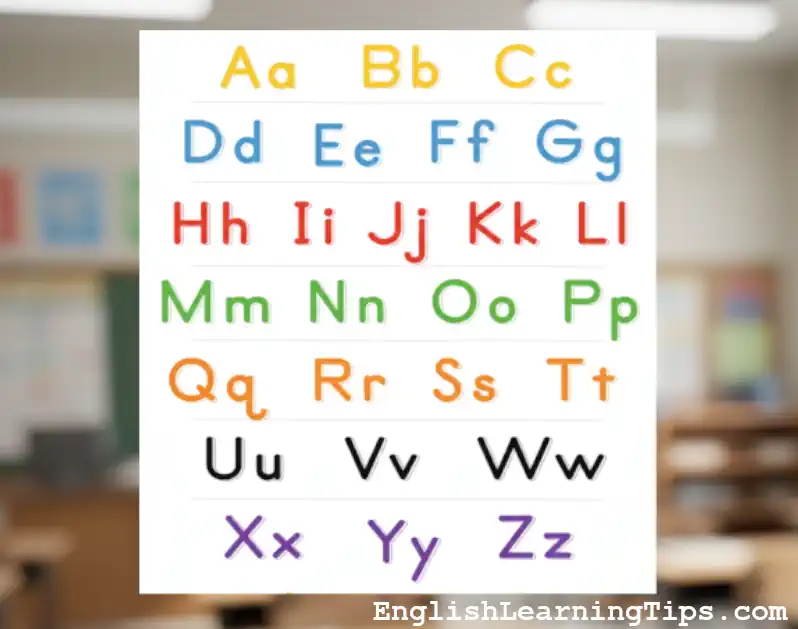
The 26 letters of the alphabet in order
Below is a quick reference table for the English alphabet, including phonetic pronunciations to help with English speaking skills.
| Uppercase | Lowercase | Letter name (Pronunciation) | Example word |
| A | a | Ay | Apple |
| B | b | Bee | Ball |
| C | c | See | Cat |
| D | d | Dee | Dog |
| E | e | Ee | Egg |
| F | f | Eff | Fish |
| G | g | Jee | Goat |
| H | h | Aych | Hat |
| I | i | Eye | Igloo |
| J | j | Jay | Jump |
| K | k | Kay | Kite |
| L | l | Ell | Lion |
| M | m | Em | Moon |
| N | n | En | Nest |
| O | o | Oh | Orange |
| P | p | Pee | Pig |
| Q | q | Cue | Queen |
| R | r | Ar | Rabbit |
| S | s | Ess | Snake |
| T | t | Tee | Tree |
| U | u | You | Umbrella |
| V | v | Vee | Van |
| W | w | Double-you | Water |
| X | x | Eks | X-ray |
| Y | y | Why | Yellow |
| Z | z | Zee (US) / Zed (UK) | Zebra |
Understanding vowels and consonants
The quickest way to wrap your head around English phonics is to split the alphabet into two camps: vowels and consonants.
- Vowels (A, E, I, O, U, and sometimes Y): These letters represent open sounds where the breath flows freely. Vowels are essential because almost every English word contains at least one.
- Consonants: The remaining 21 letters. These sounds are created by constricting the air with your lips, tongue, or teeth.
Note: The letter Y is unique because it acts as a “borrowed” vowel in words like “sky” or “fly,” but remains a consonant in words like “yellow.”
The history and origins of English letters
The alphabet we use today didn’t appear overnight. It is the result of thousands of years of linguistic evolution.
- Phoenician and Greek roots: The journey began around 1200 BCE with Phoenician symbols, which were later adapted by the Greeks.
- Latin influence: The Romans brought the Latin alphabet to Britain around 43 AD. Most of our modern letters come directly from this Roman script.
- Old English additions: Early English included unique letters like æ (ash) and þ (thorn). Over time, these were replaced by the standard 26 letters we use today.
- The arrival of J, U, and W: You might be surprised to learn that J and U didn’t even exist as separate letters until the 16th and 17th centuries. W began as a “double V” (VV), which explains its unique name.
Practical tips for learning the ABCs
If you are looking for the best way to learn the English alphabet, consistency is key. Here are the most effective methods:
1. Use the alphabet song
The classic ABC song remains one of the most effective mnemonic devices for memorizing letter order. It uses a melody that makes the sequence “stick” in your long-term memory. See the alphabet video down below.
2. Practice with visual aids
- Alphabet charts: Keep a poster visible in your study area to associate letters with visual objects.
- Flashcards: Test yourself by looking at the uppercase letter on one side and the lowercase/example word on the other.
3. Focus on writing and tracing
Writing letters by hand builds muscle memory. Start by tracing dotted lines on alphabet worksheets before moving on to free-hand writing on lined paper.
4. Read phonics-based books
Children’s “ABC books” are not just for kids; they are excellent for beginners because they emphasize the relationship between a letter and its primary sound.
In my experience, learners often struggle most with the C and G sounds because they change depending on the letters that follow them. A good rule of thumb: if an E, I, or Y follows, the sound usually softens (like “City” or “Gem”). Following those, the sounds of L and R are common hurdles; practicing “minimal pairs” like “light” and “right” can help distinguish them.
Why learning both forms (upper and lower) together matters
In English, uppercase and lowercase letters are often used in different contexts within the same sentence. By learning them as a pair (Aa), you build a stronger visual connection, which is essential for:
- Reading fluency: Recognizing letters regardless of their position in a word.
- Proper grammar: Knowing when to switch to a capital letter for names or the start of a sentence.
- Writing speed: Developing muscle memory for both “big” and “small” shapes.
Frequently asked questions about the English alphabet
Visual tools to help you learn
The Alphabet Song
Pronouncing English letters
Conclusion: Your journey with the English alphabet
Twenty-six letters. It sounds small, doesn’t it? But these symbols are the foundation for everything from Shakespearean sonnets to modern text slang. From the quirky origin of the letter W to the debate between “zee” and “zed,” these characters are the foundation of literacy and global communication. Whether you are helping a child learn their ABCs or mastering English as a second language, understanding these building blocks is the most important step in your linguistic journey.
Join the conversation
We want to hear from you! Learning the alphabet can be full of surprises.
- Which English letter do you find the hardest to pronounce?
- Did you grow up saying “zee” or “zed”?
- Do you have a favorite mnemonic or song for remembering the letters?
Share your thoughts in the comments below! If you found this guide helpful, please share it with a friend or a student who is currently practicing their English letters. Your support helps us create more free resources for learners everywhere.
Discover more from English Learning Tips
Subscribe to get the latest posts sent to your email.


