


Positioning adverbs in English: A complete guide to word order

Adverbs provide the essential context—how, when, where, and why—that turns a basic sentence into a clear story. However, English word order is strict. Moving a single adverb can make a sentence sound ‘off’ or completely change your meaning. This guide breaks down the standard rules for adverb placement to help you improve both speaking and writing.
How to position adverbs: The standard SVOA word order
In English, the standard sentence structure is Subject + Verb + Object (SVO). When adding an adverb, the most common position is after the object.
The SVOA Rule: Subject + Verb + Object + Adverb
Example: They played soccer (SVO) + confidently (A).
Important: Never place an adverb between a verb and its direct object.
- Incorrect: She reads quietly books.
- Correct: She reads books quietly.
Writer’s resource: If you want to master these patterns, English Grammar in Use is an excellent self-study book for intermediate learners.
The order of multiple adverbs
When you use a string of descriptors, follow the Manner, Place, Time (MPT) sequence. If you deviate from this, your sentence may suffer from the ‘Yoda effect’—grammatically possible, but socially awkward.
| Priority | Adverb type | Question answered | Example |
| 1 | Manner | How? | He worked hard |
| 2 | Place | Where? | at the office |
| 3 | Time | When? | yesterday. |
Three common adverb positions
To master English syntax, you must recognize the three standard adverb placements in English sentences.
1. Front-position (The beginning of the sentence)
Adverbs are placed here to provide emphasis or to set the scene for the entire sentence.
- Connecting ideas: “However, the results were different.”
- Time emphasis: “Yesterday, all my troubles seemed so far away.”
- Sentence adverbs: “Fortunately, we found the keys.”
2. Mid-position (Before the main verb)
This is the most common home for adverbs of frequency and adverbs of certainty.
- Before the verb: I always eat breakfast.
- After the “be” verb: He is often late.
- Between auxiliary and main verb: I have already finished.
3. End-position (The end of the clause)
This is the default for adverbs of manner, place, and time when you want the sentence to sound neutral.
- Manner: She sang beautifully.
- Place: I went there.
- Time: I’ll see you later.
Special cases: Adverbs that change meaning
The placement of “focusing adverbs” like only, just, and even is critical. These words modify the word immediately following them. Notice how the meaning shifts:
- “Only she kissed him.” (No one else kissed him.)
- “She only kissed him.” (She didn’t do anything else, like hug him.)
- “She kissed only him.” (She didn’t kiss anyone else.)
Formal inversion with negative adverbs
In formal or literary English, placing a negative adverb (never, rarely, seldom) at the start of a sentence triggers a “verb-subject” flip.
- Standard: I have never seen such a sight.
- Formal Inversion: Never have I seen such a sight.
Quick reference: Adverb placement table
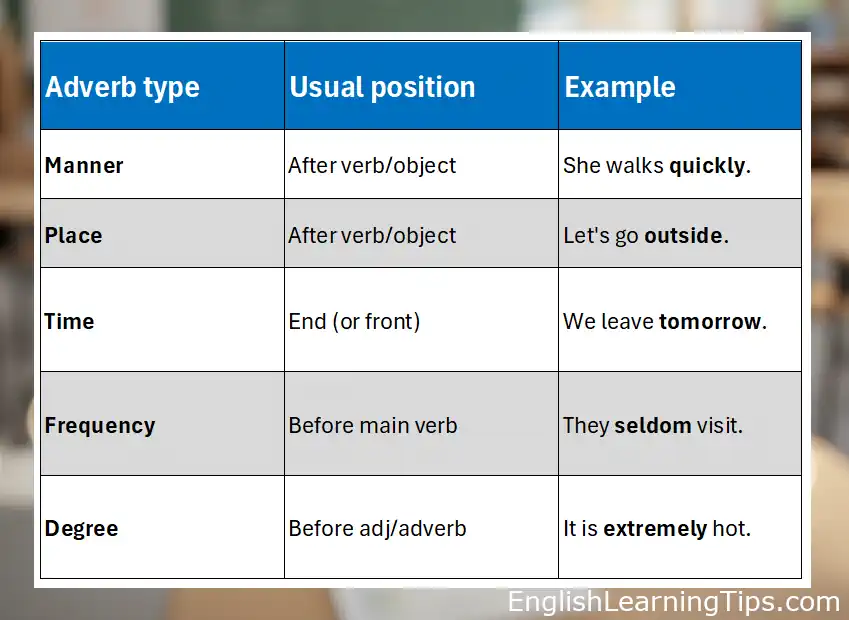
Frequently asked questions about adverb placement
Visual tools to help you learn
Where to place adverbs
Video summary: Mastering adverb positions with Wes
In this lesson from Interactive English, Wes explains that adverb placement isn’t just about memorizing rules; it’s about becoming familiar with the three primary “slots” in an English sentence.
The three standard positions
- Initial position: The first word of a sentence, often used to connect ideas or add emphasis.
- Middle position: Located between the subject and the main verb; this is the most common spot for adverbs that aren’t being stressed.
- Final position: At the very end of the main clause or sentence, typically modifying the verb.
Key adverb types discussed
- Conjunctive adverbs (Signposts): Words like however, next, and finally that act as “signposts” to guide the listener through a conversation.
- Evaluative and viewpoint adverbs: These express the speaker’s attitude or opinion (e.g., personally, fortunately) and usually start the sentence.
- Adverbs of frequency and degree: Common words like always, sometimes, and really that usually sit in the middle position to show intensity or habit.
- Manner and time adverbs: Words that describe how or when something happened (e.g., slowly, yesterday), which typically appear in the final position.
The rule of thumb for emphasis: Wes explains a simple trick: to give an adverb more stress, move it to the initial position. For example, saying “Repeatedly, I called you” makes the repetition the most important part of the message. If you don’t want to emphasize the adverb, keep it in the middle position.
Test your knowledge: Adverb placement quiz
1. Which sentence follows the correct SVOA (Subject-Verb-Object-Adverb) order?
- A) She reads quietly the book.
- B) She quietly reads the book.
- C) She reads the book quietly.
- D) Quietly she reads the book.
2. Follow the MPT (Manner, Place, Time) rule to complete this sentence: “He ran…”
- A) …yesterday quickly at the park.
- B) …quickly at the park yesterday.
- C) …at the park quickly yesterday.
- D) …yesterday at the park quickly.
3. Where is the most natural “mid-position” for the adverb in this sentence: “I [ ] have [ ] finished [ ] my homework.”
- A) Before “I”
- B) Between “I” and “have”
- C) Between “have” and “finished”
- D) After “homework”
4. Which sentence implies that NO ONE ELSE performed the action?
- A) Only he washed the car.
- B) He only washed the car.
- C) He washed only the car.
- D) He washed the car only.
5. In formal English, which is the correct “inversion” after a negative adverb?
- A) Never I have seen such a beautiful lake.
- B) Never have I seen such a beautiful lake.
- C) Never I saw such a beautiful lake.
- D) I never have seen such a beautiful lake.
Answer key
| Question | Correct answer | Why? |
| 1 | C | Adverbs should not come between the verb (reads) and the object (book). |
| 2 | B | Standard order is Manner (quickly), then Place (at the park), then Time (yesterday). |
| 3 | C | Mid-position adverbs usually sit between the auxiliary verb (have) and the main verb (finished). |
| 4 | A | “Only” modifies the word that immediately follows it. |
| 5 | B | Starting with “Never” requires flipping the subject and the auxiliary verb. |
Common adverb placement mistakes to avoid
Even advanced English learners struggle with these specific word order traps. Use this checklist to proofread your writing:
- The splitting the object error: Never place an adverb between a verb and its direct object.
- Incorrect: I like very much coffee.
- Correct: I like coffee very much.
- Misplacing “also”: The word also should follow the verb to be but come before other main verbs.
- Incorrect: I also am a student.
- Correct: I am also a student. / I also like coffee.
- The “Yoda effect” (MPT order): Do not scramble the manner, place, and time sequence.
- Incorrect: He worked yesterday hard.
- Correct: He worked hard (manner) yesterday (time).
- The “hardly” vs. “hard” mix-up: Remember that hardly does not mean “in a hard way.” It means “barely.”
- Incorrect: He works hardly at his job.
- Correct: He works hard at his job.
- Adverbs of frequency with auxiliary verbs: If you have an auxiliary verb (can, will, have), the adverb goes after it.
- Incorrect: I usually can go.
- Correct: I can usually go.
Conclusion: Mastering adverb word order
Mastering adverb placement is about more than just following strict grammar rules; it is about controlling the rhythm and clarity of your writing. By sticking to the SVOA and MPT guidelines, you ensure that your message is easy to understand. While English is flexible enough to allow for emphasis through front-positioning, consistency is what makes your writing sound natural to native speakers.
Whether you are preparing for an exam or polishing a professional email, the strategic use of adverbs will help you communicate with much greater precision.
Join the conversation
Did you find the MPT rule helpful, or is there a specific adverb that always trips you up? English grammar is full of “grey areas,” and we would love to hear your thoughts.
- Leave a comment below with your toughest adverb placement question.
- Share this guide with a fellow student or writer who wants to level up their English skills.
- Bookmark this page as a quick reference for your next writing project.
Discover more from English Learning Tips
Subscribe to get the latest posts sent to your email.


