


Adverbs of manner: Definition, rules, and examples

Adverbs of manner are essentially the “how” of a sentence. While a verb tells us what happened, these specific adverbs describe the quality or style of that action. They provide the necessary detail to help your reader visualize a scene, changing a simple sentence like “She sang” into a much more descriptive one, like “She sang beautifully.”
Whether you are writing a story or practicing English grammar, mastering these words helps you answer the question: “In what way did this happen?”
What are adverbs of manner?
An adverb of manner describes the quality or style of a verb. While verbs tell us what happened, these adverbs tell us the specific way it happened.
Common characteristics
To help you identify these words in a sentence, look for these three main traits:
- Descriptive power: They add intensity, speed, or emotion to an action.
- Placement flexibility: They usually follow the main verb or the object.
- Adjective connection: Most (but not all) are derived directly from adjectives by adding a suffix.
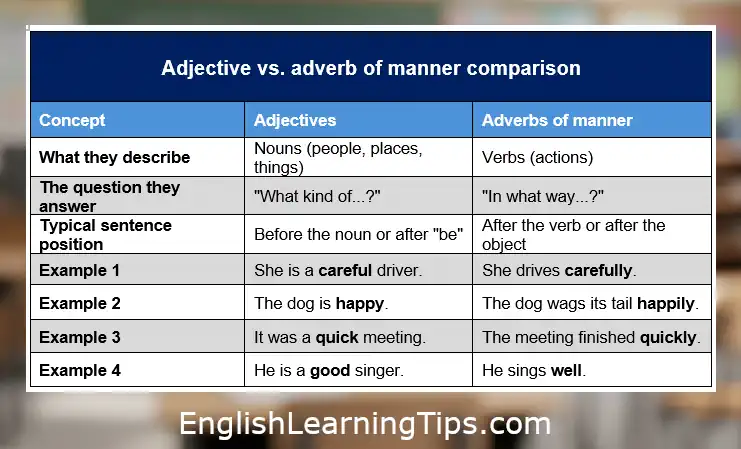
How to form adverbs of manner
Most adverbs of manner are created by adding a specific suffix to an adjective. However, English is famous for its exceptions.
1. The “-ly” rule
The most common way to form these adverbs is by adding -ly to the end of an adjective.
- Quick → Quickly
- Soft → Softly
- Careful → Carefully
2. Spelling changes
If the adjective ends in -y, change the “y” to “i” before adding “-ly.”
- Happy → Happily
- Easy → Easily
3. Irregular adverbs
Some words change completely or don’t change at all. These are the most important for learners to memorize.
| Adjective | Adverb of manner | Example sentence |
| Good | Well | He plays the piano well. |
| Fast | Fast | The athlete runs fast. |
| Hard | Hard | She worked hard on the project. |
| Late | Late | They arrived late to the party. |
Where to place adverbs of manner in a sentence
Placement changes the rhythm and emphasis of your writing. Generally, you should avoid placing an adverb between a verb and its direct object.
- After the verb: “She walked slowly.”
- After the object: “He opened the gift excitedly.”
- Before the verb (for emphasis): “He quietly left the room.”
Writing tip: Want to add some drama? Place the adverb at the start of a sentence (e.g., “Suddenly, the lights went out”) to alert the reader that something is about to change.
Comprehensive list of adverbs of manner
Use these words to add variety to your vocabulary:
- Positive manners: Cheerfully, elegantly, faithfully, generously, honestly, kindly, warmly.
- Negative manners: Angrily, greedily, lazily, nervously, rudely, selfishly.
- Speed and precision: Briefly, efficiently, promptly, quickly, slowly, swiftly.
- Effort and intensity: Diligently, effortlessly, intently, tirelessly, zealously.
Frequently asked questions about adverbs of manner
Common mistakes with adverbs of manner
Even advanced English learners trip up on these specific rules. Avoiding these four traps will immediately make your writing more professional and natural.
1. The “good” vs. “well” confusion
This is the most frequent error in spoken English. Remember: good is an adjective (describes a noun), while well is the adverb (describes the action).
- Incorrect: He plays the guitar very good.
- Correct: He plays the guitar very well.
2. Using “fastly”
Because most adverbs end in -ly, learners often try to force it onto the word “fast.” However, “fastly” is not a word in modern English.
- Incorrect: The car drove fastly down the road.
- Correct: The car drove fast down the road. (Fast is both an adjective and an adverb).
3. Placing adverbs between the verb and the object
In English, you should not separate a verb from its direct object with an adverb. The adverb usually belongs at the end of the phrase.
- Incorrect: She ate quickly the apple.
- Correct: She ate the apple quickly.
4. Confusing “hard” with “hardly”
These two look similar but have opposite meanings. “Hard” means with a lot of effort, while “hardly” means “almost not at all.”
- Incorrect: I studied hardly for the exam. (This sounds like you didn’t study!)
- Correct: I studied hard for the exam.
Conclusion: Master your adverbs of manner
Understanding adverbs of manner is one of the fastest ways to move from basic English to sounding like a native speaker. By simply adding -ly or mastering irregulars like well and fast, you give your sentences color, depth, and precision. Remember, these words don’t just describe an action; they tell a story about how that action happened.
Share your favorite adverb
We want to hear from you! To practice what you’ve learned, leave a comment below using the adverb “comfortably” or “quickly” in a sentence about your day.
If you found this guide helpful, share it with a fellow English learner or pin it to your study board. Your support helps us create more free ESL resources for students worldwide!
Expand your grammar knowledge
If you found this guide helpful, explore our other resources on adverb usage:
- Adverbs of degree: How much or to what extent.
- Adverbs of frequency: How often an action occurs.
- Adverbs of place: Where the action happens.
- Adverbs of time: When the action takes place.
- Conjunctive adverbs: How to connect independent clauses.
Discover more from English Learning Tips
Subscribe to get the latest posts sent to your email.


