

Understanding gerunds: A complete guide to grammar, rules, and examples

English words often wear many hats. Among the most versatile are gerunds—the linguistic ‘shapeshifters’ that turn actions into nouns. Derived from the Latin gerundium, meaning “to be carried out,” a gerund transforms a verb into a noun by adding the simple suffix -ing.
What begins as an action—like running, singing, or writing—becomes a concept or thing that can play a starring role in a sentence. This linguistic shapeshifter may resemble other -ing forms, such as participles, but its unique ability to function as a noun sets it apart.
In this exploration, we’ll unravel what gerunds are, how they operate, and the rules that guide their use.
Also included:
Mastering gerunds is easier with the right tools. Check out our favorite Grammar Workbook for hands-on practice.”
Nouns are the foundation of every sentence you write. This is part of the Ultimate Guide, which explores every category and rule, providing you with the tools to identify, use, and master them with total confidence.
- All about nouns in English: Types, examples, and usage
- Compound nouns in English: Rules, examples, and types
- Nominalization: Definition, examples, and how to improve your writing
- Uncountable nouns: A complete guide to mass nouns in English
- Countable nouns: A complete guide to grammar and usage
- Collective nouns: The ultimate guide to group names and usage
- Abstract nouns: Definition, examples, and how to use them
- What are concrete nouns? Definition, examples, and usage
- Proper nouns: Definition, examples, and usage rules
- Infinitives: A complete guide to understanding and using the base verb form
- Understanding gerunds: A complete guide to grammar, rules, and examples (this article)
What are gerunds?
A gerund is a verb form that functions as a noun in a sentence. It is created by taking the base form of a verb and adding the suffix -ing. For example, “run” becomes “running,” “sing” becomes “singing,” and “write” becomes “writing.”
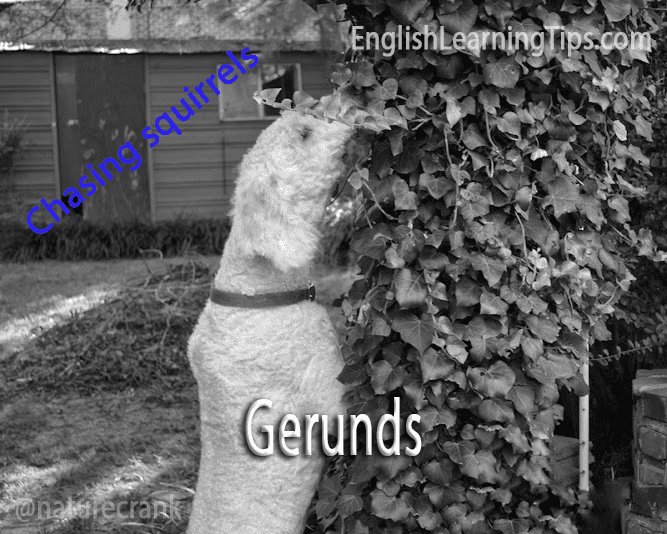
Example: Chasing squirrels keeps my dog in shape. In this sentence, “chasing” is the subject—it is the specific activity that provides the exercise.
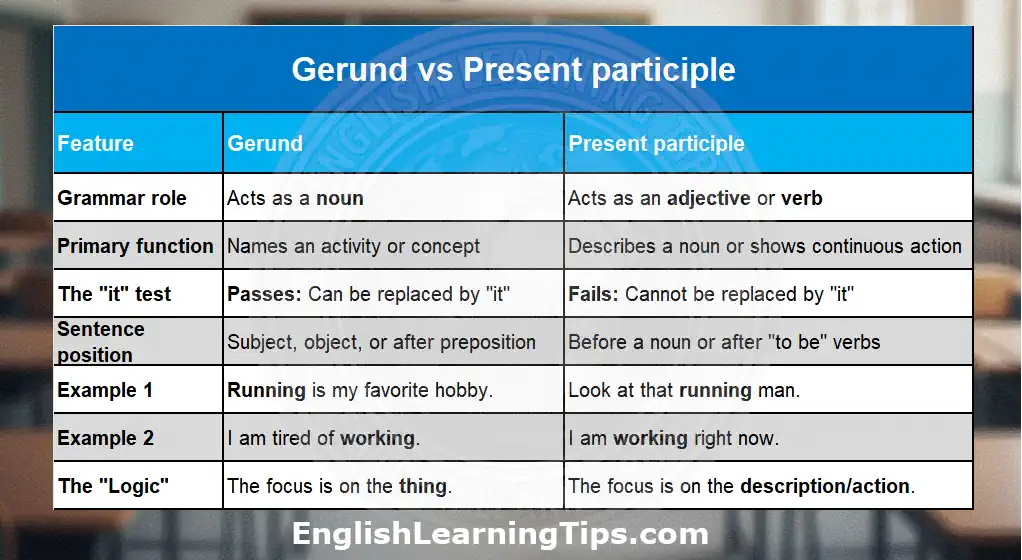
While gerunds look identical to present participles, they serve different grammatical purposes:
- Gerunds: Act as nouns (e.g., “I love reading“).
- Participles: Act as adjectives or parts of continuous verb tenses (e.g., “The reading lamp is broken”).
Pro-tip: Think of a gerund as the name of an activity. You don’t just ‘run’ (verb); you enjoy ‘running’ (the activity/noun).”
What do gerunds do in a sentence?
Gerunds allow actions to be treated as concepts. Because they function as nouns, they can occupy several different positions in a sentence:
1. Subject of the sentence
The gerund acts as the “doer” or the main topic.
- Example: Swimming is a great exercise.
2. Direct object
The gerund receives the action of the main verb.
- Example: I enjoy reading books.
3. Subject complement
A subject complement renames or defines the subject after a linking verb (like is, was, or become). Instead of showing an action, it tells us what the subject is.
- Example: “My morning ritual is meditating.” (Here, meditating = ritual).
4. Object of a preposition
When a verb follows a preposition (such as of, for, in, at, after), it must be a gerund.
- Example: He’s tired of waiting.
5. Appositive
An appositive is a noun or noun phrase that sits next to another noun to rename it or provide more specific information about it. It acts like a “bonus” description that clarifies exactly who or what you are talking about. The gerund renames or explains another noun directly.
- Example: Her talent, dancing, amazes everyone.
Gerund vs. present participle: Key differences
Because both forms end in “-ing,” they are often confused. This table helps distinguish their roles:
| Feature | Gerund | Present participle |
| Part of speech | Noun | Adjective or Verb |
| Function | Acts as a subject or object | Describes a noun or shows action |
| Example | Running is fun. | The running man is fast. |
| Substitution | Can be replaced by “it” | Cannot be replaced by “it” |
Important rules for using gerunds
To use gerunds correctly in professional writing, keep these grammatical rules in mind:
Spelling adjustments
While most gerunds simply add “-ing,” some require changes to the root word:
- Double consonants: Words with a short vowel sound before the last letter often double the consonant (e.g., run → running).
- Drop the “e”: If a verb ends in a silent “e,” drop it before adding the suffix (e.g., write → writing).
Verbs followed by gerunds
Some English verbs specifically require a gerund rather than an infinitive (“to” + verb). Common verbs include enjoy, avoid, admit, consider, and suggest.
- Correct: She enjoys swimming.
- Incorrect: She enjoys to swim.
Using possessives with gerunds
In formal writing, use a possessive pronoun (my, your, his, her, their) before a gerund.
- Formal: I appreciate your helping me.
- Informal: I appreciate you helping me.
For more rules on formal sentence structure, we highly recommend keeping a copy of The Elements of Style on your desk.
Gerund phrases
A gerund phrase consists of a gerund plus its objects or modifiers. The entire phrase functions as a single noun.
- Example: Reading mystery novels relaxes me. (“Reading mystery novels” is the subject).
Common FAQs about gerunds
The Ultimate Gerund Quiz
Gerunds mastery quiz
Select the best answer for each of the 20 questions below.
1. Understanding the possessive before a gerund (Question 18)
- Question: Choose the correct formal sentence: I dislike his smoking.
- Reason: In formal English, when a gerund is preceded by a noun or pronoun, that word should be in the possessive case. You aren’t disliking the person (“him”); you are disliking the activity (“the smoking”) that belongs to him. Therefore, “his” is grammatically superior to “him” in this context.
2. Gerunds vs. infinitives (Question 2 & 4)
- Question: He admitted to stealing the cookies. / She avoids driving. (Admitted to is a phrasal verb)
- Reason: Certain verbs in English are “gerund-only” verbs. While words like “like” or “love” can take both (I like to swim vs. I like swimming), verbs such as admit, avoid, consider, deny, finish, and suggest must be followed by a gerund.
3. Objects of prepositions (Question 3 & 14)
- Question: I am interested in learning. / We are tired of waiting.
- Reason: This is a fixed rule in English: Any verb that immediately follows a preposition (in, of, at, about, for) must be a gerund. You cannot say “interested in to learn” or “tired of wait.”
4. Distinguishing gerunds from participles (Question 9)
- Question: Identify the gerund: “The singing birds woke me up.”
- Answer: None. (In the quiz, “singing” is actually a participle here because it describes the birds).
- Reason: This is a “trick” question common in advanced exams. If the -ing word is acting as an adjective to describe a noun (The singing birds, the crying baby, the purring cat), it is a present participle, not a gerund. A gerund must function as a noun.
Summary table of “gerund-only” verbs
To score a perfect 20/20 next time, memorize these common verbs that almost always require a gerund:
| Verb | Example |
| Avoid | He avoids buying processed foods. |
| Enjoy | We enjoy hiking in the summer. |
| Finish | Have you finished writing that report? |
| Mind | I don’t mind waiting for a few minutes. |
| Suggest | She suggested going to the Italian restaurant. |
| Keep | Keep working until the timer goes off. |
40 words that can be gerunds and infinitives
Verbs with little to no change in meaning
These verbs are the easiest to use. You can follow them with a gerund or an infinitive, and the sentence will mean essentially the same thing.
| # | Verb | Example (Gerund) | Example (Infinitive) |
| 1 | Begin | He began reading. | He began to read. |
| 2 | Start | It started raining. | It started to rain. |
| 3 | Continue | She continued working. | She continued to work. |
| 4 | Like | I like swimming. | I like to swim. |
| 5 | Love | They love traveling. | They love to travel. |
| 6 | Hate | I hate waiting. | I hate to wait. |
| 7 | Prefer | I prefer walking. | I prefer to walk. |
| 8 | Can’t stand | I can’t stand sitting here. | I can’t stand to sit here. |
| 9 | Can’t bear | She can’t bear crying. | She can’t bear to cry. |
| 10 | Dread | I dread going to the dentist. | I dread to go to the dentist. |
| 11 | Intend | I intend buying a car. | I intend to buy a car. |
| 12 | Neglect | He neglected calling her. | He neglected to call her. |
| 13 | Propose | She proposed staying. | She proposed to stay. |
| 14 | Attempt | They attempted climbing. | They attempted to climb. |
| 15 | Bother | Don’t bother calling. | Don’t bother to call. |
| 16 | Cease | The noise ceased playing. | The noise ceased to play. |
| 17 | Accustom | I’m accustomed to living here. | (Usually takes gerund after ‘to’) |
| 18 | Deserve | It deserves mentioning. | It deserves to be mentioned. |
| 19 | Fear | She fears flying. | She fears to fly. |
| 20 | Scorn | He scorns lying. | He scorns to lie. |
Verbs where the meaning changes significantly
This is the “advanced” list. Using the wrong form here can lead to confusion because it changes the logic of the action.
Be careful with verbs like stop or remember. Switching between a gerund and an infinitive here doesn’t just change the grammar—it changes your entire meaning.
| # | Verb | Meaning with gerund (-ing) | Meaning with infinitive (to…) |
| 21 | Remember | Recall a past memory. | Remember a duty or task. |
| 22 | Forget | Forget a past experience. | Forget to do a planned task. |
| 23 | Stop | Quit or end an activity. | Pause one thing to do another. |
| 24 | Try | Experiment with a new method. | Make an effort or attempt. |
| 25 | Regret | Feel sorry about the past. | Give bad news (formal). |
| 26 | Mean | Involve or result in. | Intend to do something. |
| 27 | Go on | Continue the same activity. | Switch to a new activity. |
| 28 | Need | Passive meaning (needs doing). | Active duty (needs to do). |
| 29 | Want | Needs to be done (informal). | A desire to do something. |
| 30 | Help | Can’t avoid (can’t help doing). | Assist in doing something. |
| 31 | Learn | Study a subject. | Gain a specific skill. |
| 32 | Teach | Instruct a subject. | Instruct a specific skill. |
| 33 | Propose | Suggest an idea. | Intend to do something. |
| 34 | Dread | Fear a future event. | Be anxious about a specific act. |
| 35 | Quit | Stop a habit or job. | Leave a place to do something. |
| 36 | Wait | Focus on the waiting itself. | Wait specifically for an action. |
| 37 | Agree | Consent to an idea/plan. | Formal commitment to act. |
| 38 | Choose | Select between options. | Decide to perform an action. |
| 39 | Hate | Dislike an activity generally. | Dislike a specific, immediate act. |
| 40 | Prepare | Get ready by practicing. | Get ready for a specific event. |
Conclusion: Mastering the -ing
Gerunds may be linguistic shapeshifters, but once you understand their role as nouns, they become powerful tools for variety in your writing. Whether you are using them as subjects to define an activity or following a preposition to add detail, mastering the gerund allows you to move beyond simple sentence structures and express complex ideas with ease.
While the “possessive + gerund” rule or the subtle shift between “stopping to do” and “stopping doing” can be tricky, practice is the only way to make these forms feel natural.
Join the conversation: What is your favorite gerund?
Grammar is a living, breathing thing, and we want to hear from you.
- Is there a specific verb that always trips you up when choosing between a gerund and an infinitive?
- Do you have a “trick” for remembering when to use the possessive case before an -ing word?
Drop a comment below with your questions or your best example of a gerund in action. If you found this guide helpful, share it with a fellow writer or student to help them master the foundations of the English language!
Discover more from English Learning Tips
Subscribe to get the latest posts sent to your email.


