
Compound nouns in English: Rules, examples, and types

“Sunrise” = “sun” + “rise”
Have you ever wondered how a single word like “sunrise” can paint a vivid picture by blending “sun” and “rise”? This is the magic of compound nouns—a vital vocabulary-building tool that combines two or more words into a single, powerful noun.
From everyday terms like “bedroom” to modern concepts like “cloud storage,” compound nouns are everywhere. In this guide, we will break down the grammar rules for how they are formed, how to use them, and how to master their pronunciation.
Nouns are the foundation of every sentence you write. This guide explores every category and rule, providing you with the tools to identify, use, and master them with total confidence.
- All about nouns in English: Types, examples, and usage
- Compound nouns in English: Rules, examples, and types (this article)
- Nominalization: Definition, examples, and how to improve your writing
- Uncountable nouns: A complete guide to mass nouns in English
- Countable nouns: A complete guide to grammar and usage
- Collective nouns: The ultimate guide to group names and usage
- Abstract nouns: Definition, examples, and how to use them
- What are concrete nouns? Definition, examples, and usage
- Proper nouns: Definition, examples, and usage rules
- Infinitives: A complete guide to understanding and using the base verb form
- Understanding gerunds: A complete guide to grammar, rules, and examples
What are compound nouns?
In English grammar, a compound noun is a person, place, thing, or idea made up of two or more words functioning as a single unit. These combinations allow us to create concise, specific terms without needing long, descriptive phrases.
The meaning of a compound noun is often different from the individual words that make it up. For example, a greenhouse is a glass building for plants, not just any “house that is green.”
- Remember, a compound noun refers to a person, place, thing, or idea that is made up of two or more words.
- These words can be formed with adjectives, other nouns, prepositions, and verbs. Here are the common formats:
- Adjective plus noun: “greenhouse” (green + house)
- Noun plus noun: “basketball” (basket + ball)
- Noun plus verb: “haircut” (hair + cut)
- Preposition plus noun: “underground” (under + ground)
- Verb plus noun: “swimming pool” (swimming + pool)
Common ways to form compound nouns
Compound nouns aren’t just “noun + noun.” These nouns can be formed in three main ways. They can be closed, open, or hyphenated.
- Closed or solid compound nouns
- These are written as a single word with no spaces or hyphens.
- Examples: Sunflower, bedroom, toothpaste, smartphone.
- Hyphenated compound nouns
- These are connected by a hyphen (-). This is common for family roles or when three or more words are combined.
- Sometimes, more than two words are involved, like “sister-in-law” or “jack-of-all-trades,” though these are less common and often hyphenated for clarity.
- Examples: Check-in, passer-by, jack-of-all-trades, six-pack.
- Open or spaced compound nouns
- These consist of two or more separate words that act as one idea.
- Examples: Post office, bus stop, ice cream, real estate.
| Combination | Example | Components |
| Noun + noun | Basketball | basket (n) + ball (n) |
| Adjective + noun | Greenhouse | green (adj) + house (n) |
| Verb + noun | Swimming pool | swimming (v) + pool (n) |
| Noun + verb | Haircut | hair (n) + cut (v) |
| Preposition + noun | Underground | under (prep) + ground (n) |
| Noun + prepositional phrase | Mother-in-law | mother (n) + in-law (phrase) |
Essential grammar rules for compound nouns
How to pluralize compound nouns
The most common mistake with singular and plural forms of compound nouns is putting the “s” in the wrong place. To make a compound noun plural, you usually pluralize the primary noun (the “head” of the word).
- Correct: Mothers-in-law (The “mother” is plural, not the “law”).
- Correct: Directors general.
- Correct: Bus stops.
Word stress and pronunciation
In spoken English, the word stress usually falls on the first word. This distinguishes the compound from a normal adjective-noun pairing.
- GREENhouse (the building for plants) vs. green HOUSE (a house that happens to be painted green).
- WATER bottle vs. water BOTTLE (a bottle made of water).
Evolution of spelling
Spelling is flexible and often changes over time. Many words start as open compounds (web site), become hyphenated, and eventually end up as closed compounds (website). When in doubt, it is best to consult a modern dictionary, as British and American English spelling may differ. Also, note, just because you’re in America, it doesn’t mean that the British spelling isn’t used.
Frequently asked questions about compound nouns (FAQ)
The compound noun quiz
Test Your Knowledge: Compound Nouns
Select the best answer for each question to see your score!
The compound noun cheat sheet
1. The three forms of compound nouns
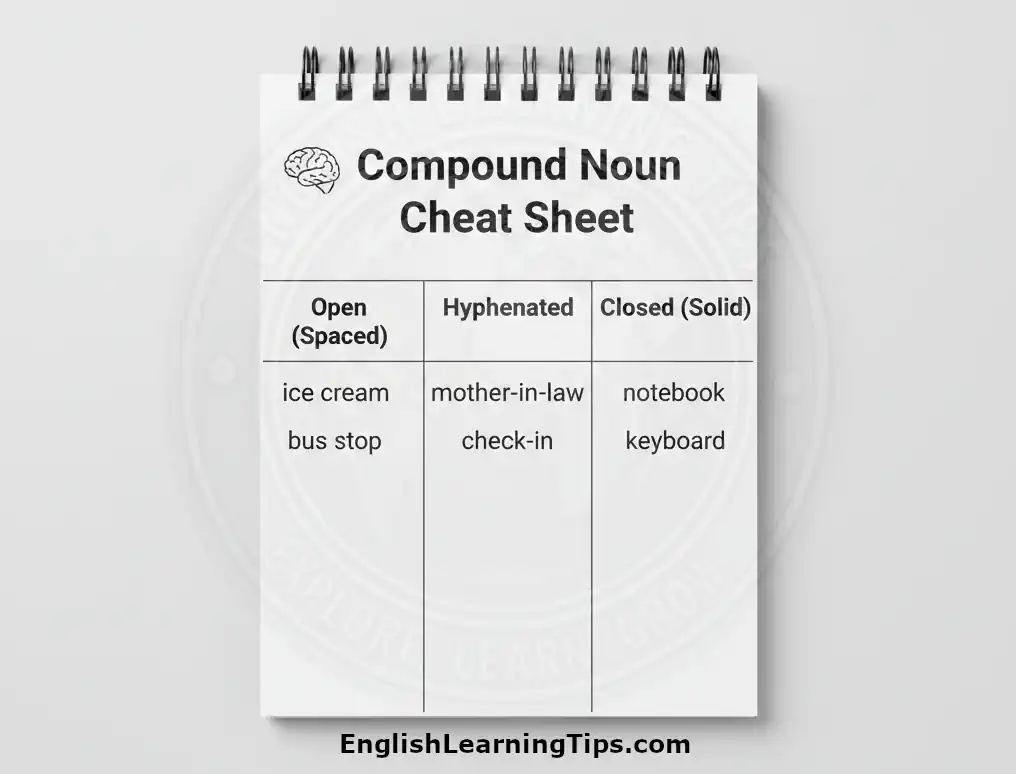
Compound nouns are formed when two words are put together to create a brand-new meaning. They usually appear in one of three styles:
| Type | Description | Examples |
| Open (Spaced) | Two words written with a space between them. | ice cream, bus stop, swimming pool |
| Hyphenated | Two or more words connected by a hyphen. | mother-in-law, check-in, six-pack |
| Closed (Solid) | Two words joined together as one. | notebook, toothbrush, keyboard |
Pro-tip: If you aren’t sure which form to use, check a dictionary. Many words start as “open” and become “closed” over time as they become more common (e.g., e-mail became email).
2. Common word combinations
Most compound nouns are Noun + Noun, but they can be formed in several ways:
- Noun + Noun: Bedroom, water bottle, toothpaste
- Adjective + Noun: Full moon, whiteboard, blackboard
- Verb(-ing) + Noun: Washing machine, frying pan, driving license
- Noun + Verb: Rainfall, sunrise, haircut
- Preposition + Noun: Underworld, bystander, onlooker
3. Pluralization rules
The most common mistake for ESL learners is adding the “-s” to the wrong word.
Rule: Always make the principal word (the most important noun) plural, not the description.
- Correct: mothers-in-law (The “mothers” are plural, not the “law”).
- Correct: passers-by (The people are plural).
- Correct: directors-general.
- Closed compounds: Just add the “-s” to the end: toothbrushes, notebooks.
4. Pronunciation & word stress
In English, word stress is vital for being understood.
- Compound Nouns: The stress usually falls on the first word.
- GREENhouse (a place for plants) vs. green HOUSE (a house that happens to be painted green).
- FOOTball, KEYboard, RAINcoat.
- Compound Adjectives/Verbs: These often have stress on the second part (e.g., to overFLOW).
5. Quick practice list
Here are 10 essential compound nouns every learner should know:
- Backpack (Closed)
- Post office (Open)
- Brother-in-law (Hyphenated)
- Firefighter (Closed)
- Living room (Open)
- Software (Closed)
- Check-out (Hyphenated)
- Sunlight (Closed)
- Rainforest (Closed)
- Public transport (Open)
Conclusion: Mastering the building blocks of English
Compound nouns are more than just a grammar rule—they are the shorthand of the English language. By blending two distinct ideas into one, we gain the ability to describe the world with precision, from the software on your phone to the sunlight through your window.
Whether you are navigating the tricky pluralization of mothers-in-law or deciding if ice cream needs a hyphen (it doesn’t!), remember that language is constantly evolving. Staying curious about these word pairings will not only improve your writing but also help you sound more like a native speaker.
Join the conversation: What is your favorite “weird” compound noun?
English is full of “fossils” and strange combinations. Did you know that ladybug, honeymoon, and nightmare are all compound nouns with fascinating histories?
We want to hear from you:
- What is a compound noun that always trips you up?
- Is there a new “tech” compound (like cloud computing) that you find confusing?
- Do you prefer email or e-mail?
Drop a comment below and let’s discuss! If you found this guide helpful, share it with a fellow learner or your favorite English teacher—let’s help everyone master the art of the compound noun together.
Discover more from English Learning Tips
Subscribe to get the latest posts sent to your email.


