
Phoneme, morpheme, and grapheme: Understanding the building blocks of English

To master the English language—whether you are teaching literacy or studying linguistics—you must distinguish between two fundamental components: phonemes and morphemes. While they are both “smallest units,” they operate on entirely different levels of communication.
One deals with the sounds we hear, while the other deals with the meaning we understand.
What is a phoneme?
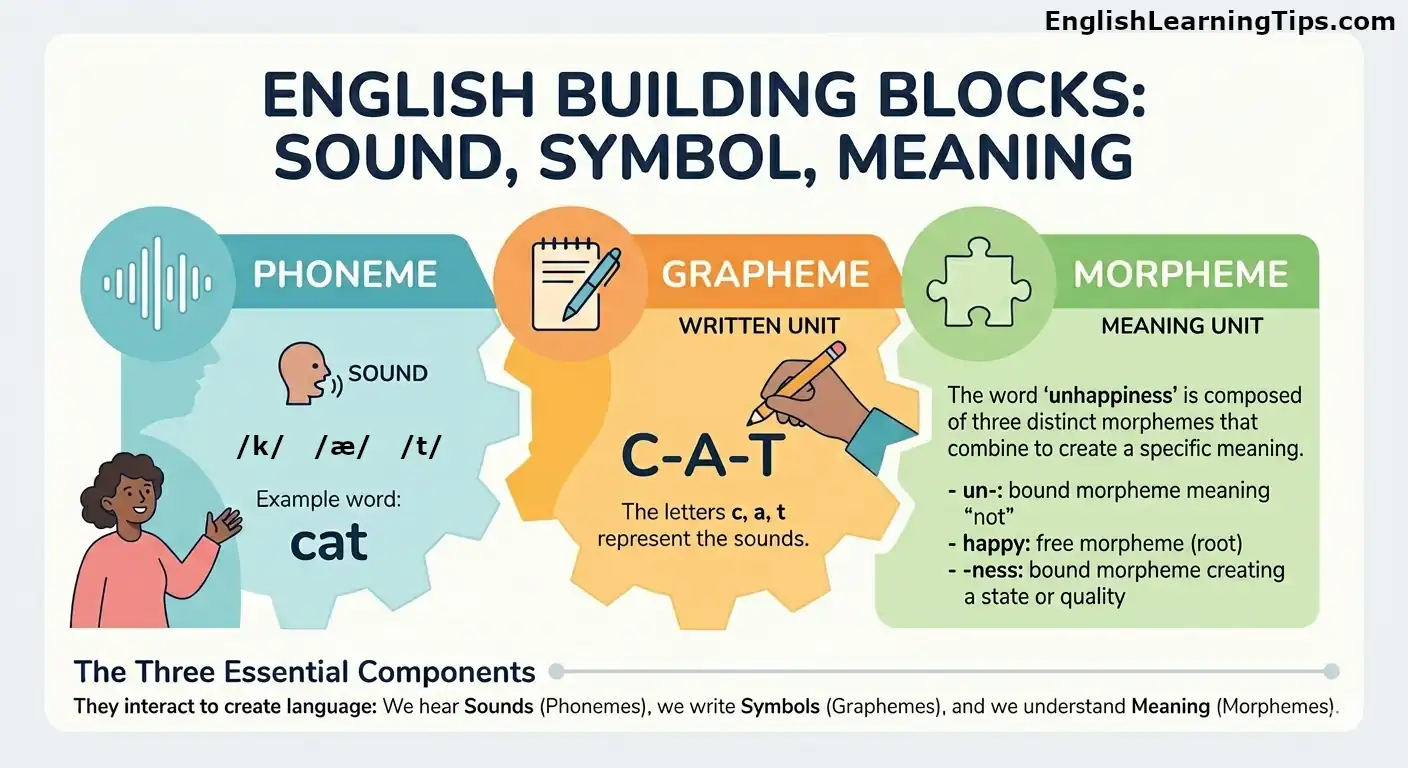
A phoneme is the smallest unit of sound in a language that can change the meaning of a word. Phonemes do not have meaning on their own; their only job is to distinguish one word from another.
In English, there are approximately 44 phonemes, though there are only 26 letters in the alphabet. This is why “phonemic awareness” is a vital skill for early readers—it is the ability to hear and manipulate these individual sounds.
Examples of phonemes
- Minimal pairs: In the words cat (/kæt/) and bat (/bæt/), the only difference is the initial sound. Therefore, /k/ and /b/ are distinct phonemes.
- Consonant shifts: Changing the /p/ in pit to a /b/ creates bit.
- Vowel sounds: The difference between hop and hip relies entirely on the middle phoneme.
What is a morpheme?
A morpheme is the smallest unit of meaning in a language. Unlike a phoneme, a morpheme must carry a specific “sense” or grammatical function. It is the most basic building block of vocabulary.
Types of morphemes
Morphemes are generally categorized into two groups:
- Free morphemes: These can stand alone as functional words (e.g., “dog,” “run,” “happy”).
- Bound morphemes: These cannot stand alone and must be attached to a root word. These include prefixes like “un-” and suffixes like “-ly” or “-ed.”
Examples of morphemes
- Single morpheme: The word apple is one morpheme. You cannot break it down further without losing the meaning.
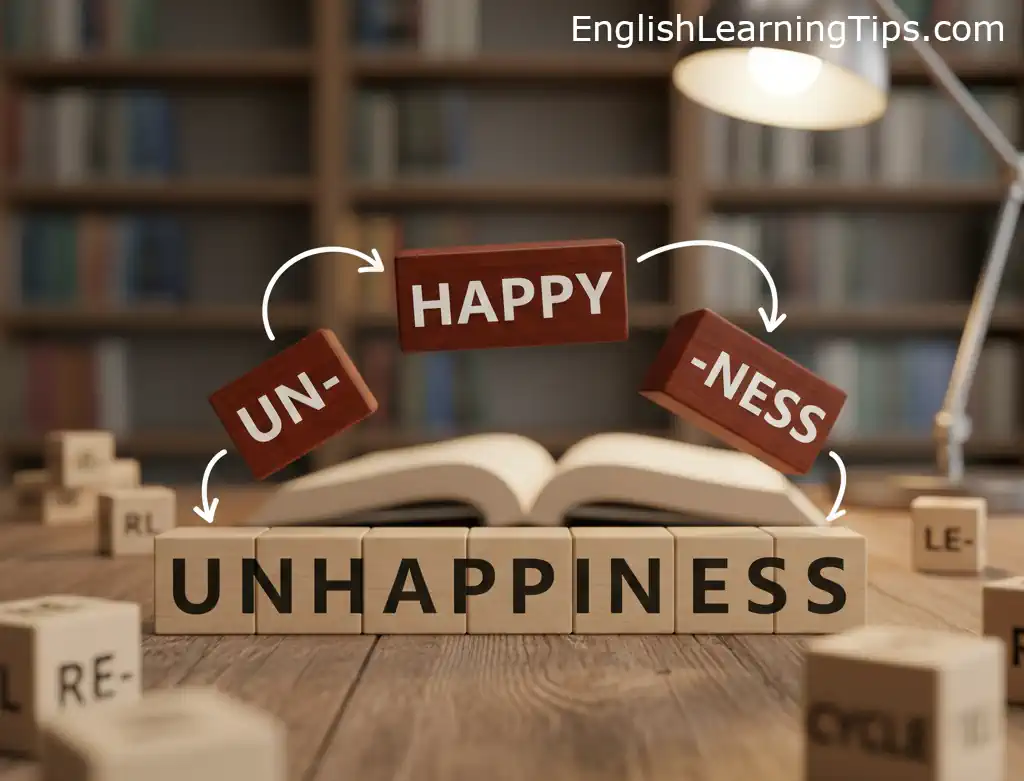
- Multiple morphemes: The word unbreakable contains three morphemes:
- un- (bound morpheme meaning “not”)
- break (free morpheme/root)
- -able (bound morpheme meaning “capable of”)
What is a grapheme?
While a phoneme is a unit of sound, a grapheme is the smallest functional unit of a writing system. In simpler terms, it is the letter or group of letters that represent a single phoneme.
Understanding the relationship between phonemes and graphemes—often called phonics—is what allows us to translate spoken language into written text and vice versa.
Examples of graphemes
- Single letters: In the word cat, the letters c, a, and t are each individual graphemes representing the sounds /k/, /æ/, and /t/.
- Digraphs: Some graphemes consist of two letters that make one sound, such as the sh in ship or the ch in chat.
- Trigraphs and Quadgraphs: Graphemes can even be three or four letters long, like the igh in light or the eigh in eight.
Key differences: Phoneme vs. morpheme comparison
| Feature | Phoneme | Grapheme | Morpheme |
| Primary focus | Sound (Acoustics) | Symbol (Writing) | Meaning (Semantics) |
| Medium | Spoken language | Written language | Vocabulary/Grammar |
| Inherent meaning | No | No | Yes |
| Smallest unit of… | Language sound | Written representation | Language meaning |
| Example | The /f/ sound | The “ph” in “phone” | The “-ed” in “jumped” |
Frequently asked questions about phonemes and morphemes
Visual tools to explain phoneme vs. morpheme
Video: Phonemes, graphemes, and morphemes
Video: Segmenting phonomemes and morphemes
Glossary: Essential linguistic terms for students and educators
To fully understand how phonemes and morphemes fit into the structure of English, it is helpful to recognize these related branches of linguistics:
1. Grapheme
A grapheme is the written representation of a phoneme. It can be a single letter (like “t”) or a group of letters (like “sh” or “tch”) that represent one sound. While English has about 44 phonemes, it uses over 250 graphemes to represent them.
2. Syntax
Syntax refers to the set of rules, principles, and processes that govern the structure of sentences in a given language, specifically word order and punctuation. While morphemes build words, syntax builds sentences.
3. Semantics
Semantics is the branch of linguistics concerned with meaning. This includes the study of individual words (morphemes), phrases, and how context changes the way we interpret language.
4. Phonology
Phonology is the study of the speech sounds used in a particular language. It focuses on the patterns of sounds and the rules governing how those sounds interact with one another.
5. Morphology
Morphology is the study of the internal structure of words. It examines how morphemes (roots, prefixes, and suffixes) are combined to create complex words and change grammatical functions.
6. Pragmatics
Pragmatics looks at how context contributes to meaning. It deals with the “unspoken” rules of communication—how we use language to achieve specific goals, social cues, and the difference between literal and implied meaning.
7. Orthography
Orthography is the conventional spelling system of a language. It is the bridge between phonemes (sounds) and graphemes (letters), dictated by the standardized rules of writing.
Conclusion: Why the phoneme and morpheme distinction matters
Understanding the difference between a phoneme and a morpheme is more than just a linguistic exercise; it is the key to mastering English literacy. By recognizing how sounds (phonemes) build into meaningful units (morphemes), students can significantly improve their decoding skills, spelling accuracy, and overall vocabulary retention.
Whether you are analyzing the 44 phonemes in the English language or breaking down complex words into their root morphemes, you are uncovering the DNA of how we communicate.
Join the conversation
Did this breakdown help clear up the confusion between sounds and meanings? We want to hear from you!
- Test your knowledge: Can you think of a word that has only one morpheme but four or more phonemes? Share your example in the comments below.
- Help a fellow student: If you found this guide helpful, share it with your classmates or fellow educators on social media.
Your insights help our community grow, and we respond to every question posted in the comments!
Discover more from English Learning Tips
Subscribe to get the latest posts sent to your email.


