

Cleft sentences: A guide to structure and emphasis

Cleft sentences are a specialized grammatical construction used to highlight a specific part of a statement. The word “cleft” literally means divided; by “cleaving” a single thought into two distinct clauses, you can make your most important point impossible to miss.+1
Whether you are writing a persuasive essay or speaking in a formal setting, mastering these structures allows you to control the rhythm and impact of your language. While most learners focus on the “big two,” there are actually six distinct kinds of cleft sentences used to shift focus:
- It-clefts
- Wh-clefts (pseudo-clefts)
- Reversed wh-clefts
- All-clefts
- There-clefts
- Th-clefts
Why use cleft sentences?
Cleft sentences aren’t just about variety; they serve three primary functions in English:
- Focusing attention: They act like a linguistic spotlight, drawing the eye to the most important piece of information.
- Information structure: They help distinguish between “given” information (what the audience already knows) and “new” information (the point you are making).
- Contrast and correction: They are frequently used to correct a misconception or emphasize a specific choice over another.
It-clefts vs. wh-clefts
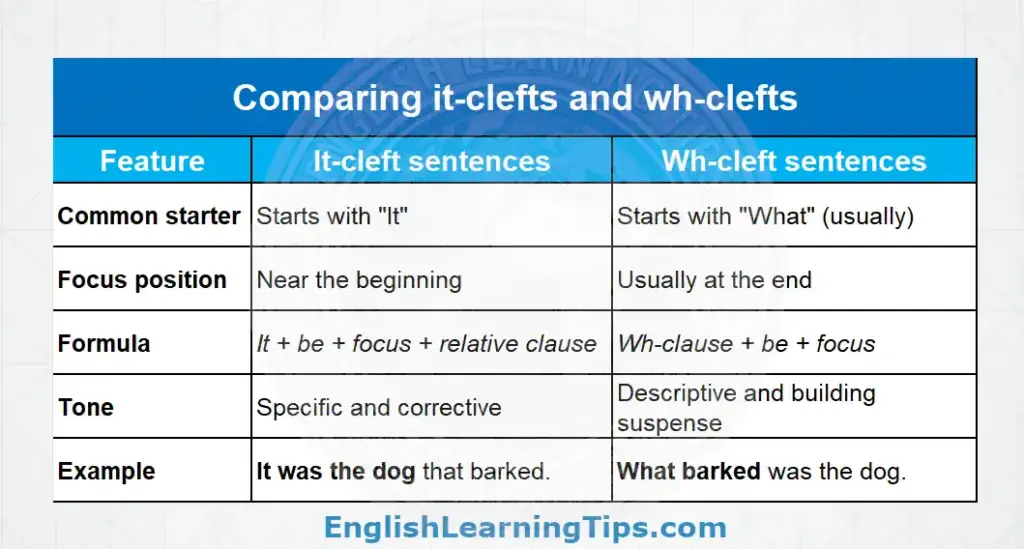
In English grammar, there are two main ways to “split” a sentence. Each serves a slightly different stylistic purpose.
1. It-clefts
This is the most common version. You use ‘It’ as a placeholder to push the important information to the front.
The structure: It + be (conjugated) + emphasized element + that/who clause.
- Standard sentence: Sarah bought the flowers.
- It-cleft: “It was Sarah who bought the flowers.” (Focuses on the person)
- It-cleft: “It was the flowers that Sarah bought.” (Focuses on the object)
Master advanced structures: Cleft sentences are just one part of high-level English. For a deep dive into complex grammar, I recommend Advanced Grammar in Use with Answers. It is widely considered the best resource for mastering the nuances of formal writing.
2. Wh-clefts (pseudo-clefts)
Also known as pseudo-clefts, these often use “what” to introduce the known information, saving the “new” information for the end of the sentence for maximum impact.
The structure: Wh-clause + be + emphasized element.
- Standard sentence: I need a strong coffee.
- Wh-cleft: “What I need is a strong coffee.”
- Standard sentence: We want a fair resolution.
- Wh-cleft: “What we want is a fair resolution.”
Advanced cleft sentence variations
If you want to vary your writing further, consider these four additional structures. These variations allow for more nuanced tone shifts, helping you highlight reasons, existing conditions, or singular desires with precision.
1. Reversed wh-clefts (inverted pseudo-clefts)
This is simply a wh-cleft flipped around. It places the focus at the very beginning of the sentence rather than the end.
- Example: “A vacation is what I need right now.”
2. All-clefts
This structure uses “all” to mean “the only thing.” It is highly effective for emotional emphasis or simplification.
- Structure: All + subject + verb + is/was + emphasized element.
- Example: “All I did was ask a question.”
3. There-clefts
These use “there” to introduce new information or emphasize the existence of a specific person or thing performing an action.
- Example: “There was a man who called for you earlier.”
4. Th-clefts (the-thing clefts)
These use specific noun phrases like “the thing,” “the person,” or “the reason” to provide even more specific focus than a standard “what.”
- Example: “The reason I’m here is to help you succeed.”
Summary of the 6 kinds of cleft sentences
| Type | Focus | Example |
| It-cleft | The Subject/Object | It was the rain that ruined our picnic. |
| Wh-cleft | The Action or Need | What ruined our picnic was the rain. |
| Reversed wh-cleft | The Result | A new car is what he really wants. |
| All-cleft | The “Only” Thing | All she did was smile. |
| There-cleft | Existence/Subject | There is a cat that stays in this garden. |
| Th-cleft | Specific Reason/Noun | The thing I love is coffee. |
How cleft sentences change meaning
Using a cleft sentence shifts the presupposition of a statement. If you say, “It was Mark who ate the cake,” you are presupposing that someone ate the cake, and you are identifying Mark as the culprit. This creates a much stronger tone than the neutral “Mark ate the cake.”
Pro tip: Use cleft sentences sparingly. If every sentence is a cleft sentence, the emphasis loses its power and the writing becomes clunky.
Frequently asked questions about cleft sentences
Visual tools to help you learn cleft sentences
Video: Give emphasis in English
This video will discuss ways you can add emphasis to your sentences in English includes clefts.
Video: Using cleft sentences properly
Refine your writing style: If you’re using cleft sentences to improve your prose, you might also find Dreyer’s English: An Utterly Correct Guide to Clarity and Style helpful. It’s a fantastic guide for anyone wanting to move beyond basic rules into professional-level writing.
Conclusion: Mastering the art of emphasis
Cleft sentences are more than just a grammatical quirk; they are a practical way to highlight key information without repeating yourself. Whether you are using an it-cleft to clarify a specific detail or a wh-cleft to build anticipation for a big reveal, these structures ensure your most important points never get lost in the shuffle.
By shifting the focus of your sentences, you guide your reader’s internal monologue and create a narrative flow that feels both intentional and authoritative. Now that you know how to “cleave” your prose for maximum impact, you can transform flat, neutral statements into dynamic pieces of communication.
What do you think?
We want to hear from you! Was there a specific type of cleft sentence—perhaps the all-cleft—that changed the way you think about emphasis? Or is there a tricky sentence you’re trying to rewrite right now?
- Drop a comment below with your favorite example or a question about a complex structure.
- Share this guide with a fellow writer or student who is looking to level up their English grammar.
Discover more from English Learning Tips
Subscribe to get the latest posts sent to your email.


