

During vs while: How to use them correctly

Choosing between “during” and “while” can be tricky because both words describe things happening at the same time. However, the difference isn’t about meaning—it’s about grammar.
The quickest way to remember the difference is to look at what follows the word. Is it a thing (noun), or is it an action (verb)?
The main difference: Nouns vs. clauses
The primary distinction lies in the part of speech that follows each word:
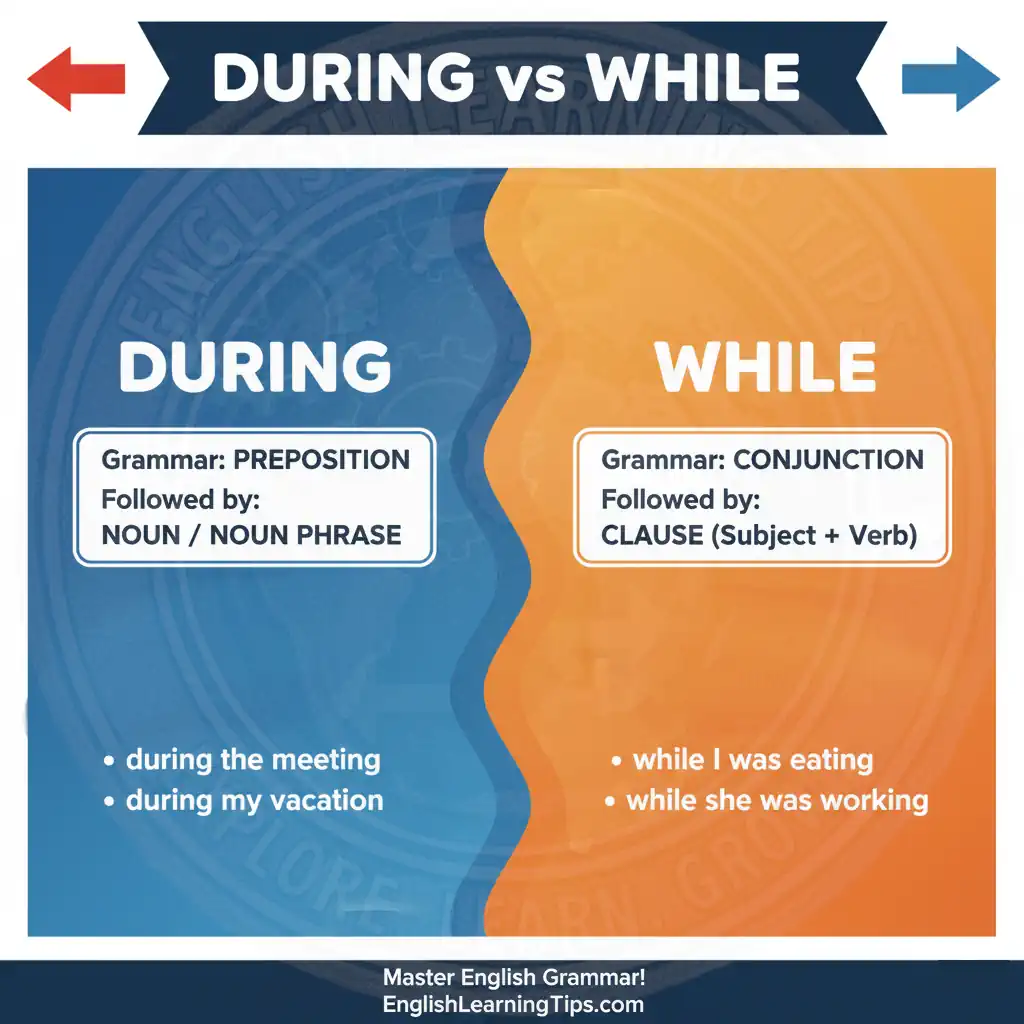
- During is a preposition. It is followed by a noun or noun phrase.
- While is a conjunction. It is followed by a clause (a subject and a verb).
When to use during
Use during to talk about an event or a specific period of time. It tells us when something happened, but it doesn’t describe the action itself.
Sentence structure: During + Noun
- “We stayed indoors during the storm.” (The storm = noun)
- “I fell asleep during the film.” (The film = noun)
- “He received many gifts during his birthday.” (His birthday = noun phrase)
When to use while
Use while to talk about two actions happening simultaneously. Because while connects two ideas, it needs a subject and a verb to follow it.
Sentence structure: While + Subject + Verb
- “The phone rang while I was cooking dinner.” (I = subject; was cooking = verb)
- “She listened to music while she exercised.” (She = subject; exercised = verb)
- “While we were in Paris, we saw the Eiffel Tower.” (We = subject; were = verb)
Note: You can also use while with an “-ing” verb if the subject is removed (e.g., “While walking, I saw a bird”). This is called a reduced relative clause.
During vs while: Comparison table for quick reference
| Feature | During | While |
| Part of speech | Preposition | Conjunction |
| Followed by | Noun or noun phrase | Clause (Subject + Verb) |
| Focus | A specific time or event | Simultaneous actions |
| Example | “…during the game” | “…while they were playing” |
Still unsure about a specific sentence? These common edge cases from English learners and writers cover the trickiest scenarios.
If you want to master more than just ‘during’ and ‘while,’ the English Grammar in Use Book with Answers is the go-to for self-study and practice.
Frequently asked questions: Grammar tips for during and while
During vs while: Common mistakes checklist
Use this quick checklist to audit your work before you hit send or publish.
- Mistake: Using “during” with a verb.
- Incorrect: I checked my emails during I was eating.
- Correct: I checked my emails while I was eating.
- Mistake: Using “while” with a simple noun.
- Incorrect: I fell asleep while the movie.
- Correct: I fell asleep during the movie.
- Mistake: Confusing duration with timing.
- Incorrect: I stayed there during three days.
- Correct: I stayed there for three days. (Use “for” for length of time; “during” for when it happened).
- Mistake: Overusing “while” for simple sequences.
- Incorrect: I went to the store while I bought milk.
- Correct: I went to the store and bought milk. (Only use “while” if the actions are truly simultaneous).
Writer’s pro tip: Keep a Laminated English Fundamentals Cheat Sheet at your desk. It’s a lifesaver for quickly checking prepositions and conjunctions without breaking your flow.
Final thoughts: Choosing the right word every time
The easiest way to master during vs while is to identify the word that follows. If you are pointing to a noun (like a “meeting” or “vacation”), use during. If you are describing an action with a subject and a verb (like “I was running”), use while.
Mastering this ‘Noun vs. Verb’ rule is the fastest way to stop second-guessing your grammar. Once you spot the difference, you’ll find that your writing flows more naturally and your meaning stays sharp.
Study hack: I track all my grammar notes in a Rocketbook Reusable Notebook. It lets me digitize my handwritten practice sentences so I can review them on my phone later!
Join the conversation
Did this guide help clear up the confusion, or is there a specific sentence that still has you stumped?
- Leave a comment below with your trickiest “during vs while” sentence, and we’ll help you break it down!
- Share this post with a friend or colleague who is brushing up on their English grammar.
Discover more from English Learning Tips
Subscribe to get the latest posts sent to your email.


