


Since vs. for: How to use them correctly

Choosing between since and for is a common hurdle for English learners, but the rule is simpler than it looks. While both words describe time, they answer different questions: “When did it start?” versus “How long did it last?”
The quick rule
- Use since for a specific point in time (Since 2010, since Monday, since lunchtime).
- Use for for a period or duration of time (For five hours, for three weeks, for ten years).
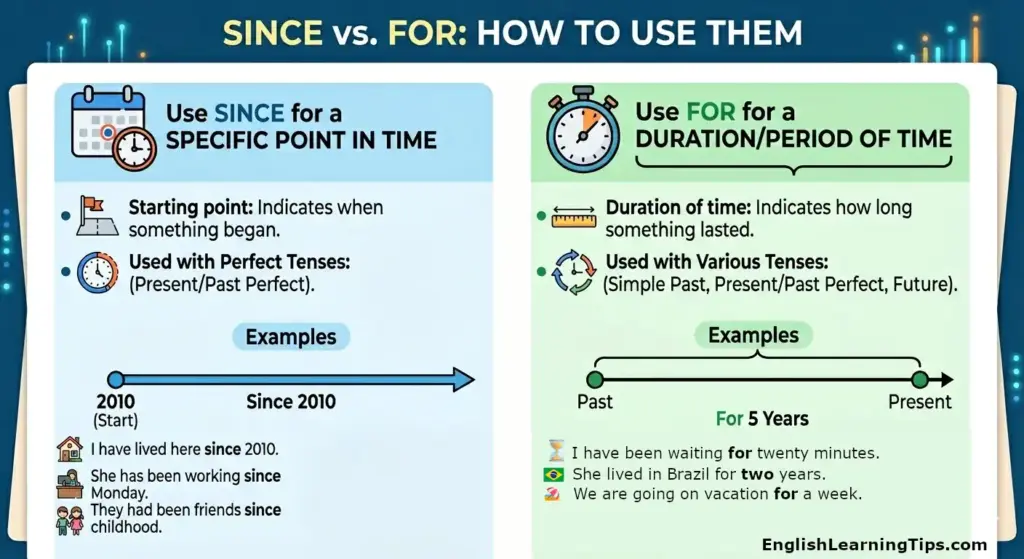
Pro-tip: If you are a visual learner, this infographic-style grammar guide is a lifesaver. It uses diagrams to show the difference between “since” and “for” much like the ones in this post.
How to use since with points in time
We use since to refer to a specific starting point in the past. Think of it as a starting line. It shows when an action began and implies it’s still happening now. Because of this connection to the present, “since” is almost always used with perfect tenses (like the present perfect).
Common starting points include:
- Dates and years: Since 1998, since March 15th.
- Times: Since 8:00 a.m., since breakfast.
- Events: Since the wedding, since I graduated, since childhood.
Examples:
- “I have lived in New York since 2015.”
- “It has been raining since this morning.”
- “He hasn’t eaten since he woke up.”
Pro tip: You can use a number with “since” if you add the word ago (e.g., “I’ve been a chef since ten years ago”). However, it’s almost always more natural to just say “for ten years.”
How to use for with periods of time
We use for when we are measuring the length of time (the duration). Unlike “since,” which requires a specific starting point, “for” can be used with almost any tense, including the past, present, and future.
Common durations include:
- Number + time unit: For 20 minutes, for six days, for five years.
- Vague periods: For a long time, for a while, for ages.
Examples:
- “I lived in London for three years.” (Past tense: the action is finished)
- “She has been exercising for 40 minutes.” (Present perfect continuous: the action is ongoing)
- “They will be away on holiday for two weeks.” (Future tense)
Comparison table: Since vs. for at a glance
| Feature | Since | For |
| Main focus | The starting point | The total duration |
| Question it answers | “Since when?” | “How long?” |
| Common tenses | Present perfect, past perfect | Simple past, present, future, perfect |
| Example phrase | Since Tuesday | For three days |
Frequently asked questions about since and for
Since vs. for practice quiz
Test your knowledge by choosing the correct word for each sentence:
- I haven’t seen him _______ last Christmas.
- They have been married _______ forty years.
- It has been snowing _______ three hours.
- She has worked as a doctor _______ she graduated.
- We’ve been waiting _______ a long time.
Answers: 1. Since | 2. For | 3. For | 4. Since | 5. For
Want more practice? The best way to master these rules is through repetition. I highly recommend Raymond Murphy’s English Grammar in Use. It’s the world’s best-selling grammar book for a reason—it has hundreds of exercises exactly like the quiz above.
Summary: Mastering time expressions
The easiest way to remember the distinction is to look at the words following the preposition. If you see a number (six, ten, several), you likely need for. If you see a specific name or date (Monday, January, I was a child), you likely need since.
Refining these small details will make your English sound more natural and professional, whether you’ve been practicing since you were a student or just for a few weeks.
Join the conversation
We want to hear from you! To practice what you’ve just learned, try writing a sentence using both since and for in the comments section below, and we will let you know if you got it right.
If you found this guide helpful, please share it with a friend or classmate who is currently tackling English grammar. Your shares help us create more free resources for learners around the world!
Deepen your knowledge
If you’re serious about perfecting your English, keep a copy of The Blue Book of Grammar and Punctuation on your desk. It’s a concise, easy-to-read guide that covers everything from prepositions to professional comma usage
Discover more from English Learning Tips
Subscribe to get the latest posts sent to your email.


