

Personification: Definition, examples, and how to use it in writing

Have you ever heard the wind whisper or seen the sun smile? These aren’t just poetic flourishes; they are examples of personification, a literary device that makes objects feel human.
By giving human traits to inanimate objects, animals, or abstract ideas, personification makes your writing feel more alive. It’s one of the most effective ways to build a connection with your reader through imagery.
What is personification?
Personification is a literary device where human qualities, emotions, or actions are attributed to non-human entities. This includes inanimate objects, animals, or even abstract concepts like time or love.
When you use personification, you aren’t saying an object literally became human; rather, you are using figurative language to help a reader relate to something unfamiliar or static.
Key characteristics of personified language
- Human traits: Attributing emotions (loneliness), physical features (arms), or consciousness to objects.
- Human actions: Describing things as “dancing,” “shouting,” or “crying.”
- Non-literal meaning: The reader understands the “angry storm” isn’t actually feeling rage, but rather acting with intensity.
By using these traits, you move past just describing a scene and start telling a story through the environment.
Personification vs. Anthropomorphism
While often confused, these two terms have distinct roles in literature. (See the video at the end for a visual explanation).
| Feature | Personification | Anthropomorphism |
| Definition | Giving human traits to objects/ideas for imagery. | Giving non-humans actual human behavior and form. |
| Intent | Figurative and descriptive. | Literal characterization. |
| Example | The wind howled in the night. | The Big Bad Wolf wearing a suit and talking. |
Common examples of personification in literature
Using personification makes your descriptions more immersive. Here are a few classic ways it appears in everyday writing:
- “The wind whispered through the trees.” (Gives the wind the human action of whispering).
- “The sun smiled down on the valley.” (Attributes a human expression to a celestial body).
- “The old floorboards groaned under my feet.” (Assigns a human vocalization of pain or age to wood).
- “Opportunity knocked once at the door.” (Treats an abstract concept like a physical visitor).
If you want to master the mechanics of style alongside your use of personification, I highly recommend keeping a copy of The Elements of Style on your desk. It’s a timeless resource for avoiding ‘purple prose’ and keeping your descriptions sharp.
How to write personification in three steps
Integrating personification requires a balance between creativity and clarity. Follow these three steps to master the technique:
1. Identify your subject
Choose the object or idea you want to highlight. Is it a flickering candle? A heavy silence? A crashing wave?
2. Select a human emotion or action
Think about the mood you want to set. If you want a scene to feel threatening, give the object “aggressive” human traits. If you want it to feel peaceful, choose “gentle” actions.
- Aggressive: The fire devoured the forest.
- Gentle: The morning mist caressed the lake.
3. Use active verbs and descriptive adjectives
The most effective personification relies on strong verbs. Instead of saying “the car was loud,” try “the engine coughed and protested as it turned over.”
Struggling to find the right human trait for your subject? The Emotion Thesaurus is a fantastic tool that helps you map out physical cues and internal feelings that you can apply to your non-human characters or settings.
Why should you use personification?
Good writing is about more than just grammar; it’s about holding a reader’s attention. Whether you are writing a novel, a blog post, or a professional email, personification helps by:
- Adding emotional depth: It evokes empathy by making objects feel relatable.
- Improving visualization: It creates a “mental movie” for the reader, making your content more memorable.
- Simplifying the abstract: It makes complex themes (like “justice” or “death”) easier to grasp by giving them a human face.
Writer’s tip: I’ve found that the best personification happens when you match the object’s ‘personality’ to the tone of the story. If your character is sad, the rain shouldn’t just fall—it should weep. The goal is to enhance the mood, not distract from it.
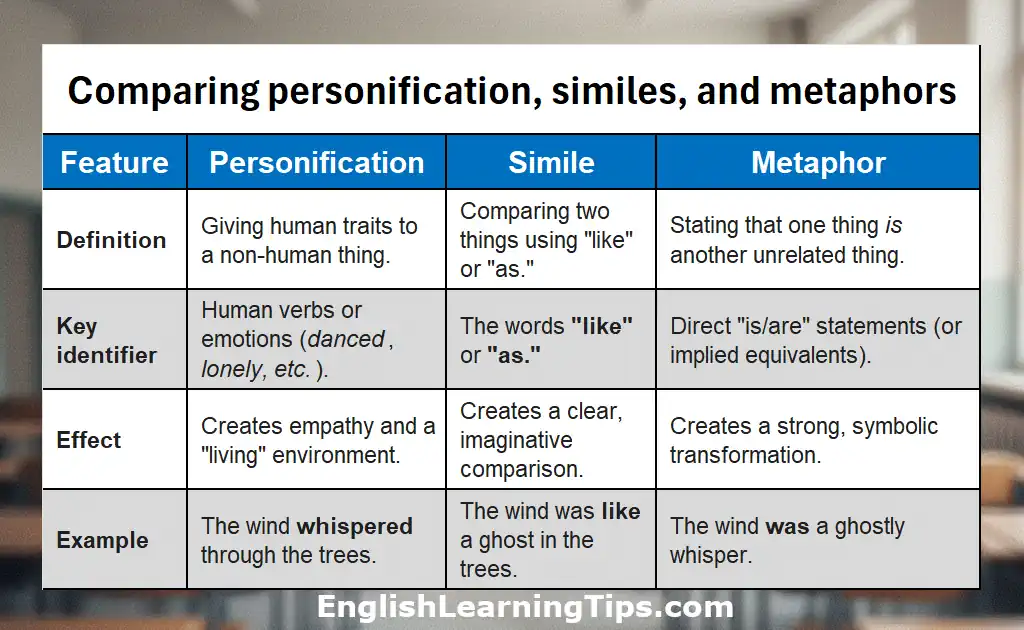
Comparing personification, similes, and metaphors chart
Frequently asked questions about personification
Visual tools to help you learn
Video: Personification defined
Video: Personification vs. Anthropomorphism
Tailoring personification for ESL learners
Understanding figurative language is a major milestone for language learners, but it comes with unique challenges. If you are teaching or learning English, keep these four tips in mind.
1. Watch for cultural idioms
Many common personification examples are rooted in Western idioms. For instance, “the teapot sang” makes sense if you know Western kettles whistle, but it might confuse a student from a culture where tea is prepared differently.
- Teacher’s tip: Use “universal” subjects like weather (rain, sun, wind) or basic emotions.
2. Distinguish between personification and “errors”
ESL students often struggle with collocations (words that naturally go together). If a student writes “the chair is sad,” a teacher might mark it as a word-choice error.
- The fix: Explicitly teach that personification is a choice for effect, not a literal description. Use a visual aid to show the “Human” vs. “Object” overlap.
3. Focus on “active” vs. “passive” verbs
Personification is a great way to teach active verbs. Instead of focusing on adjectives (the “angry” sky), encourage students to use human actions. This helps them expand their verb bank beyond “is,” “has,” and “goes.”
- Example: Instead of “The sun is bright,” try “The sun glared at the desert.”
4. Bridge the gap with L1 (First Language)
Many languages, like Spanish or Arabic, use gendered nouns. A student might find it easier to personify a “table” if their native language already assigns it a masculine or feminine identity.
- Instructional strategy: Ask students if objects in their native language “feel” like a man or a woman. This “Gender-to-Personification” bridge is a powerful mnemonic tool.
For teachers and students, using Creative Writing Prompt Cubes can make practicing personification a game. Simply roll for an object and an action to see what kind of vivid imagery you can create.
Comparison of figurative language for learners
| Device | Focus for ESL | Simple Example |
| Personification | Giving an object a human verb or feeling. | The alarm clock shouted at me. |
| Simile | Using “like” or “as” to compare. | The clouds are like cotton candy. |
| Metaphor | Saying one thing is another. | The moon is a white balloon. |
Checklist for an ESL-friendly personification lesson
- [ ] Use visual aids: Show a picture of a “smiling” sun before writing the sentence.
- [ ] Avoid slang: Stick to “standard” human emotions like happy, tired, or brave.
- [ ] Practice “Action Swapping”: Give them a list of objects and a list of human verbs and let them “mix and match.”
Master the art of personification
Personification is more than just a creative flourish; it is a bridge between the reader’s experience and the inanimate world. By giving a voice to the wind or a personality to a storm, you transform static descriptions into an immersive narrative. Whether you are writing a short story, a poem, or a marketing pitch, using this literary device effectively will make your work more relatable and memorable.
Personification is a simple way to take your writing from flat to cinematic. Next time you’re stuck on a description, look at the objects around you—the coffee mug on your desk, the clouds outside, or even your buzzing phone. How would they describe their day if they could speak?
Join the conversation
We want to hear from you! What is the most creative example of personification you’ve ever read (or written)?
- Drop a comment below with your favorite example.
- Share this guide with a fellow writer or student who wants to level up their descriptive skills.
- Subscribe for more deep dives into figurative language and writing tips.
Discover more from English Learning Tips
Subscribe to get the latest posts sent to your email.


