
Do vs have: A guide to auxiliary and main verb usage

Mastering the difference between do and have is a major milestone for English learners. While both words function as auxiliary verbs (helping verbs), they serve entirely different grammatical purposes. Using them correctly is the key to forming clear questions, expressing possession, and mastering complex tenses.
This guide was inspired by a student’s question about the two words and breaks down when to use “do” versus “have,” providing clear examples and a comparison table to help you avoid common mistakes.
What is the difference between do and have?
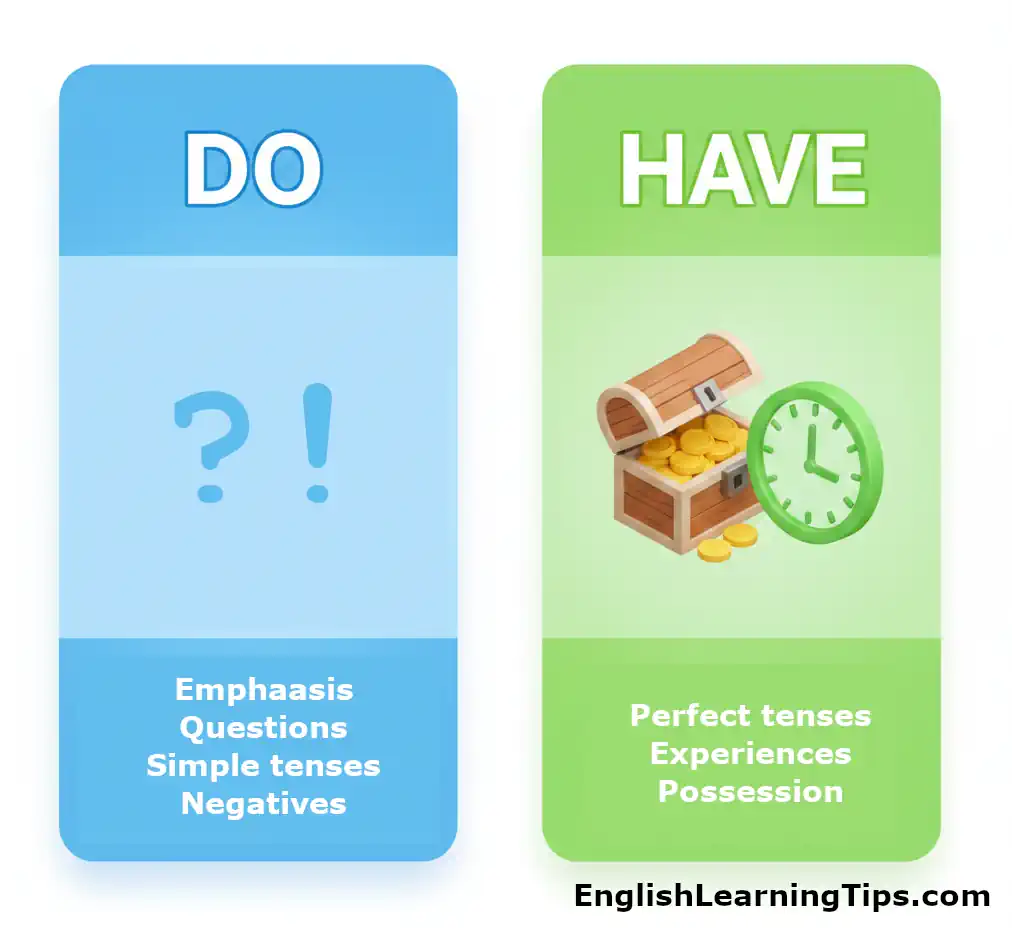
The primary difference lies in their function: Do is used to create emphasis, negatives, and questions in simple tenses. Have is primarily used to form “perfect” tenses or to indicate possession and experiences.
When to use “do”
In English grammar, do (and its forms does and did) acts as a “dummy operator.” We use it when a sentence doesn’t have another helping verb.
- Forming questions: “Do you live here?” or “Does she like tea?”
- Creating negative statements: “I do not (don’t) know the answer.”
- Adding emphasis: “I do want to go to the party!” (used to contradict a previous doubt). Remember, we always use the base form of the verb afterwards (e.g., “He does want” instead of “He does wants”).
- Substitution: “I like pizza, and my brother does, too.”
When to use “have”
Have (and its forms has and had) is more versatile because it can be both a helping verb and a primary action verb.
- Perfect tenses: Used with a past participle to show completed actions. “I have finished my homework.”
- Possession: To show ownership. “She has a new car.”
- Experiences and actions: “I am having a bad day” or “We had a great dinner.”
- Obligation: “I have to leave now.”
Comparison table: Do vs have at a glance
| Function or use | The verb: Do | The verb: Have |
| Simple questions | Do you play tennis? | — |
| Negative statements | They do not want coffee. | — |
| Possession | — | I have a blue bike. |
| Perfect tenses | — | He has already eaten. |
| Third person singular | Uses does (He/She/It) | Uses has (He/She/It) |
| Past tense form | Did | Had |
Recommended study tools
If you find the “do vs have” distinction tricky, these world-class resources are highly recommended for your home library:
- English Grammar in Use: The world’s best-selling grammar book for intermediate learners. It includes dedicated chapters on auxiliary verbs and perfect tenses.
- Practical English Usage by Michael Swan: A must-have for advanced students who want to understand the “why” behind complex English rules.
Key grammatical distinctions
1. Tense construction
Do is the backbone of the present simple and past simple. It helps the main verb without changing the main verb’s form.
- Example: “Did you see that?” (The verb “see” stays in the base form).
‘Have‘ is the backbone of the perfect aspect. Unlike “do,” it requires the main verb to change into its past participle form.
- Example: “Have you seen that?” (The verb “see” changes to “seen”).
2. Main verb vs. auxiliary verb
One of the most confusing parts for learners is that have can be a main verb (meaning “to own”), while do as a main verb means “to perform an activity.”
- “I have a job.” (Main verb: possession)
- “I do my hair.” (Main verb: action)
- “I do have a job.” (Do is the auxiliary; have is the main verb).
Frequently asked questions about do and have
Master these concepts with our practice worksheet
Ready to test your skills? We’ve put together a comprehensive do vs have practice PDF that includes 20 targeted exercises. This worksheet covers:
- Basic conjugation: Choosing between does and has.
- Negative forms: Mastering don’t, doesn’t, and didn’t.
- Advanced tenses: Perfecting the present perfect and emphatic do.
- Answer key: Full explanations for every question.
Related English grammar resources
- Auxiliary verbs vs. helping verbs vs. modal verbs
- Be verbs: Understanding irregular forms
- How to pronounce /-ed/ sounds in English
- Modal verbs
- Mastering verb tenses in English explained
Videos to help your journey
Conclusion: Putting it all together
Understanding the nuances of do and have is more than just a grammar exercise; it is about gaining the confidence to express yourself accurately. By identifying whether you are focusing on a simple action (do) or a completed experience or possession (have), you can navigate nearly any conversation in English with ease.
While these rules might feel overwhelming at first, consistent practice turns these “dummy operators” and “perfect tenses” into second nature. Remember that even native speakers occasionally mix these up in casual speech, so the goal is progress, not perfection.
Join the conversation: What is your biggest grammar challenge?
We would love to hear from you! Is there a specific sentence where you always struggle to choose between do and have? Or perhaps you have a “lightbulb moment” tip that helped you finally understand the difference?
Leave a comment below with your questions or share your favorite grammar tip. Our community of learners and educators is here to help you improve, and your question might be exactly what another student needs to hear today!
Discover more from English Learning Tips
Subscribe to get the latest posts sent to your email.


