


Adjectives and adverbs: Adding color to your English

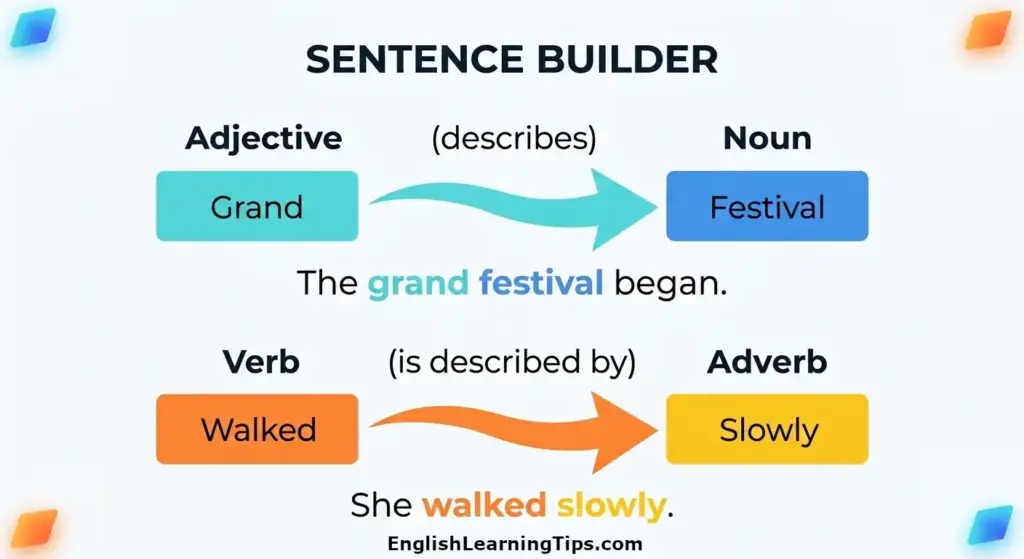
Mastering English is about more than just grammar; it is about nuance. Adjectives are words that describe or modify nouns (e.g., a blue sky), while adverbs modify verbs, adjectives, or other adverbs to explain how, when, or where something happens (e.g., she ran quickly). While nouns and verbs provide the skeleton of a sentence, these descriptive words add the detail and emotion that make your communication stand out. Our levels are based on the CEFR global standard for language proficiency, ensuring you learn the right words for your specific stage.
Whether you’re confused about the difference between adjectives and adverbs or need to up your grammar skills, this guide provides a curated list of descriptive words categorized by proficiency level. To help you understand nuance, we have included definitions, sentence examples, and antonyms (opposites) in parentheses [example: Happy (Sad). Sad is the antonym of happy].
English vocabulary levels at a glance
If you are looking for specific word types, use the table below to jump to your current learning stage.
| Level | Goal | Key Focus |
| Beginner | Foundation | Essential everyday descriptions |
| Intermediate | Variety | Adding emotion and specific detail |
| Advanced | Precision | Professional and academic nuance |
| Expert | Mastery | Rare, literary, and high-impact vocabulary |
If you prefer hands-on practice, the English for Everyone: English Vocabulary Builder is a fantastic physical companion to this guide. It uses illustrations to help you memorize the adjectives and adverbs listed below.
Beginner adjectives and adverbs: The essentials
At the starting level, focus on high-frequency words that describe your immediate environment and feelings.
Beginner adjectives
- Happy (Sad): Feeling good or pleased.
- Example: She was happy to see her friend after a long time.
- Big (Small): Large in size.
- Example: The dog is big.
- Old (New): Having existed for a long time.
- Example: This book is old.
- Good (Bad): Pleasant or satisfactory.
- Example: It’s a good day today.
- Cold (Hot): Having a low temperature.
- Example: The water is cold.
- Beautiful (Ugly): Pleasing to the eye.
- Example: She wore a beautiful dress to the party.
- Fast (Slow): Moving or happening quickly.
- Example: The car was going very fast.
Beginner adverbs
- Well (Badly): In a good or satisfactory manner.
- Example: She sings well.
- Quickly (Slowly): At a fast speed.
- Example: He runs quickly.
- Always (Never): At all times.
- Example: I always eat breakfast in the morning.
- Loudly (Quietly): In a noisy manner.
- Example: She spoke loudly to be heard over the crowd.
- Often (Seldom): Frequently.
- Example: I often go to the gym.
Intermediate adjectives and adverbs: Expanding your range
Intermediate learners should move beyond “good” or “big” to use more specific synonyms that convey exact emotions or states of being.
Intermediate adjectives
- Lively (Dull): Full of energy and excitement.
- Example: The party was lively with music and dancing.
- Tired/Fatigued (Energetic): Needing rest or sleep.
- Example: He feels fatigued after a long shift at work.
- Interesting/Engaging (Boring): Capturing your attention.
- Example: That documentary was incredibly engaging.
- Busy/Occupied (Idle): Actively engaged in work or tasks.
- Example: She is busy with her homework.
- Young/Inexperienced (Mature): Having lived for a short period.
- Example: The intern is talented but still quite young.
Intermediate adverbs
- Usually (Rarely): In the regular course of events.
- Example: I usually wake up at 7 a.m.
- Easily (With difficulty): Without much effort.
- Example: She passed the exam easily.
- Carefully (Carelessly): In a cautious manner.
- Example: She carefully placed the antique vase on the shelf.
- Honestly (Deceitfully): In a truthful manner.
- Example: She answered the difficult question honestly.
- Temporarily (Permanently): For a short period of time.
- Example: The store is temporarily closed for renovations.
Advanced adjectives and adverbs: Nuance and flow
Advanced vocabulary allows you to describe complex situations and abstract concepts with sophistication.
Pro -tip: Once you reach the advanced level, a reliable thesaurus becomes your best friend. We recommend the Merriam-Webster Pocket Thesaurus for finding quick alternatives to common words while you write.
Advanced adjectives
- Exquisite: Extremely beautiful or delicate.
- Example: The exquisite painting caught everyone’s attention.
- Resilient: Able to recover quickly from difficulties.
- Example: She is a resilient person who bounces back from challenges.
- Vibrant: Full of energy and life.
- Example: The vibrant colors of the festival were breathtaking.
- Serene: Calm, peaceful, and untroubled.
- Example: The lake was serene in the early morning mist.
- Eloquent: Fluent and persuasive in speaking.
- Example: The speaker gave an eloquent speech about social change.
Advanced adverbs
- Effortlessly: Without any apparent difficulty.
- Example: He solved the complex physics puzzle effortlessly.
- Subsequently: After a particular thing has happened.
- Example: She passed the exam and subsequently received a scholarship.
- Exclusively: Only; restricted to a specific group or thing.
- Example: The event is reserved exclusively for VIP guests.
- Meticulously: Showing great attention to detail.
- Example: She meticulously organized her research notes.
- Unequivocally: In a way that leaves no doubt.
- Example: The director unequivocally denied the rumors.
Expert adjectives and adverbs: Literary mastery
These words are often found in high-level literature, academic journals, or formal speeches. To see how these words appear in modern publications, you can browse the Oxford English Corpus for real-world examples.
Expert adjectives
- Ephemeral: Lasting for a very short time.
- Example: The beauty of the sunset was ephemeral, fading in minutes.
- Magnanimous: Generous and forgiving toward a rival.
- Example: Despite the fierce competition, he was magnanimous in victory.
- Pernicious: Having a harmful effect in a subtle or gradual way.
- Example: The pernicious effects of misinformation are a global concern.
- Ubiquitous: Present, appearing, or found everywhere.
- Example: Smartphones have become ubiquitous in modern society.
- Sublime: Of such excellence or beauty as to inspire great awe.
- Example: The sublime views from the Alps were unforgettable.
Expert adverbs
- Indefatigably: Without tiring; tirelessly.
- Example: He worked indefatigably to finish the project on time.
- Sporadically: Occasionally; at irregular intervals.
- Example: The rain fell sporadically throughout the afternoon.
- Sublimely: In a way that is incredibly beautiful or excellent.
- Example: The orchestra played sublimely during the finale.
- Flawlessly: In a perfect manner without any mistakes.
- Example: She performed the concerto flawlessly.
- Reluctantly: In a manner showing hesitation or unwillingness.
- Example: He reluctantly agreed to the new terms of the contract.
Frequently asked questions about adjectives and adverbs
Conclusion: Elevate your English with descriptive power
Mastering the balance between adjectives and adverbs is the fastest way to transition from “textbook English” to natural, evocative communication. By moving beyond basic descriptors like good or big and integrating advanced terms like exquisite or meticulously, you gain the ability to express complex thoughts with precision.
Remember, the goal isn’t just to use more words, but to use the right words. Whether you are writing a professional email or sharing a story with friends, these sparkling gems of vocabulary will ensure your message is not just heard, but felt.
Join the conversation: What is your favorite descriptive word?
We want to hear from you! Learning is most effective when it is social.
- Which word from our list was new to you? * Is there a “tricky” adverb or adjective you always struggle with? Drop a comment below and let’s discuss! If you found this guide helpful, share it with a fellow learner or teacher. Your support helps us create more deep-dive resources for the English-learning community.
Discover more from English Learning Tips
Subscribe to get the latest posts sent to your email.


