

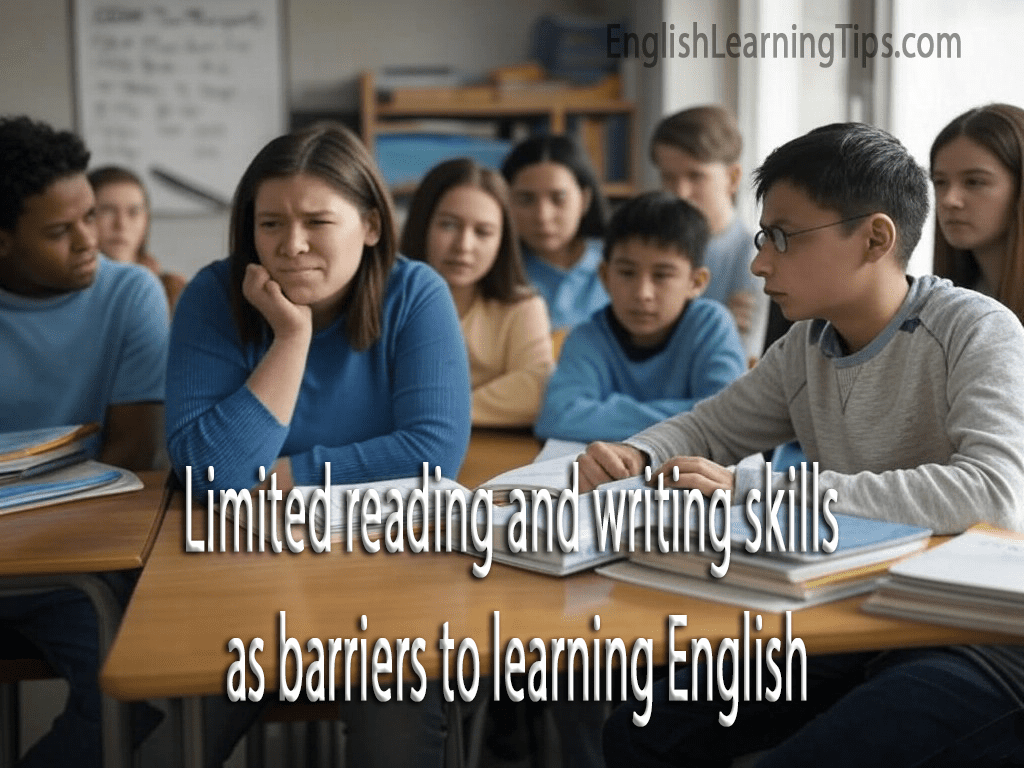
How limited reading and writing skills act as barriers to learning English

Learning a new language is a multifaceted journey, but for many students, the path is blocked by fundamental literacy gaps. When an individual has limited reading and writing skills, the process of mastering English as a Second Language (ESL) becomes significantly more difficult. These “literacy barriers” don’t just slow down progress—they can prevent a learner from ever reaching full proficiency.
This article explores why literacy is the backbone of language acquisition and provides actionable strategies to overcome these common challenges faced by ESL students.
Why reading and writing are essential for English proficiency
Many learners believe that “just speaking” is enough to become fluent. However, research shows that literacy skills provide the structural framework for language. Without them, a learner is essentially building a house without a foundation.
- Vocabulary expansion: Reading is the primary way we encounter “low-frequency” words that aren’t used in daily conversation but are essential for academic and professional success.
- Grammar reinforcement: While we hear grammar in speech, we see it in writing. Reading allows the brain to process complex syntax at its own pace.
- Cognitive load: When a student struggles to decode letters or form characters, their brain has less “processing power” left to understand the actual meaning of the words.
Key barriers: How literacy gaps hinder ESL progress
Understanding the specific ways that limited literacy impacts learning is the first step toward finding a solution.
1. Academic and professional limitations
In a globalized workforce, English proficiency is often synonymous with career advancement. If a learner cannot draft a professional email or synthesize a report, their “speaking fluency” will only take them so far. In academic settings, these students often fall behind because they cannot keep up with the volume of required reading.
2. The broken feedback loop
Writing is one of the most effective ways to receive corrective feedback. When a student writes a paragraph, a teacher can pinpoint exact grammatical errors. If a student avoids writing due to limited skills, they miss out on this “precision coaching,” leading to fossilized errors that are harder to fix later.
3. Reduced cultural and idiomatic awareness
So much of the English language is buried in subtext, idioms, and cultural references. These are often best learned through stories, news articles, and literature. Limited reading skills restrict a learner’s exposure to these nuances, often resulting in “flat” or potentially inappropriate language use.
4. Impact on confidence and motivation
The psychological barrier is perhaps the most damaging. When every reading task feels like a struggle, “affective filter” (a psychological block to learning) rises. Learners may become discouraged, leading to a cycle of avoidance that further stalls their progress.
Comparison: Conversational vs. Literacy-based learning
| Feature | Conversational learning (Oral) | Literacy-based learning (Reading/Writing) |
|---|---|---|
| Primary focus | Immediate communication | Long-term retention & structure |
| Vocabulary | High-frequency / Slang | Academic / Technical / Diverse |
| Grammar | Intuitive / Flexible | Precise / Rule-oriented |
| Feedback | Immediate but often shallow | Delayed but highly detailed |
| Critical thinking | Fast-paced / Reactive | Analytical / Reflective |
Strategies to overcome literacy barriers in English
If you or your students are struggling with these barriers, use these evidence-based methods to bridge the gap:
- Utilize simplified “graded readers”: Don’t jump into complex novels. Use texts specifically designed for your current level to build “reading stamina” without frustration. For those just starting, series like the Oxford Bookworms Library or Pearson English Kids Readers offer a wide range of classics and original stories adapted specifically for language learners.
- The multisensory approach: Use the VAKT method (Visual, Auditory, Kinesthetic, and Tactile). Trace letters while saying their sounds, or use text-to-speech tools to follow along with a written text. Tactile tools, such as Sandpaper Letters or Dry Erase Tracing Boards, are surprisingly effective for adult learners who need to build the muscle memory required for English script.
- Structured writing frames: Instead of a blank page, use “sentence starters” or templates to practice syntax without the anxiety of starting from scratch.
- Leverage technology: Use apps that gamify phonics and spelling to make the “boring” parts of literacy more engaging.
- Focus on high-frequency sight words: Memorizing the 100 most common English words can immediately reduce the cognitive load of reading by up to 50%.
Frequently asked questions about ESL literacy
This article is part of our comprehensive series: Common challenges faced by ESL students. To learn more about navigating the complexities of English language acquisition, browse our other resources.
Discover more from English Learning Tips
Subscribe to get the latest posts sent to your email.


