

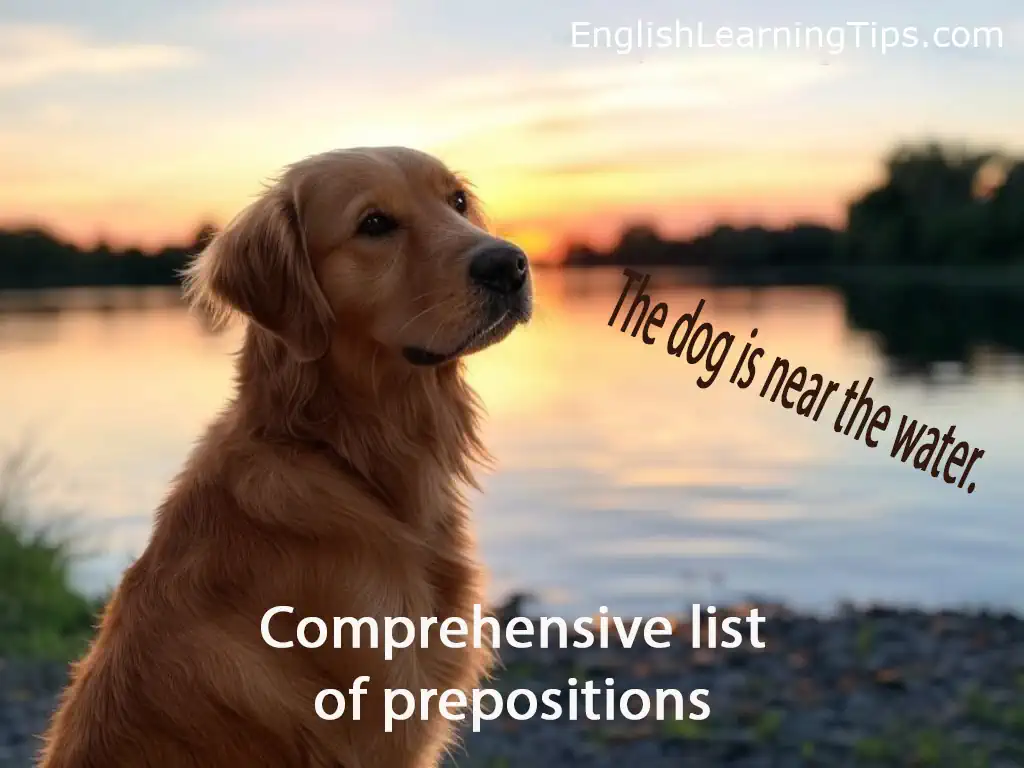
Comprehensive list of prepositions: A complete guide with examples

Prepositions are the unsung heroes of the English language, quietly weaving connections between words to bring clarity and meaning to our sentences. Defined as words that show the relationship between a noun or pronoun and another element in a sentence—often indicating direction, location, time, or manner—prepositions are essential for effective communication.
In this guide, we provide a comprehensive list of 51 common prepositions, ranging from daily essentials like “in” and “on” to more advanced terms like “notwithstanding.”
Writer’s Tip: Keeping a physical copy of Publication Manual of the American Psychological Association
or a Merriam-Webster Collegiate Dictionary on your desk is the best way to master complex prepositional phrases and formal writing standards.
51 common prepositions in English
The following list includes single-word prepositions and compound phrases, organized with clear examples to show how they function in natural speech and writing.
Single-word prepositions
| Preposition | Example sentence |
| About | He talked about his new job. |
| Above | The stars are above the clouds. |
| Across | She walked across the bridge. |
| After | We’ll meet after dinner. |
| Against | He leaned against the wall. |
| Along | They walked along the beach. |
| Among | She felt at home among friends. |
| Around | He looked around the room. |
| At | I’ll see you at noon. |
| Before | Please come before 5 PM. |
| Behind | The cat is hiding behind the couch. |
| Below | The temperature is below zero. |
| Beneath | The treasure lies beneath the sand. |
| Beside | He sat beside his sister. |
| Besides | Besides being a teacher, I’m also a lifelong learner. |
| Between | The secret is between you and me. |
| Beyond | The path continues beyond the forest. |
| By | She stood by the door. |
| Despite | He succeeded despite the challenges. |
| Down | She walked down the stairs. |
| During | It rained during the night. |
| Except | Everyone was there except him. |
| For | This gift is for you. |
| From | I received a letter from my friend. |
| In | She’s in the kitchen. |
| Inside | The keys are inside the drawer. |
| Into | He jumped into the pool. |
| Like | She looks like her mother. |
| Near | There’s a park near my house. |
| Of | He’s a friend of mine. |
| Off | He fell off the ladder. |
| On | The book is on the table. |
| Onto | She climbed onto the roof. |
| Out | He went out for a walk. |
| Outside | The children are playing outside. |
| Over | The plane flew over the city. |
| Past | He walked past the shop. |
| Since | I’ve known her since childhood. |
| Through | They walked through the woods. |
| Throughout | She was happy throughout the day. |
| Till | Wait till I come back. |
| To | She gave the book to me. |
| Toward(s) | He moved towards the exit. |
| Under | The dog is under the table. |
| Underneath | The wallet was underneath the bed. |
| Until | We waited until the rain stopped. |
| Up | He climbed up the mountain. |
| Upon | Once upon a time… |
| With | He came with his brother. |
| Within | The answer lies within you. |
| Without | He left without saying goodbye. |
Compound prepositions
Compound prepositions (or complex prepositions) consist of two or more words functioning as a single unit.
- According to: According to the weather forecast, it’ll rain.
- Because of: The game was canceled because of the rain.
- Close to: He lives close to the station.
- Due to: The delay was due to heavy traffic.
- Except for: Everything was perfect, except for the weather.
- In front of: There’s a car in front of the house.
- In spite of: In spite of the cold, she went out.
- Instead of: She went jogging instead of watching TV.
- Next to: The library is next to the school.
- On account of: The event was postponed on account of the storm.
- Out of: He made a sculpture out of clay.
Frequently asked questions about prepositions
Common preposition mistakes to avoid
| Incorrect | Correct | Why? |
| Bored of | Bored with | “With” is the standard idiomatic partner for “bored.” |
| Different than | Different from | “From” is preferred in formal writing to show distinction. |
| Arrived to | Arrived at | You arrive at a destination, you move to a destination. |
| Discuss about | Discuss | “Discuss” already implies “talk about,” so “about” is redundant. |
Mastering English grammar
This list covers a significant portion of the most frequently used prepositions. However, because language is always evolving, new combinations are formed regularly. For those looking to master the nuances of English, consider exploring these related topics:
- Prepositions 101: A beginner’s overview
- Prepositions of position: Detailed usage of “in,” “on,” and “at”
- How to use prepositions for giving directions
- Prepositions of time and duration
If you want to move beyond lists and start practicing, we highly recommend the English Grammar in Use Workbook. It is widely considered the “gold standard” for practicing prepositions and sentence structure.
Discover more from English Learning Tips
Subscribe to get the latest posts sent to your email.


