

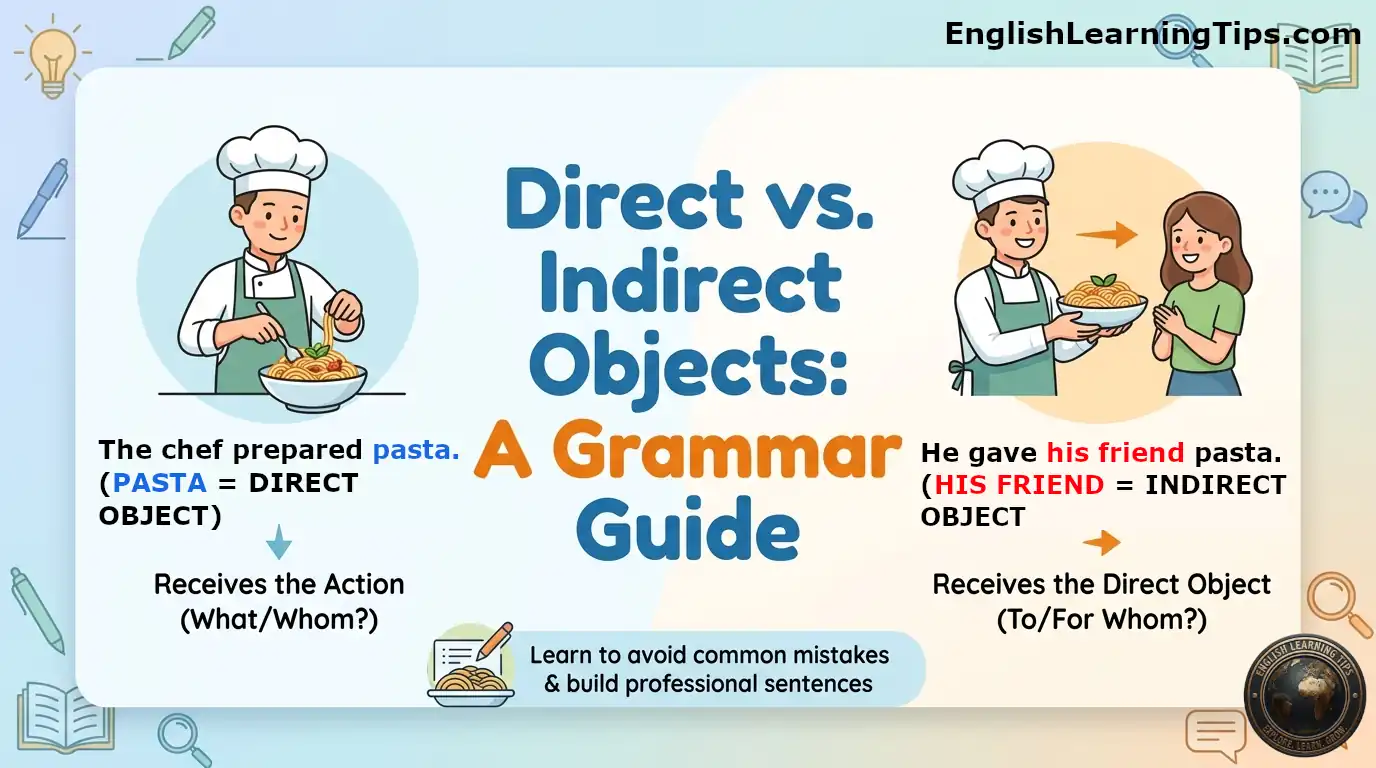
Direct and indirect objects: A comprehensive guide to English grammar

Understanding the difference between a direct object and an indirect object is essential for mastering English sentence structure. These grammatical components clarify who is performing an action and who is receiving it, allowing you to build more descriptive and professional sentences.
In this guide, you will learn how to identify each object, see them in action with clear examples, and avoid common mistakes that even native speakers make.
What is a direct object?
A direct object is a noun, noun phrase, or pronoun that directly receives the action of a transitive verb. To find the direct object in a sentence, locate the verb and ask “What?” or “Whom?“
Direct object examples:
- The chef prepared pasta. (What did the chef prepare? Pasta)
- She called her brother. (Whom did she call? Her brother)
- The team won the trophy. (What did they win? The trophy)
Grammar tip: A direct object cannot exist without a transitive verb. Intransitive verbs—like sleep, run, or laugh—do not take direct objects because the action doesn’t “happen” to something else.
What is an indirect object?
An indirect object is the recipient of the direct object or the person/thing for whom the action is performed. It answers the questions “To whom?“, “For whom?“, or “For what?“
Crucially, an indirect object almost always appears between the verb and the direct object.
Indirect object examples:
- She gave her friend a gift. (To whom did she give the gift? Her friend)
- Dad bought us ice cream. (For whom did he buy ice cream? Us)
- The teacher assigned the students homework. (To whom was it assigned? The students)
Direct object vs. indirect object: Key differences at a glance
Use this table to quickly distinguish between these two sentence parts:
| Feature | Direct object | Indirect object |
| Primary role | Receives the verb’s action | Receives the direct object |
| Key question | What? or Whom? | To whom? or For whom? |
| Sentence position | After the verb (or after the indirect object) | Between the verb and direct object |
| Is it required? | Yes (for transitive verbs) | No (it is optional) |
| Sentence example | I sent a letter. | I sent him a letter. |
How to identify direct and indirect objects in 3 steps
If you are struggling with sentence diagramming or identifying parts of speech, follow this simple formula:
- Find the subject and the verb: Identify who is doing what.
- Locate the direct object: Ask “What?” or “Whom?” after the verb.
- Locate the indirect object: If there is a direct object, ask “To or for whom?” was it done.
Example walkthrough:
“The company sent employees a bonus.”
- Verb: Sent
- Sent what? A bonus (Direct object)
- Sent to whom? Employees (Indirect object)
Common verbs that use both objects
In English, certain verbs are more likely to take both a direct and an indirect object. These are often referred to as ditransitive verbs. Common examples include:
- Give / Lend / Pass: “Pass me the salt.”
- Tell / Show / Teach: “Teach the class the lesson.”
- Buy / Make / Get: “I bought my sister a coffee.”
- Promise / Offer / Send: “They offered him a job.”
The prepositional phrase trap
A common point of confusion is when the recipient follows a preposition like “to” or “for.” In these cases, the word is no longer an indirect object; it is the object of a preposition.
- With indirect object: “I sent Sarah the files.”
- With prepositional phrase: “I sent the files to Sarah.”
While the meaning is identical, the grammatical structure changes. Informal writing often uses the first version for brevity and the second for emphasis.
Frequently asked questions (FAQs) about objects in grammar
Video: Indirect objects and direct objects grammar lesson
Master your sentence structure today
Understanding direct and indirect objects is more than just a grammar exercise; it is the key to writing clear, professional English. By identifying the recipient of an action versus the recipient of the object, you can eliminate wordiness and avoid common “dangling” or incomplete sentences. Whether you are prepping for an English exam or polishing a business email, these rules provide the framework for better communication.
What do you think?
Did this guide help clear up the confusion between these two objects? Grammar can be tricky, and we would love to hear from you.
- Leave a comment: Do you have a “trick” for remembering the difference? Or is there a specific verb that always trips you up?
- Share this guide: If you found these examples helpful, share this article with a fellow student or colleague who wants to level up their writing skills.
Your feedback helps us create better resources for the entire community!
Discover more from English Learning Tips
Subscribe to get the latest posts sent to your email.


