

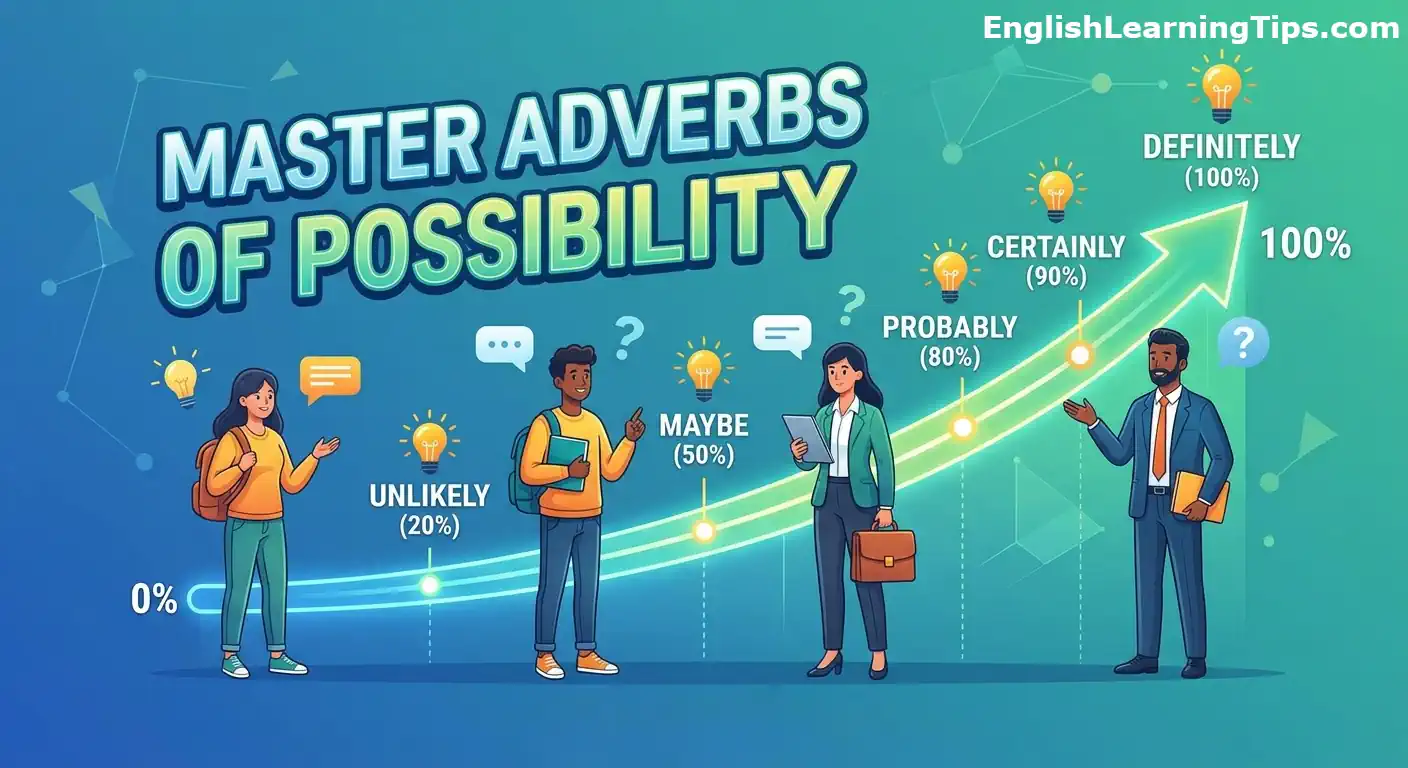
Adverbs of possibility: a complete guide with examples

Adverbs of possibility (also known as adverbs of probability) are essential tools for expressing your level of certainty. Whether you are writing a professional report, preparing for an IELTS exam, or refining your creative writing, these words allow you to convey nuance about predictions, opinions, and future events.
Mastering these adverbs helps you move beyond simple statements and add depth to your English grammar.
What are adverbs of possibility?
Adverbs of possibility indicate how sure a speaker or writer is about a statement. They answer questions like, “How likely is this to happen?” or “What is the level of certainty?”
Unlike modal verbs (such as may, might, or could), which change the verb itself, adverbs of possibility modify the entire clause to fine-tune the degree of confidence.
The spectrum of certainty
You can think of these adverbs as a scale, ranging from complete certainty to extreme doubt. These adverbs help establish the ‘epistemic modality‘ of a sentence—a term used by linguists to describe how a speaker expresses their certainty about a claim.
List of adverbs of possibility: degrees of certainty
Not sure which word to pick? Use this quick-reference table to match your adverb to your intended level of certainty.
| Adverb | Degree of certainty | Contextual usage |
| Definitely | Very high | Used to express total conviction. |
| Certainly | Very high | Often used for emphasis or agreement. |
| Undoubtedly | Very high | A formal choice for undeniable facts. |
| Clearly | High | Based on observable evidence. |
| Obviously | High | Implies the fact is evident to everyone. |
| Probably | Medium-high | The most common term for likelihood. |
| Likely | Medium-high | Often used in more formal writing. |
| Possibly | Medium | Indicates a neutral chance of occurrence. |
| Perhaps | Medium-low | Frequently used to sound polite or tentative. |
| Maybe | Medium-low | Best for informal, conversational English. |
| Conceivably | Low | Very formal; used for theoretical possibilities. |
| Unlikely | Low | Expresses a strong doubt that it will happen. |
If you want to master these subtle shifts in meaning, having a comprehensive reference guide on your desk is essential. Many advanced learners and teachers swear by Advanced Grammar in Use by Martin Hewings; it is arguably the best resource for understanding how adverbs like these function within complex, academic, and professional sentence structures.
How to use adverbs of possibility in sentences
Placement is the key to natural-sounding English. While there are a few exceptions, follow these core English grammar rules to maintain proper syntax.
1. The “Maybe” and “Perhaps” rule
These two are flexible but most commonly appear at the very beginning of a sentence or clause.
- Perhaps it will stop raining by noon.
- Maybe we should consider a different approach.
2. The “Before the main verb” rule
For most other adverbs (such as probably, definitely, certainly), place the adverb before the main verb.
- They will probably arrive by 7 pm.
- She is definitely the most qualified candidate.
3. Combining with modal verbs
You can pair these adverbs with modal verbs like might, could, or will to create a more sophisticated tone.
- We might possibly visit the museum if we have time. (Low certainty)
- You will definitely succeed if you remain consistent. (High certainty)
Pro Tip: Avoid “stacking” adverbs (using two or three in a row). It makes sentences feel cluttered and weakens your message. Use one strong adverb rather than two weak ones. For example, saying ‘He will possibly maybe come’ sounds unnatural to native speakers. Stick to one.
Common mistakes with adverbs of possibility
Even advanced learners occasionally slip up when using these adverbs. Avoid these three frequent errors to sound more natural and professional in your English.
1. Stacking adverbs
A common mistake is using two adverbs of possibility in the same clause (e.g., “It will possibly maybe rain”). This is redundant and sounds unnatural to native speakers.
- Incorrect: He will probably likely attend the meeting.
- Correct: He will probably attend the meeting.
2. Misplacing the adverb in negative sentences
When making a negative statement, the adverb usually needs to come before the word “not” or the negative verb form to maintain proper flow.
- Incorrect: It won’t probably happen.
- Correct: It probably won’t happen.
3. Confusing “hardly” with possibility
As mentioned, hardly does not express possibility—it describes the extent of something (meaning “almost not”). Using it as a synonym for “unlikely” is a common error.
- Incorrect: It is hardly to rain today.
- Correct: It is unlikely to rain today.
Don’t feel discouraged if you find these tricky—even C2-level speakers do! For a deeper dive into common pitfalls and style conventions, Practical English Usage by Michael Swan is the definitive guide that answers almost any question you could have about English nuance and usage.
Frequently asked questions (FAQs) about adverbials of possibility
Visual tools to help you learn
Video: Maybe, probably, definately (adverbs)
Video: How do I indicate degrees of possibility using adverbs?
Mastering your confidence in English
Using adverbs of possibility is the ultimate way to transition from speaking like a beginner to communicating like a native. Whether you are aiming for precision in your academic essays or simply want to sound more nuanced in daily conversation, these small but powerful words hold the key to your message’s tone. By carefully selecting your adverbs, you control not just what you say, but exactly how much confidence you project to the world.
Join the conversation
Now that you have a better grasp of the possibility spectrum, which adverb do you find yourself using the most? Does definitely sound a bit too strong for your emails, or are you a fan of perhaps for its subtle, polite tone?
Share your thoughts in the comments below! If you found this guide helpful, please share it with a friend or colleague who is working on their English grammar—it might be just the clarity they need to boost their writing scores.
Discover more from English Learning Tips
Subscribe to get the latest posts sent to your email.


