

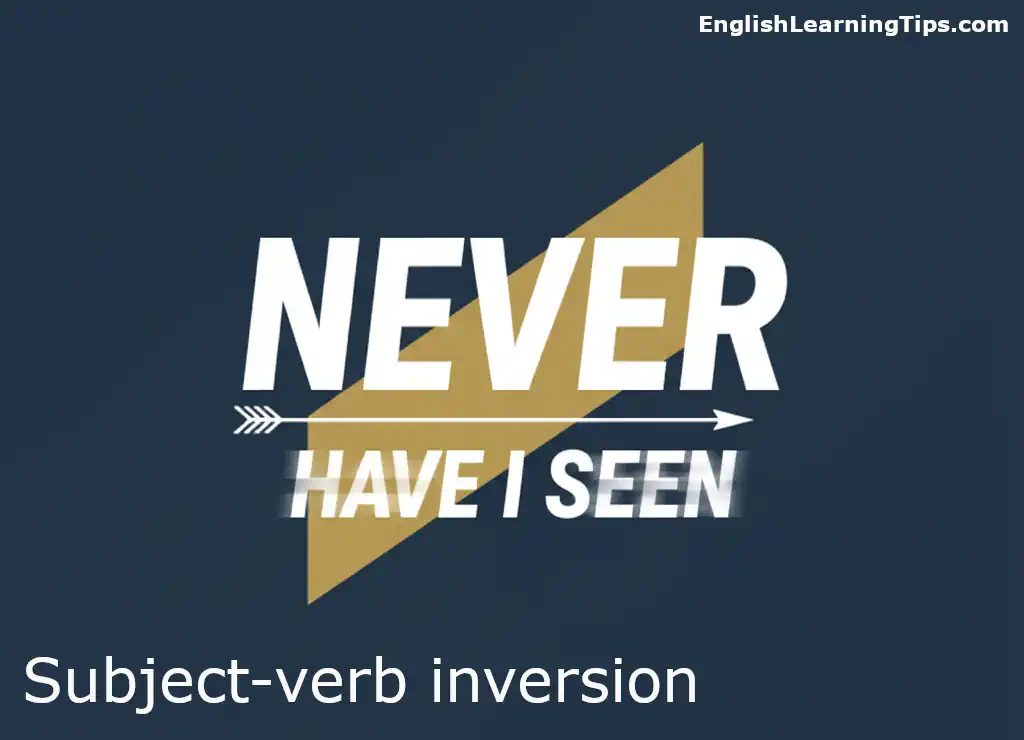
Understanding subject-verb inversion in English grammar: A complete guide

Subject-verb inversion is a vital technique for achieving advanced fluency, formal tone, and dramatic emphasis in English writing. While standard English typically follows a subject + verb structure, mastering inversion allows you to elevate your style for academic, literary, and professional contexts.
What is subject-verb inversion?
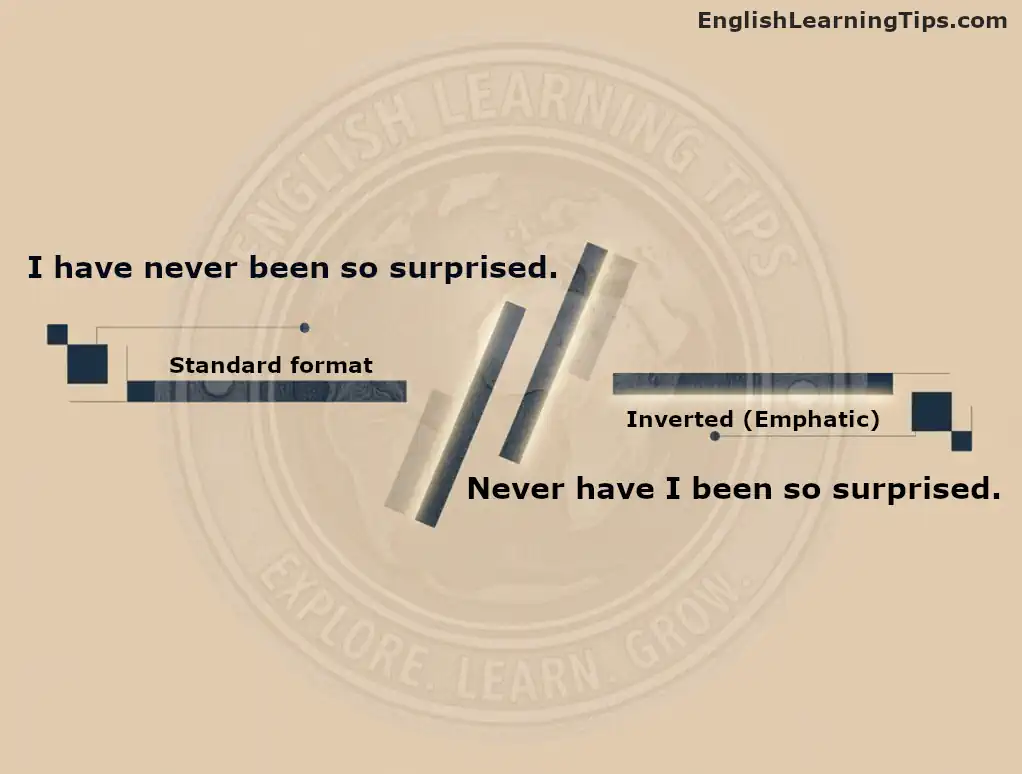
Subject-verb inversion occurs when the verb or auxiliary verb is placed before the subject, rather than after it. In a standard declarative sentence, the order is subject + verb (e.g., “He rarely goes out”). When we apply inversion, the word order flips to verb + subject (e.g., “Rarely does he go out”).
This grammatical shift is commonly used to:
- Add emphasis: Draw specific attention to an action or description.
- Enhance formality: Perfect for academic essays, IELTS writing tasks, and professional correspondence.
- Create literary flow: Often used in descriptive prose to build imagery.
When to use subject-verb inversion
Understanding the specific contexts for inversion is key to using it naturally. Here are the most common scenarios where this structure is required or appropriate.
1. In standard interrogative sentences
This is the most common use of inversion. English questions typically require an auxiliary verb to move before the subject.
| Sentence Type | Standard Order | Inverted Order (Question) |
| Present simple | You are ready. | Are you ready? |
| With auxiliary | She can swim. | Can she swim? |
| Action verb | They have finished. | Have they finished? |
Note: For present or past simple verbs without an auxiliary, we use the “do/does/did” support.
2. After negative or restrictive adverbials
Fronting negative expressions adds significant emphasis. When you place these words at the beginning of a sentence, inversion is mandatory.
- Never: “Never have I seen such a stunning sunrise.”
- Rarely: “Rarely does he arrive before the meeting starts.”
- No sooner: “No sooner had the train departed than it began to snow.”
- Not only: “Not only did she win the championship, but she also broke the record.”
3. Formal conditional sentences
In high-level academic or literary English, you can remove “if” by inverting the auxiliary verb.
- Should: “Should you require further assistance, please contact our support team.” (If you should require…)
- Were: “Were I in your position, I would accept the offer.” (If I were in your position…)
- Had: “Had I known about the changes, I would have prepared differently.” (If I had known…)
4. Locative inversion (Place adverbials)
Writers often use this technique to make descriptions more vivid by fronting the location.
- “On the horizon appeared the first light of dawn.”
- “In the heart of the forest stands a century-old oak tree.”
5. Agreement with “so,” “neither,” and “nor”
This is a standard requirement for maintaining conversational flow when agreeing or disagreeing.
- “I enjoy classical music.” — “So do I.”
- “He doesn’t like spicy food.” — “Neither does she.”
Common pitfalls to avoid
While inversion is a powerful tool, overusing it can make your writing sound forced or archaic. Follow these best practices to ensure your usage sounds natural:
- Don’t force it: Only use inversion for emphasis or in specific formal structures. In casual conversation, keep the standard subject + verb order.
- Mind the auxiliary: A common error is forgetting to add “do/does/did” when inverting.
- Incorrect: “Rarely I go to the cinema.”
- Correct: “Rarely do I go to the cinema.”
- Check your context: Inversion is largely a tool for formal writing and deliberate emphasis. Using it in a quick text message to a friend will likely sound unnatural.
Frequently asked questions (FAQs)
Recommended resources for advanced writers
If you are looking to further refine your grasp of complex syntax and formal style, these three books are essential additions to any writer’s desk:
- Advanced Grammar in Use by Martin Hewings: This is my top recommendation for learners moving toward C1 or C2 proficiency. It provides excellent, in-depth explanations of the nuanced grammar structures (like subject-verb inversion) we discussed above.
- Practical English Usage by Michael Swan: If you want a definitive, desk-side reference for those “tricky” grammar questions that arise during professional writing, this is an invaluable guide.
- The Elements of Style by Strunk & White: A classic for a reason. While not strictly a grammar textbook, it is the ultimate resource for learning how to cut clutter and use sentence variation to make your writing more impactful.
Mastering your sentence variety
Subject-verb inversion is more than just a formal rule—it is a powerful tool for controlling the rhythm, emphasis, and tone of your writing. By moving beyond standard word order, you can transform a plain statement into an impactful, professional, or literary piece of prose. Remember that the key to mastering this structure lies in nuance; use inversion to highlight your most important points, but keep it balanced to ensure your writing remains clear and engaging.
Practice makes perfect
Now that you understand the mechanics of inversion, it is your turn to try. Pick one of your recent essays or professional emails and identify a sentence that could benefit from a little extra emphasis. Can you rewrite it using an emphatic adverbial phrase or a formal conditional?
What has been your experience using inversion in your writing? Do you find it difficult to identify when it sounds natural versus forced, or do you have a favorite “go-to” inversion phrase for your academic work? Leave a comment below and share your thoughts or questions with our community. If you found this guide helpful for your grammar studies or exam preparation, please share this article with a friend or colleague who is looking to level up their English writing skills.
Discover more from English Learning Tips
Subscribe to get the latest posts sent to your email.


