

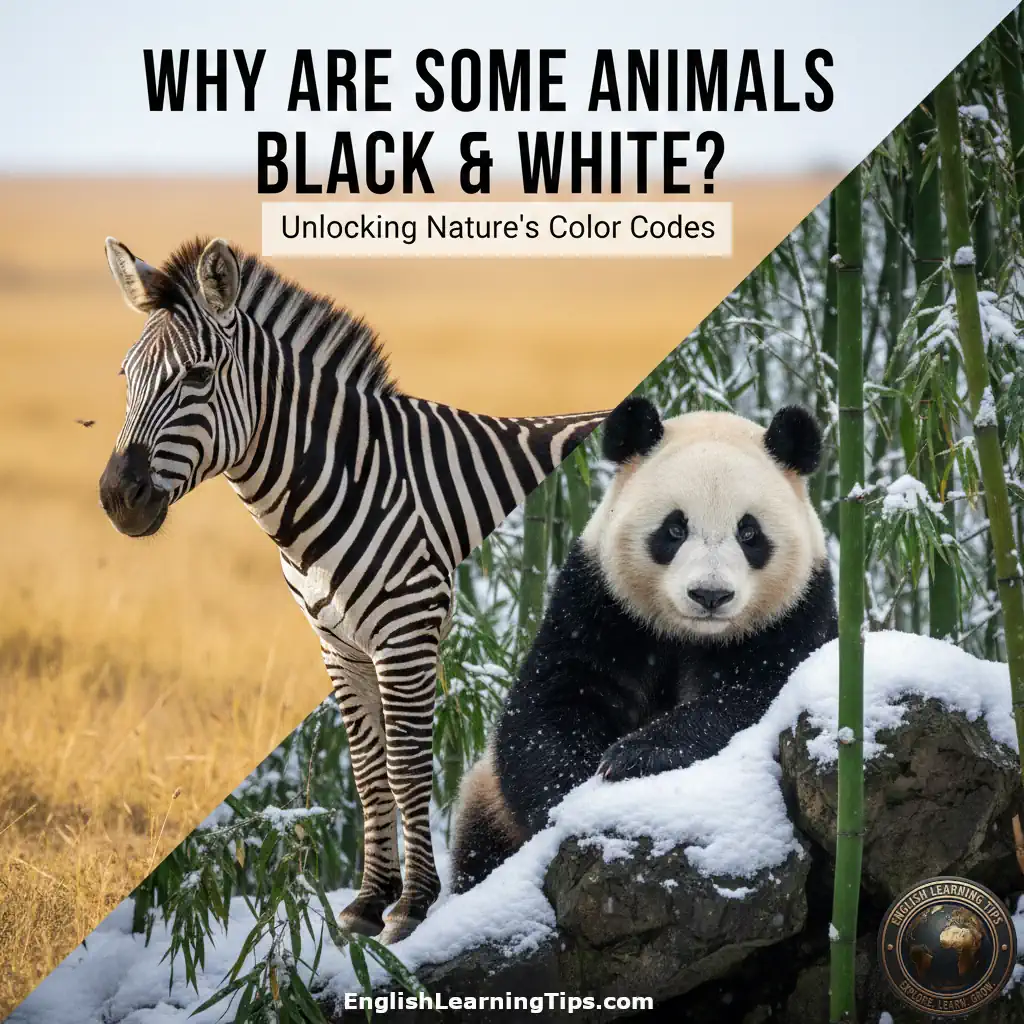
Why are some animals black and white? — Video-based ESL lesson

This lesson plan is designed to help English learners understand the biological reasons behind animal coloration while boosting their vocabulary and communication skills. Through the study of zebras, pandas, and other species, students will explore concepts like camouflage and biological signaling while practicing natural English conversation.
Lesson plan: Nature’s color codes
Level: Intermediate (B1/B2)
Time: 45 minutes
Topic: Evolutionary biology and animal behavior
Objectives: By the end of this lesson, students will be able to explain the functions of black-and-white patterns in nature, use specific vocabulary related to visual perception and discovery, and conduct a structured discussion using target phrases.
Background
Nature is filled with vibrant colors, but many species—from the striped zebra to the giant panda—rely on a stark, black-and-white palette. Scientists have spent years investigating these patterns to determine how they contribute to survival. While some colors serve as a warning to predators, others are masterclasses in concealment or physical protection.
Research suggests that these patterns are not accidental. For zebras, high-contrast stripes may serve as a deterrent against biting insects, a theory supported by a study published in the journal PLOS ONE. Conversely, for animals like the giant panda, black-and-white fur can provide effective camouflage in the mottled light of snowy, rocky environments. Understanding these adaptations helps us appreciate the complex strategies animals use to stay safe.
If you’re fascinated by the hidden reasons behind animal traits, I highly recommend reading An Immense World by Ed Yong. It’s an incredible look into how different species experience the world and will give you a much deeper appreciation for the adaptations we discussed.
Basic vocabulary
To discuss evolutionary traits, students need precise vocabulary to describe how animals interact with their environment.
Vocabulary list
| Word | Part of Speech | Conjugations | Definition | Example Sentence |
| Optical | Adjective | Optically (adv) | Relating to sight | The stripe pattern creates an optical trick. |
| Illusion | Noun | Illusory (adj) | A false perception | The image is just an optical illusion. |
| Bunch | Noun/Verb | Bunched, bunching | A large group/number | I did a whole bunch of research today. |
| Effective | Adjective | Effect (n), Effectively (adv) | Successful in producing a result | This pattern is effective against flies. |
| Perceive | Verb | Perception (n), Perceptual (adj) | To become aware of through senses | Flies perceive the stripes differently. |
| Disguise | Noun/Verb | Disguised (adj), Disguising (v) | To hide the true appearance | Snow provides a perfect disguise. |
| Click | Verb | Clicked, clicking | To suddenly understand | It finally clicked in my mind. |
| Giveaway | Noun | – | A clue that reveals a secret | The noise was a giveaway of his location. |
| Complex | Adjective | Complexity (n) | Consisting of many parts | The reasons for coloring are complex. |
| Predict | Verb | Prediction (n), Predictable (adj) | To say what will happen in the future | It is hard to predict animal behavior. |
Vocabulary for extension
- Aposematism (n): The advertising of danger by an animal to potential predators.
- Camouflage (n/v): Hiding by blending into the surroundings.
- Mimicry (n): The act of imitating another species to gain a survival advantage.
- Predator (n): An animal that hunts others for food.
- Evolutionary (adj): Relating to the process of gradual development.
- Adaptation (n): A change that helps an organism survive.
- Distinctive (adj): Clearly different from others; unique.
- Repel (v): To force something to move away.
- Contrast (n/v): The state of being strikingly different from something else.
- Theory (n): A system of ideas intended to explain something.
Teaching tips
Use visual cards to associate the words with images. For “optical illusion,” show a famous illusion image to demonstrate the concept before defining it. Encourage students to create their own sentences using “a whole bunch of” in a personal context, such as “a whole bunch of homework.”
Grammar spotlight: Describing nature and change
To help you communicate more effectively about animal behavior and evolutionary science, this section focuses on three key areas of English grammar. Mastering these will help you move beyond simple descriptions and allow you to explain complex cause-and-effect relationships.
Phrasal verbs of discovery
In scientific discussion, we often need to describe the process of moving from ignorance to knowledge. These phrasal verbs are essential for narrating that journey:
- To click (in one’s mind): Used when a complex idea or mystery is suddenly understood.
- Example: After watching the documentary, the reason for the zebra’s stripes finally clicked in my mind.
- To figure out: To solve a problem or understand a situation after some effort.
- Example: Researchers spent years trying to figure out why pandas are so difficult to spot in snowy mountains.
- To point out: To bring attention to a specific fact or detail.
- Example: The professor pointed out that dark colors absorb more heat than light colors.
Causative verbs and psychological influence
Causative verbs explain how one action influences another, which is perfect for describing predator-prey dynamics or environmental stimuli:
- To put (someone/something) off: To cause someone or something to lose interest or be discouraged.
- Example: The high-contrast patterns of the zebra put flies off from landing to bite.
- To make (something) happen: Using “make” + object + base verb to describe a direct result.
- Example: The bright colors make predators avoid the animal, fearing they might be poisonous.
Habitual behaviors: Used to vs. Would
When discussing evolutionary history or the long-term habits of species, we distinguish between past states and repeated past actions.
- Used to: Used for past states or habits that are no longer true (or are now very different).
- Example: Animals used to be viewed as simple creatures, but now we know their behaviors are highly complex.
- Would: Used for repeated actions in the past. It adds a sense of nostalgia or vivid narration to scientific history.
- Example: For centuries, naturalists would watch these animals in the wild and write down their observations, trying to find patterns in their coloring.
Grammar Tip: Use used to for a state (e.g., It used to be a mystery) and would for a repeated action (e.g., Scientists would test different patterns). You cannot use “would” to describe a state.
Useful phrases
Key phrases
- “It clicked in my mind.” (Used when you suddenly understand something.)
- “A whole bunch of…” (Used to describe a large amount.)
- “It puts me off.” (Used to express losing interest or being discouraged.)
- “It’s not black and white.” (Used to say a situation is complex, not simple.)
Teaching tips
Role-play scenarios where students have to use these phrases. For example, have them describe a time they finally understood a math problem using the phrase “it clicked.”
Example conversations
Student A: Did you know that zebras have stripes to confuse insects?
Student B: I heard that too, but I thought it was for camouflage.
Student A: It’s actually more complex than that.
Student B: That makes sense because nature rarely has a simple answer.
Student A: I was reading about pandas and their black-and-white fur.
Student B: They seem so easy to spot, right?
Student A: Actually, from a distance in the snow, they are perfectly camouflaged.
Student B: That’s a great example of how a color pattern can be a disguise.
Student A: Do you think aposematism is the only reason animals have bright warning colors?
Student B: Probably not; it’s just one theory.
Student A: Right, it’s not a black-and-white issue.
Student B: Exactly, many factors influence why an animal evolves in a certain way.
Teaching tips
Focus on natural intonation. Remind students that phrases like “it clicked” should sound conversational and enthusiastic, while “not black and white” should be delivered with a thoughtful tone.
Teaching strategy
Use the “Predict-Observe-Explain” strategy. Before revealing the facts, ask students to guess why zebras are striped. Then, show the video or images and have them explain if their original prediction matches the scientific findings.
Here’s a 45-minute lesson plan
Step 1: Warm-up (5 minutes)
Show pictures of three black-and-white animals. Ask students to brainstorm why they might have those colors.
Step 2: Vocabulary introduction (10 minutes)
Introduce the 10 core vocabulary words using a slide deck with images.
Step 3: Phrase practice (10 minutes)
Practice the “Key phrases” section in pairs, ensuring correct pronunciation and context.
Step 4: Conversation practice (15 minutes)
Have students work in pairs to perform the example conversations, then create one original dialogue about a different animal.
Step 5: Wrap-up and personalization (5 minutes)
Ask students to share one interesting fact they learned and one new word they will try to use today.
Discussion questions
- Why do some animals use bright colors to warn predators?
- Answer: They use aposematism to signal that they are toxic or taste bad, avoiding a fight.
- What is the benefit of an optical illusion for a zebra?
- Answer: It confuses biting flies, making it difficult for them to land or bite accurately.
- Why might a panda be hard to see in the mountains?
- Answer: Its colors blend into the high-contrast environment of snow and dark rocks.
- What does it mean if a problem is “not black and white”?
- Answer: It means the situation is complex and has many shades of gray or multiple perspectives.
- Can you think of any human-made examples of camouflage?
- Answer: Military uniforms or hunters using camo patterns to blend into forests.
Additional tips
- Cultural sensitivity: Be aware that some cultures may have specific myths or folktales about these animals; allow space for students to share those.
- Visual aids: Use high-quality photography to show the animals in their natural habitats to reinforce the camouflage concept.
- Adapt for level: For lower levels, focus on basic descriptions; for higher levels, encourage them to research and debate other evolutionary theories.
- Technology: Use digital quiz tools to test vocabulary knowledge at the end of the lesson.
Common mistakes to address
- Grammar: Students often confuse “disguise” with “mask.” Clarify that a disguise changes your look, while a mask covers your face.
- Word choice: Students may use “black and white” literally. Remind them of the idiomatic usage when discussing complex topics.
Example activity
“The Animal Designer”
Divide students into groups. Give them a fictional environment (e.g., a purple desert or a neon-lit forest). Ask them to design a “new” animal and decide what color it would be to survive in that environment, presenting their reasoning using the target vocabulary.
Homework or follow-up
- Writing: Write a 150-word paragraph explaining one evolutionary theory you learned today.
- Speaking: Record a 1-minute video explaining why a specific animal has its unique colors.
- Research: Find one other animal that uses camouflage and share the reason why with the class next time.
FAQs
- Do all animals use camouflage? No, some use “warning colors” to stand out to predators.
- Is it true that zebras have stripes to hide from lions? Not necessarily; research suggests the stripes are more effective against flies than against large mammalian predators.
- What is the best way to remember these vocabulary words? Using them in personal stories (“It clicked in my mind”) is the most effective method.
- Is “aposematism” commonly used in daily conversation? No, it is a scientific term; use it when discussing biology.
- Why are there so many theories about animal color? Because observing animals in the wild is difficult, and many traits serve multiple purposes simultaneously.
Conclusion
Nature’s design is a constant puzzle that challenges our understanding of survival. Whether it’s a zebra’s stripes or a panda’s coat, every pattern tells a story of adaptation. We hope this lesson helped you “click” with some new English vocabulary and scientific concepts!
Which animal’s survival strategy do you find the most fascinating? Let us know in the comments below, and don’t forget to share this article with a fellow nature lover!
Discover more from English Learning Tips
Subscribe to get the latest posts sent to your email.


