

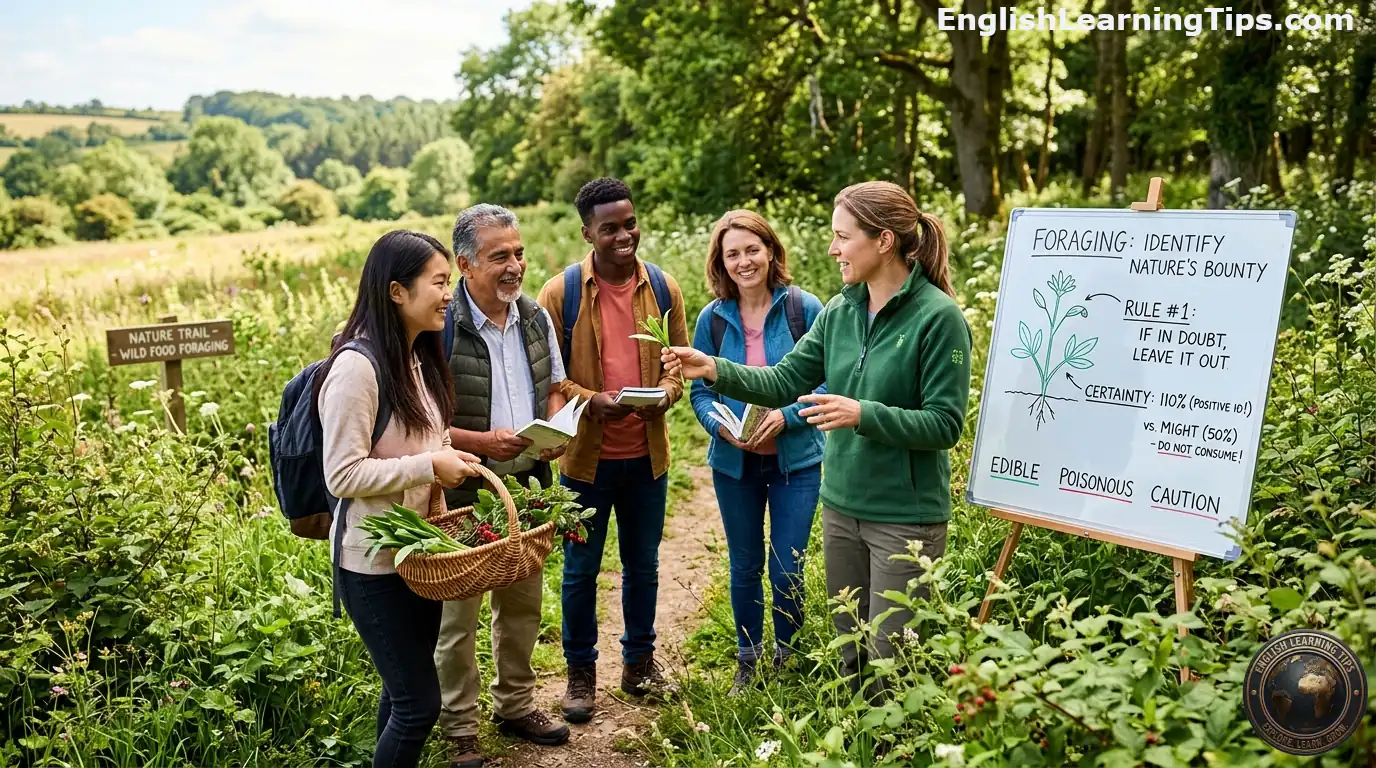
Foraging for wild food: A complete ESL lesson plan

Foraging for wild food has seen a massive resurgence in recent years. This practice involves searching the natural landscape for edible plants, mushrooms, and fruits that grow without human cultivation. While it is a rewarding way to connect with nature and find fresh ingredients like wild garlic or chestnuts, it requires high levels of precision. Our lesson focuses on the skills needed to identify nature’s bounty while staying safe, emphasizing the golden rule of foraging: if in doubt, leave it out.
Lesson plan: Harvesting nature: A guide to foraging wild food.
Level: Intermediate (B1-B2).
Time: 60 minutes.
Topic: Foraging and identifying wild edible plants.
Objectives: To expand vocabulary related to nature and botany, practice expressing degrees of certainty, and develop caution-based conversational skills.
Background
The history of foraging is as old as humanity itself. Before the advent of agriculture, every human was a forager, relying on a deep knowledge of the seasons and local flora to survive. In modern times, foraging has shifted from a necessity to a fashionable hobby and a sustainable way to source organic, nutrient-dense food. From picking blackberries in the British countryside to hunting for matsutake mushrooms in Japan, it bridges the gap between urban life and the natural world.
However, the stakes are high. The environment is filled with “look-alikes”—poisonous species that closely resemble edible ones. Foragers must act as amateur horticulturalists, carefully scanning their surroundings to ensure positive identification. Because of the risks associated with toxic plants and fungi, such as the deadly Death Cap mushroom, exercising caution is the most critical skill any forager can possess.
Basic vocabulary
Introducing essential words related to foraging and botany helps students describe the natural world and the processes involved in gathering food.
Vocabulary list
- Forage (Verb)
- Conjugations/Forms: Forager (n), Foraging (n/gerund)
- Definition: To search widely for food or provisions.
- Example: We spent the afternoon foraging for wild garlic by the river.
- Horticulturalist (Noun)
- Conjugations/Forms: Horticulture (n), Horticultural (adj)
- Definition: A person who studies or grows garden plants.
- Example: The horticulturalist explained which soil is best for berries.
- Identify (Verb)
- Conjugations/Forms: Identification (n), Identifiable (adj)
- Definition: To recognize or establish what something is.
- Example: You must identify the mushroom before you pick it.
- Edible (Adjective)
- Conjugations/Forms: Edibility (n)
- Definition: Fit or safe to be eaten.
- Example: Not all red berries in the forest are edible.
- Poisonous (Adjective)
- Conjugations/Forms: Poison (n/v), Poisonously (adv)
- Definition: Capable of causing illness or death if taken into the body.
- Example: The Death Cap is one of the most poisonous fungi in the world.
- Certainty (Noun)
- Conjugations/Forms: Certain (adj), Certainly (adv)
- Definition: The state of being completely confident about something.
- Example: She spoke with certainty about the safety of the herbs.
- Variety (Noun)
- Conjugations/Forms: Vary (v), Various (adj)
- Definition: A different form or type of something.
- Example: Japan has a huge variety of wild mushrooms.
- Stigma (Noun)
- Conjugations/Forms: Stigmatize (v)
- Definition: A mark of disgrace or a negative unfair belief.
- Example: There is a stigma that all wild mushrooms are dangerous.
- Caution (Noun)
- Conjugations/Forms: Cautious (adj), Cautiously (adv)
- Definition: Care taken to avoid danger or mistakes.
- Example: Always exercise caution when exploring unfamiliar terrain.
- Consume (Verb)
- Conjugations/Forms: Consumption (n), Consumer (n)
- Definition: To eat, drink, or ingest.
- Example: Do not consume any plant unless you are 110% sure it is safe.
Vocabulary for extension
- Deep knowledge (Noun phrase): A thorough understanding gained through experience.
- Scanning (Verb/Gerund): Searching a wide area with your eyes to find something specific.
- Rural (Adjective): Relating to the countryside rather than the town.
- Maligned (Adjective): Spoken about in a critical or unfair manner.
- Landscape (Noun): All the visible features of an area of countryside or land.
- Fungi (Noun – plural): A group of living organisms including mushrooms and molds.
- Self-taught (Adjective): Having acquired knowledge or skills on one’s own.
- Misplaced (Adjective): Not appropriate or correct in a particular situation.
- Botanical (Adjective): Relating to plants or the study of plants.
- Wild (Adjective): Growing or produced without human aid or care.
Teaching tips
- Visual matching: Show photos of edible plants alongside their poisonous look-alikes to emphasize the word “identify.”
- Word families: Create a “tree” on the board showing how “caution” (noun) grows into “cautious” (adj) and “cautiously” (adv).
Grammar spotlight: Foraging for wild food
In the context of foraging, we often use conditionals and idioms of certainty. Use the “First Conditional” to discuss real possibilities and warnings (e.g., If you eat that, you will get sick). Additionally, the phrase a hundred and ten percent is a common hyperbole used to express absolute certainty. When teaching “exercise caution,” explain that “exercise” functions as a formal verb meaning “to use” or “to apply,” rather than physical movement.
The first conditional for warnings and results
The first conditional is essential for discussing real-life consequences in nature. It connects a specific action (the condition) with a likely result.
Structure:
If + present simple,… will + infinitive
- Positive warning: “If you identify the plant correctly, you will have a delicious meal.”
- Negative warning: “If you eat that berry, you will get very sick.”
- Safety rule: “If you are not 110% sure, you will leave it on the ground.”
Teaching tip: Remind students that the if-clause represents the “condition” and the will-clause represents the “certain result.”
Expressing degrees of certainty
Foragers must differentiate between “guessing” and “knowing.” We use different modal verbs and phrases to show how sure we are.
| Degree of certainty | Grammar/Phrase to use | Example sentence |
| 100% – 110% | Must be / Know | “That must be wild garlic; I can smell it.” |
| 50% – 70% | Might / Could | “This might be a chanterelle, but I’m not sure.” |
| 0% (Uncertain) | In doubt | “I am in doubt, so I will not pick it.” |
Collocations with “exercise” and “caution”
In formal English and safety instructions, we often use the verb exercise to mean “to apply” or “to use” a quality.
- The common mistake: Students often say, “You must be caution” or “You must exercise cautious.”
- The correction: Caution is a noun. Cautious is an adjective.
Correct usage:
- “You must exercise caution (noun) when scanning the landscape.”
- “You must be cautious (adjective) when picking fungi.”
Hyperbole and the “110 percent” rule
In everyday English, we use hyperbole (exaggeration) to emphasize a point. Even though 100% is technically the maximum, foragers say “110%” to mean there is absolutely zero risk.
- Example: “Don’t consume it unless you are a hundred and ten percent sure.”
- Function: This functions as an intensive idiom to prevent students from taking “lucky guesses.”
Useful phrases
Key phrases
- If in doubt, leave it out: The most important rule for safety.
- Positive identification: Knowing exactly what a species is.
- A hundred and ten percent: Being completely sure without any doubt.
- Exercise caution: To be very careful.
- Deep knowledge: Having more than just basic facts.
Teaching tips
- Roleplay warnings: Have students practice giving advice using “If I were you, I would exercise caution because…”
- Drill the mantra: Have the class repeat “If in doubt, leave it out” to help them remember the rhyme and the logic.
Example conversations
Conversation 1: Basic description
Student A: Have you ever tried foraging for your own food?
Student B: Only once. I went looking for blackberries in the local park.
Student A: Was it easy to find them?
Student B: Yes, they are easy to identify, so I felt safe eating them.
Conversation 2: Adding details
Student A: I want to start looking for wild mushrooms this weekend.
Student B: You really need to exercise caution with fungi.
Student A: I know. I’ve been scanning the landscape for a good guide book first.
Student B: Good idea, because some poisonous ones look just like the edible ones.
Conversation 3: More advanced
Student A: My grandmother was a bit of a horticulturist and had a deep knowledge of herbs.
Student B: That’s amazing. Did she ever teach you how to pick wild garlic?
Student A: She did, but she always said you must be a hundred and ten percent sure.
Student B: It’s a shame there is such a stigma around wild food; it’s so fresh.
Teaching tips
- Emotion in dialogue: Ask students to read Conversation 2 with a “worried” tone to emphasize the danger of mushrooms.
- Substitution: Encourage students to replace “blackberries” with other local fruits from their own country.
Teaching strategy
Use the Task-Based Learning (TBL) approach. Give students a “field guide” (a sheet with photos and descriptions) and ask them to “forage” around the classroom where you have hidden pictures of plants. They must decide which ones to “keep” and which to “leave out” based on the descriptions, practicing their vocabulary in a simulated high-stakes environment.
Here’s a 45-minute lesson plan
Step 1: Warm-up (5 minutes)
Ask the students if they have ever picked fruit from a tree or a bush. Discuss what they found and if they were worried about it being safe.
Step 2: Vocabulary introduction (10 minutes)
Introduce the “Vocabulary list” using the chart provided. Check for pronunciation, especially for “horticulturalist” and “caution.”
Step 3: Phrase practice (10 minutes)
Introduce the “Key phrases.” Ask students to create their own “rules for safety” using the phrase “If in doubt…”
Step 4: Conversation practice (15 minutes)
Students work in pairs to practice the three example conversations. Then, they must create a fourth conversation where one person is “110% sure” and the other is “exercising caution.”
Step 5: Wrap-up and personalization (5 minutes)
Ask students: “If you could only forage one type of food for the rest of your life, what would it be and why?”
Discussion questions
- Why do you think foraging has become fashionable among young people?
- Answer: Many people want to be more sustainable and connect with nature away from technology.
- What are the risks of being self-taught in foraging?
- Answer: Without a teacher or deep knowledge, you might misidentify a plant and eat something poisonous.
- How does a “stigma” affect the way we see certain foods?
- Answer: It makes us afraid of things like mushrooms, even if many of them are delicious and safe.
- Is it better to forage in rural areas or urban parks?
- Answer: Rural areas often have more variety, but you must ensure the land isn’t private or polluted.
- What does it mean to be “a hundred and ten percent” sure?
- Answer: It means you have absolutely no doubt at all; you are completely certain.
Additional tips
- Cultural sensitivity: Some cultures have long traditions of foraging (like mushroom hunting in Eastern Europe or Japan). Acknowledge these traditions.
- Visual aids: Use high-quality photos of the Death Cap mushroom versus a button mushroom to show how similar they look.
- Adapt for level: For lower levels, focus on “safe” vs “dangerous.” For higher levels, focus on the nuances of “maligned” and “stigma.”
- Technology: Suggest apps like iNaturalist or PictureThis that help with plant identification, but remind students of the 110% rule.
Common mistakes to address
- Grammar: Using “cautious” (adjective) when “caution” (noun) is needed. (e.g., Saying “You must exercise cautious” instead of “exercise caution.”)
- Word choice: Confusing “edible” with “eatable.” While similar, “edible” is the standard term for things safe for human consumption.
Example activity
The identification challenge: Display five photos of wild plants. Provide five short descriptions. Students must match the description to the plant and label them as “Edible,” “Poisonous,” or “In Doubt.”
Homework or follow-up
- Writing: Write a 150-word paragraph about a plant that is common in your country. Is it edible?
- Speaking: Record a short voice note explaining the rule “If in doubt, leave it out” to a friend who wants to go foraging.
- Research: Find out what a “horticulturalist” does on a daily basis and prepare to share three facts next class.
FAQs
Is foraging legal everywhere?
No, laws vary by country and region. In some places, you can pick for personal use, but in others, it is restricted to protect the environment.
How can I be 110% sure a plant is safe?
You should use multiple sources: a field guide, an identification app, and ideally, advice from an expert horticulturalist.
Are all red berries poisonous?
Not all, but many are. This is why positive identification is necessary before you consume anything.
Why are mushrooms considered more dangerous than plants?
Mushrooms often have very similar-looking toxic counterparts, and the toxins in fungi can be more concentrated and fast-acting.
Conclusion: Join the foraging conversation
Foraging is a beautiful way to explore the outdoors and discover the hidden flavors of the landscape. Whether you are a beginner picking blackberries or an aspiring horticulturalist searching for rare fungi, remember that positive identification is your best friend. Always exercise caution and stay safe!
What is the most unusual thing you have ever found in the wild? Have you ever tried foraging in your local area? Leave a comment below to share your experiences and share this article with your fellow nature lovers to spread the word about foraging safety!
Discover more from English Learning Tips
Subscribe to get the latest posts sent to your email.


