

Cause and effect in English grammar: A complete guide

Why did that happen? What was the result? In English, these aren’t just questions—they are a specific grammatical relationship called cause and effect. This logical relationship is a cornerstone of everyday conversation, academic writing, and professional communication. Mastering these structures makes your English clearer, more persuasive, and more professional.
What is cause and effect in English?
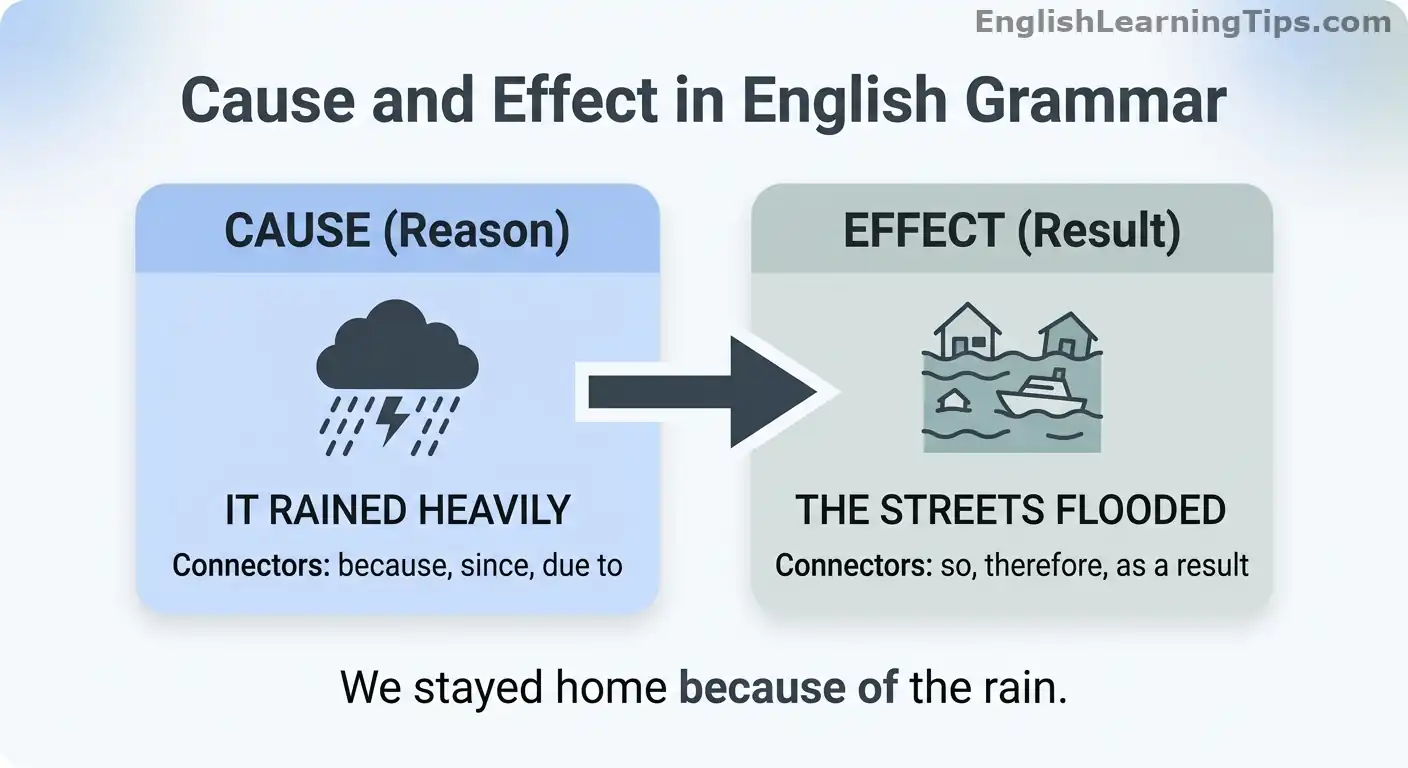
In grammar, a cause is the reason or action that triggers an event. An effect is the result or outcome of that specific cause.
- Cause: It rained heavily.
- Effect: The streets flooded.
You can express this relationship in any order. English offers a variety of tools to link these ideas, ranging from simple conjunctions to formal transitions.
Key words and phrases to introduce a cause
When you want to focus on the reason something happened, use these connectors.
- Because, since, and as: These are followed by a full clause (subject + verb).
- Because of, due to, and owing to: These are prepositions followed by a noun or noun phrase.
Examples of cause in sentences:
- I stayed home because I felt sick.
- Since the flight was delayed, we missed our connection.
- The event was canceled due to bad weather.
- Because of the heavy traffic, we arrived late.
Pro-tip: If you are unsure whether to use a comma before “because,” just remember: only use one if the “because” clause comes at the start of the sentence. If it’s at the end, keep the comma out!
Key words and phrases to show an effect
To highlight the result or outcome, use these transition words.
- So: Highly common in spoken English.
- Therefore, consequently, and as a result: Ideal for professional or academic writing.
- Thus and hence: These are the most formal options.
Examples of effect in sentences:
- It was late, so we went straight to bed.
- She studied every day; therefore, she passed the exam.
- The company cut costs. As a result, profits increased.
How to structure cause and effect sentences
The way you punctuate a sentence depends on whether you start with the cause or the effect.
- Using conjunctions (because, since, as): If the “because” clause comes first, use a comma. If it comes second, no comma is needed.
- Because we left late, we missed the train.
- We missed the train because we left late.
- Using transitions (therefore, as a result): These usually start a new sentence or follow a semicolon.
- The roads were icy. Therefore, we drove slowly.
Cause and effect conjunctions: Comparison table
| Type | Words and phrases | Followed by | Best use case |
| Cause | because, since, as | Full clause | General conversation |
| Cause | because of, due to | Noun phrase | Writing and speaking |
| Effect | so | Full clause | Casual speech |
| Effect | therefore, as a result | Full clause | Formal reports |
| Effect | thus, hence | Clause or phrase | Academic essays and scientific or formal reports |
Common mistakes: Affect vs. effect and more
To write well, you must avoid these frequent errors:
- Confusing “affect” and “effect”: Affect is usually a verb (to influence). Effect is usually a noun (the result).
- Incorrect: The weather effected my mood.
- Correct: The weather affected my mood.
- Misusing “because”: Never use “because” directly before a noun.
- Incorrect: We stayed home because the rain.
- Correct: We stayed home because of the rain.
- Punctuation with “so”: Always place a comma before “so” when it connects two independent thoughts.
Tips to improve your grammar
- Vary your vocabulary: Instead of using “because” every time, try “since” or “due to.”
- Read news articles: Journalists frequently use cause-effect structures to explain global events.
- Practice rewriting: Take a simple sentence like “I was hungry, so I ate” and turn it into “Since I was hungry, I ate.”
Frequently asked questions: Cause and effect grammar
Master cause and effect for better English
Mastering cause and effect in English grammar is more than just a writing exercise; it is about making your ideas more logical and your arguments more persuasive. By using the right transition words and avoiding common pitfalls like the affect vs. effect trap, you can significantly improve your fluency in both academic and professional settings.
Remember to vary your sentence structures. Instead of relying solely on “because,” experiment with formal transitions like consequently or due to to give your writing more depth and professional polish.
Join the conversation: What is your biggest grammar struggle?
We want to hear from you! Which cause and effect rule do you find the most challenging to remember? Is it the punctuation for therefore, or perhaps knowing when to use since versus because?
Leave a comment below with your thoughts or a practice sentence, and we will jump in to help! If you found this guide helpful for your studies or work, share this article with a friend or colleague who is also working on their English skills. Your support helps us create more free resources like this one.
Discover more from English Learning Tips
Subscribe to get the latest posts sent to your email.


