

What are participles: A guide to past and present forms (participle phrases)

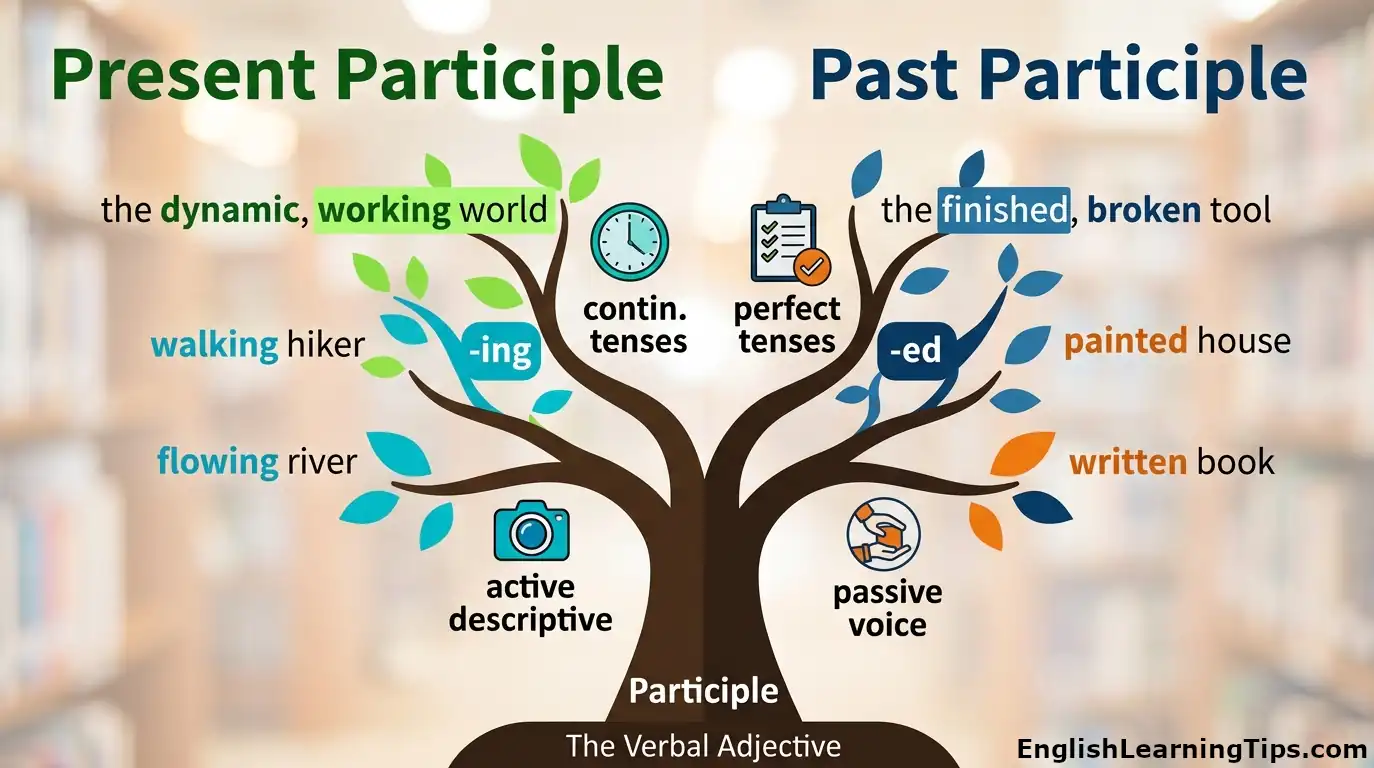
In English grammar, a participle is a word formed from a verb that can function as an adjective or help create complex verb tenses. They are often called “verbal adjectives” because they describe nouns while giving your prose variety and precision.
To master English, you must understand the two primary types: the present participle and the past participle.
Understanding the present participle
The present participle always ends in -ing. While it looks identical to a gerund, its function is different. It is used to form continuous tenses or to describe a noun that is performing an action.
- Continuous tense: She is walking to the store.
- As an adjective: The crying baby finally fell asleep.
What is a past participle?
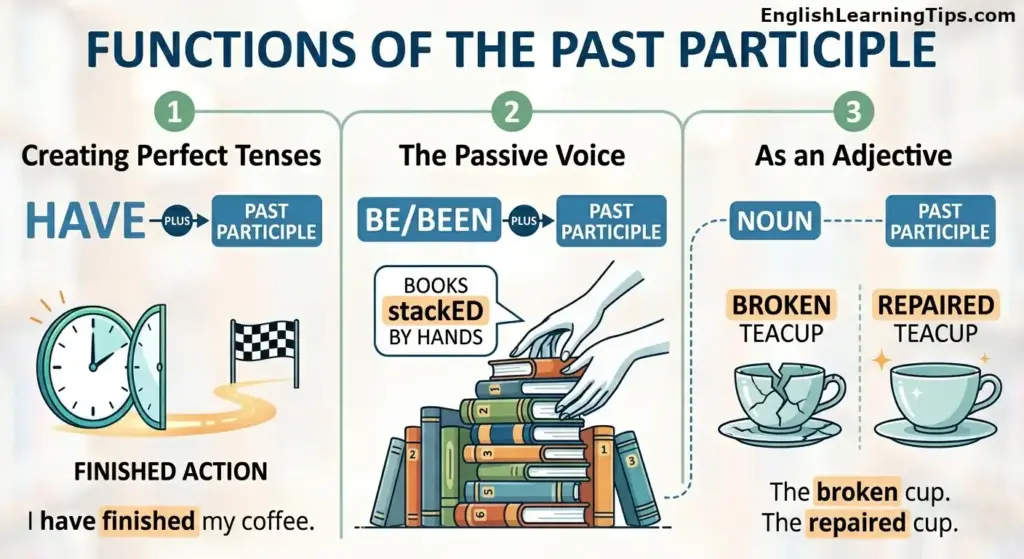
The past participle is slightly more complex because its form depends on whether the verb is regular or irregular. For regular verbs, it ends in -ed. For irregular verbs, the form can change entirely (e.g., seen, broken, gone).
Its primary roles include:
- Creating perfect tenses: Using “have” or “had” (e.g., I have finished).
- The passive voice: Focusing on the recipient of the action (e.g., The letter was written).
- As an adjective: Describing a state resulting from an action. (e.g., The broken window).
Key differences: Comparing participle types
| Feature | Present participle | Past participle |
| Ending | Always ends in -ing | -ed (regular) or varied (irregular) |
| Active/Passive | Active (the thing doing the action) | Passive (the thing receiving action) |
| Verb tense | Used in continuous tenses | Used in perfect tenses |
| Example | The boring movie (The movie bores us) | The bored student (The student feels bored) |
How to use participles in a sentence
Using these correctly improves your writing flow and allows you to combine ideas using participle phrases.
Participle phrase examples and usage
A participle phrase consists of a participle plus any modifiers or complements. These phrases function as multi-word adjectives to add detail and sophistication to your sentences.
- Example: Covered in snow, the mountain looked majestic.
- Writing tip: Avoid “dangling participles.” Ensure the noun being described is clearly placed next to the phrase.
- Present participle phrase: Running late for the meeting, Sarah forgot her briefcase.
- Past participle phrase: Exhausted by the long journey, the travelers finally reached the inn.
Placement rule: To keep your writing clear, always place the phrase as close as possible to the noun it modifies. If the phrase is at the beginning of the sentence, it must describe the subject that follows the comma.
Common mistakes: Avoiding the “ed” vs “ing” trap
Many English learners confuse participles when describing feelings.
- Incorrect: I am very interesting in history.
- Correct: I am very interested in history.
Rule of thumb: Use -ing for the cause of the feeling (the book is interesting) and -ed for the person experiencing the feeling (I am interested).
Common questions: Understanding participles in English
Conclusion: Mastering participles in your writing
Understanding past and present participles is one of the most effective ways to move from basic English to a more professional, fluid style of writing. Whether you are using a participle phrase to add detail to a sentence or correctly choosing between -ed and -ing adjectives, these “verbal adjectives” give your prose variety and precision.
While irregular verbs like run, sung, and seen can be tricky at first, consistent practice will make these structures second nature. By focusing on the relationship between the action and the noun, you can avoid common pitfalls like dangling participles and keep your grammar polished.
Share your thoughts: Which participle trips you up?
Grammar can be a bit of a maze, and we all have those specific irregular verbs that make us double-check the dictionary. Is there a particular past participle that always feels “off” when you write it? Or perhaps you have a trick for remembering the difference between a gerund and a present participle?
Drop a comment below and let’s discuss! If you found this guide helpful, please share it with a fellow student or writer who wants to sharpen their English grammar skills.
Discover more from English Learning Tips
Subscribe to get the latest posts sent to your email.


