

Noun phrases: What they are and how to use premodifiers and postmodifiers for better writing

A noun phrase (NP) is a word or a group of two or more words headed by a noun or pronoun that functions as a single grammatical unit. In a sentence, a noun phrase acts exactly like a noun—it can be the subject that performs an action, the object that receives it, or the complement that provides more information.
While a single word like “water” is a noun, “the cold sparkling water” is a noun phrase. The ‘head’ is the anchor of the phrase. Every other word exists solely to describe, limit, or specify that central noun.
Recommended resource: If you want to practice building noun phrases, The English Grammar Workbook for Adults is our top pick for clear, hands-on exercises.
The structural components of a noun phrase: Premodifiers and postmodifiers
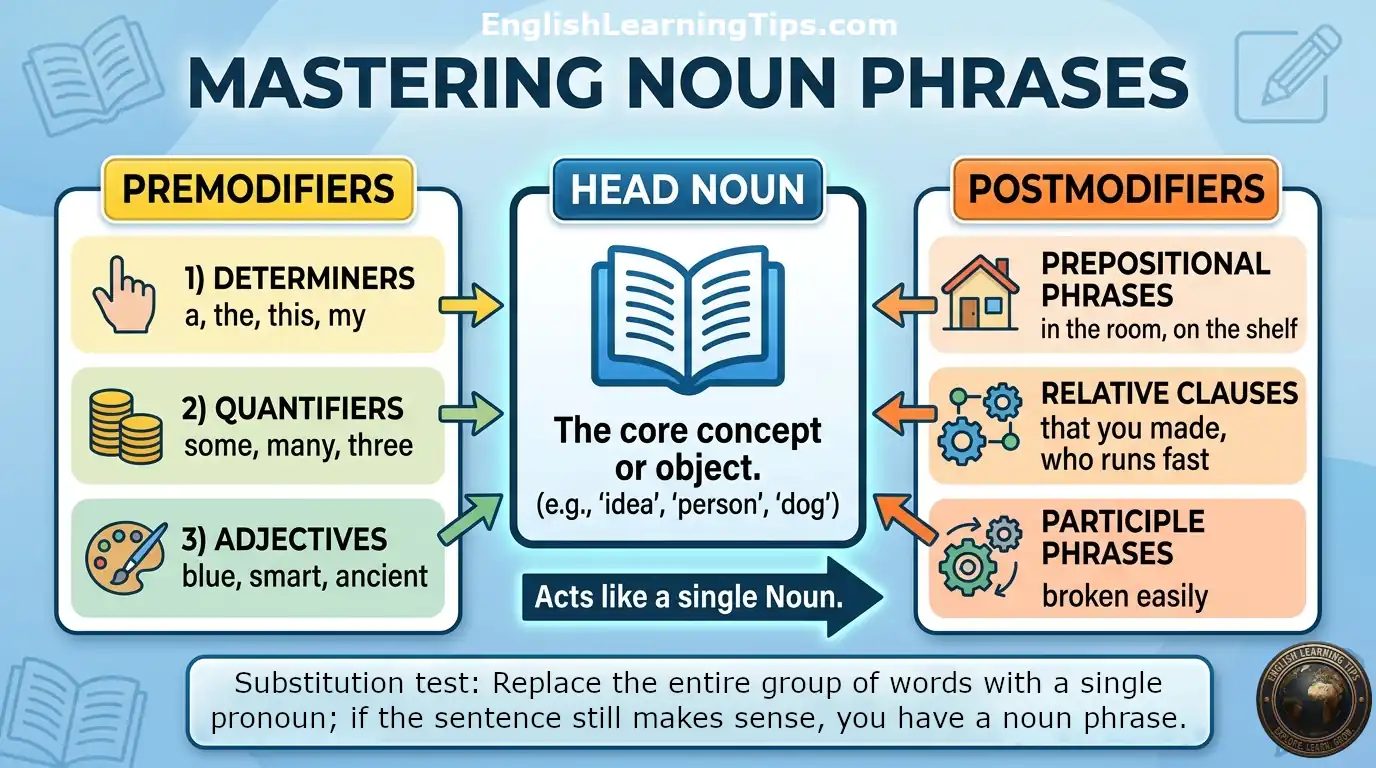
To build a noun phrase, you start with a head noun and add modifiers. These modifiers appear either before the noun (premodifiers) or after it (postmodifiers).
1. Premodifiers
These words come before the head noun to provide context or quantity:
- Determiners: Articles (a, an, the), possessives (my, his, Sarah’s), and demonstratives (this, those).
- Quantifiers: Words indicating amount (some, many, three, all).
- Adjectives: Descriptive words (blue, expensive, ancient).
2. Postmodifiers
These follow the head noun to add specific detail or restricted meaning:
- Prepositional phrases: Words starting with a preposition (in the room, with the red hat).
- Relative clauses: Phrases starting with who, which, or that (who lives next door).
- Participle phrases: Phrases beginning with “-ing” or “-ed” words (sitting on the bench, broken by the wind).
| Component | Example phrase | Head noun |
| Simple NP | The phone | phone |
| Premodified NP | Those three heavy boxes | boxes |
| Postmodified NP | The man in the suit | man |
| Complex NP | A rare stamp from the 1800s | stamp |
How to identify a noun phrase in a sentence
If you aren’t sure if a group of words is a noun phrase, use the substitution test. You can replace an entire noun phrase with a single pronoun—such as it, he, she, or they—without changing the basic meaning of the sentence.
- Original: [The small dog with the fluffy tail] barked at me.
- Test: [He] barked at me.
Because “He” can replace the entire bracketed section, you know that “The small dog with the fluffy tail” is a single noun phrase.
Tip: Watch out for appositives—noun phrases that rename another noun right next to them (e.g., ‘My friend, a talented baker, made this’).
5 Functions of noun phrases in English grammar
Noun phrases are versatile. Depending on where they sit in a sentence, they fulfill different roles:
- Subject: The person or thing performing the action.
- Example: The local bakery opens at dawn.
- Direct object: The entity receiving the action.
- Example: I finally bought that vintage record player.
- Indirect object: The person or thing for whom the action is done.
- Example: She gave her younger brother some advice.
- Subject complement: Follows a linking verb to describe the subject.
- Example: That man is a world-renowned architect.
- Object of a preposition: Follows a preposition to provide location or timing.
- Example: We walked through the dense pine forest.
Noun phrase vs. noun clause: Key differences
It is easy to confuse these two, but they have distinct structures. A noun phrase does not contain a subject and a finite verb. A noun clause, however, functions like a noun but contains its own subject and verb.
- Noun phrase: I like [the blue dress]. (No verb inside the brackets).
- Noun clause: I like [what you are wearing]. (“You” is the subject and “are wearing” is the verb).
Tips for using noun phrases in professional writing
- Avoid “noun strings”: Using too many nouns in a row (e.g., “production department quality control manual”) can confuse readers. Use prepositions to break them up.
- Vary your length: Use simple noun phrases for impact and complex ones for technical precision.
- Check for agreement: Ensure your determiners (like this or those) match the number of your head noun.
Frequently asked questions: Noun phrases in English
Mastering noun phrases: Final thoughts
Noun phrases are the tools that allow you to move beyond simple, choppy sentences toward writing with depth and precision. Whether you are prepping for a grammar exam or optimizing your website for search engines, a strong grasp of these structures is essential for clear communication.
Join the conversation
Which part of English grammar do you find most challenging? Did the substitution test help you identify a tricky noun phrase today?
Drop a comment below with your own example of a complex noun phrase, or share this guide with a fellow student or writer who wants to sharpen their skills. Your feedback helps us create better resources for the community!
Discover more from English Learning Tips
Subscribe to get the latest posts sent to your email.


