

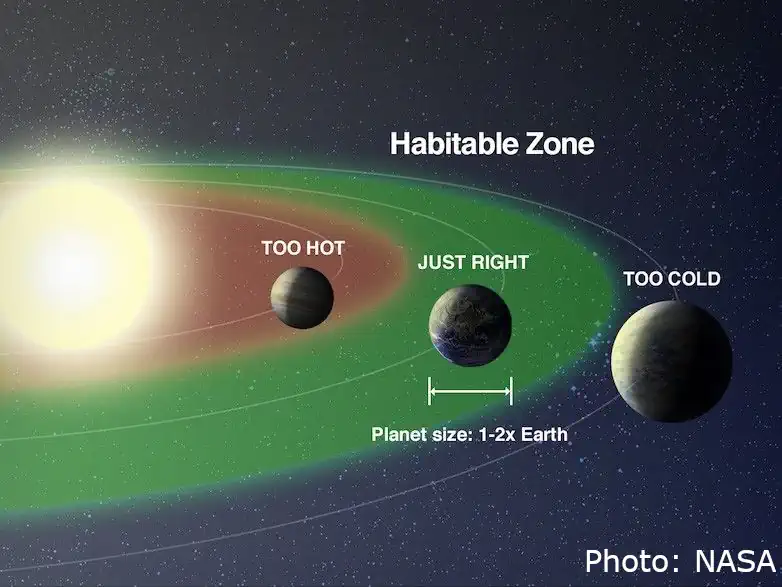
ESL lesson plan: Explores the habitable zone and life beyond planet Earth

Are you ready to explore the universe with your students? In this ESL lesson, students will practice advanced listening and reading comprehension while discussing space exploration, exoplanets, and the search for alien life. By using real-world audio concepts, learners will build confidence speaking about scientific discoveries and expressing hope using natural English expressions.
Lesson plan: Exploring the habitable zone: The search for life beyond planet Earth
Level: Intermediate to Upper-Intermediate (B1-B2)
Time: 45 minutes
Topic: Space exploration, exoplanets, and atmospheric conditions for life
Objectives: Students will learn to use science-related vocabulary, understand how to express possibility or elimination using phrasal verbs, and practice discussing hypothetical conditions for life in the universe.
Video: Searching for life on another planet
Background
The quest to discover life beyond planet Earth has captivated scientists and the public for generations. While science fiction movies often depict alien life as little green men, real-world astronomers focus on finding exoplanets—planets orbiting stars outside our own solar system—that possess the right environmental conditions to support living organisms.
Recently, scientists have turned their attention to a rocky planet called TRAPPIST-1e. Located approximately 40 light years away, this planet orbits within its star’s habitable zone, where temperatures might allow liquid water to exist. By analyzing the potential atmosphere of these distant worlds, researchers can rule out hostile greenhouse gases and search for life-sustaining elements like nitrogen, bringing humanity one step closer to answering whether we are truly alone in the universe.
Basic vocabulary
Vocabulary list
- Habitable (adjective)
- Other forms: Habitat (noun), habitability (noun), habitably (adverb)
- Definition: Suitable or fit for a person, animal, or plant to live in.
- Example sentence: Scientists are searching for habitable planets that could support liquid water.
- Zone (noun)
- Other forms: Zone (verb), zonal (adjective), zoned (adjective)
- Definition: An area or region distinguished from adjacent parts by a distinctive feature or characteristic.
- Example sentence: The planet sits perfectly within the habitable zone of its host star.
- Potential (adjective)
- Other forms: Potential (noun), potentiality (noun), potentially (adverb)
- Definition: Having or showing the capacity to develop into something in the future.
- Example sentence: The data suggests the atmosphere has potential signs of chemical activity.
- Rule out (phrasal verb)
- Other forms: Rules out (third-person singular), ruled out (past tense), ruling out (present participle)
- Definition: To exclude, dismiss, or eliminate the possibility of something.
- Example sentence: Astronomers have ruled out the presence of thick toxic gases on the new planet.
- Dominated (adjective/verb past participle)
- Other forms: Dominate (verb), dominance (noun), dominant (adjective)
- Definition: Controlled, commanded, or heavily influenced by a specific element or feature.
- Example sentence: Earth’s atmosphere is dominated by nitrogen and oxygen.
- Fingers crossed (idiomatic expression)
- Other forms: Cross one’s fingers (verb phrase)
- Definition: An expression used to hope for good luck or a positive outcome.
- Example sentence: Fingers crossed the weather clears up so we can use the telescope tonight.
- Exoplanet (noun)
- Other forms: Exoplanetary (adjective)
- Definition: A planet that orbits a star outside our solar system.
- Example sentence: Discovery of a new rocky exoplanet always excites the scientific community.
- Atmosphere (noun)
- Other forms: Atmospheric (adjective), atmospherically (adverb)
- Definition: The envelope of gases surrounding a planet or other celestial body.
- Example sentence: A planet’s atmosphere plays a massive role in regulating its surface temperature.
- Greenhouse gas (noun)
- Other forms: Greenhouse gases (plural noun)
- Definition: A gas that contributes to the greenhouse effect by absorbing infrared radiation.
- Example sentence: Carbon dioxide is a greenhouse gas that can make a planet incredibly hot.
- Decent (adjective)
- Other forms: Decency (noun), decently (adverb)
- Definition: Of an acceptable, satisfactory, or appropriate quality or standard.
- Example sentence: The climate needs to maintain a decent temperature for liquid surface water to stay stable.
Vocabulary for extension
- Universe (noun)
- Other forms: Universal (adjective), universally (adverb)
- Definition: All existing matter and space considered as a whole; the cosmos.
- Science fiction (noun)
- Other forms: Sci-fi (abbreviation), science-fictional (adjective)
- Definition: Fiction based on imagined future scientific or technological advances and major social or environmental changes.
- Transcript (noun)
- Other forms: Transcribe (verb), transcription (noun)
- Definition: A written, printed, or typed copy of words that have been spoken.
- Solar system (noun)
- Other forms: Solar systems (plural noun)
- Definition: The collection of eight planets and their moons in orbit around the sun, or a similar system around another star.
- Rocky (adjective)
- Other forms: Rock (noun), rockiness (noun)
- Definition: Consisting of or full of rock or rocks; solid and stone-like rather than gaseous.
- Hydrogen (noun)
- Other forms: Hydrogenous (adjective)
- Definition: A colorless, odorless, highly flammable gas, the chemical element of atomic number 1.
- Carbon dioxide (noun)
- Other forms: CO2 (chemical formula)
- Definition: A colorless gas produced by burning carbon and organic compounds and by respiration.
- Nitrogen (noun)
- Other forms: Nitrous (adjective), nitrogenous (adjective)
- Definition: A colorless, odorless unreactive gas that forms about 78 percent of the earth’s atmosphere.
- Model (noun)
- Other forms: Model (verb), modeling (noun)
- Definition: A simplified description, especially a mathematical or scientific one, of a system or process, to assist calculations and predictions.
- Support (verb)
- Other forms: Support (noun), supportive (adjective), supporter (noun)
- Definition: To provide everything necessary for a person or thing to live, exist, or remain healthy.
Teaching tips
- Use visual aids to help students conceptualize words like atmosphere and habitable zone. Draw a star on the board with a green shaded area to represent the safe region where life can exist.
- Have students practice the physical gesture for fingers crossed while practicing the idiom, as linking body language to idioms improves memory retention.
- Pro-tip: Encourage students to identify the roots of words (e.g., habit in habitable and habitat) to build structural vocabulary awareness.
Grammar spotlight: Present perfect continuous and passive structures in scientific English
This lesson highlights the use of the present perfect continuous tense to describe ongoing research and discoveries (subject+have/has+been+verb-ing). For instance: “Scientists have been looking at an exoplanet.” This structure shows an action started in the past and is still happening now.
Another important structure is the passive voice combined with an agent or element: “subject+is/are+dominated+by+agent”. For example: “The atmosphere is dominated by nitrogen.” Use this to emphasize the element that has the most control or presence in a situation rather than the action itself.
Present perfect continuous for ongoing research
The present perfect continuous tense is used to describe an action that began in the past and is still continuing in the present. In scientific contexts, this structure frequently highlights ongoing investigations, observations, or data analysis where the process itself is highly significant.
- Structure: Subject + have/has + been + verb\text{-}ing
- Example from the lesson: “Scientists have been looking at an exoplanet.”
- Usage note: Use this tense to emphasize the duration or continuous nature of the research. It shows that the work is not yet finished and that astronomers are actively gathered data up to the present moment.
Passive voice with an agent for atmospheric composition
When discussing science, the focus is often on the element or characteristic being observed rather than the person doing the observing. The passive voice allows students to describe the state or composition of a planet objectively. Combining the past participle dominated with the preposition by helps specify the primary component of an environment.
- Structure: Subject + is/are + dominated + by + agent/element
- Example from the lesson: “The atmosphere of TRAPPIST-1e is dominated by nitrogen.”
- Usage note: This structure emphasizes the dominant element (nitrogen) as the most significant feature of the subject (the atmosphere). It is an essential pattern for students when describing chemistry, geography, or climate profiles.
Interactive grammar practice
To help students internalize these rules, try these quick exercises during the lesson:
- Continuous transformation: Have students change simple past statements into the present perfect continuous. For instance, change “They studied the star” to “They have been studying the star.”
- Active to passive switch: Ask students to rewrite active sentences into the passive structure. For example, change “Carbon dioxide dominates the planet” to “The planet is dominated by carbon dioxide.”
Useful phrases
Key phrases
- Away from planet Earth: Used to talk about things happening or existing in deep space.
- Rule out the possibility: To officially decide that something is not likely or impossible.
- One step closer: Making progress toward a major breakthrough or final goal.
- Fingers crossed for…: Wishing for good fortune regarding a specific future event.
Teaching tips
- Have students create their own sentences replacing “planet Earth” with their hometown to practice the phrase structure (e.g., “Away from London…”).
- Create a matching game where students must pair “rule out” with its synonyms like “eliminate” or “dismiss” to solidify context.
Example conversations
Conversation 1: Basic description
Student A: Did you read about that rocky planet called TRAPPIST-1e? Student B: Yes, it is an exoplanet in a different solar system. Student A: It is a similar size to Earth and sits in the habitable zone. Student B: That means something could actually live there!
Conversation 2: Adding details
Student A: Scientists have been looking closely at its atmosphere. Student B: Have they discovered any thick greenhouse gases? Student A: No, they ruled out that it is full of carbon dioxide. Student B: That is amazing news because it won’t be too hot.
Conversation 3: More advanced
Student A: They think the atmosphere might be dominated by nitrogen. Student B: Fingers crossed it keeps the planet at a decent temperature. Student A: If the models work out, we are one step closer to finding life. Student B: I cannot wait to see what future space research uncovers.
Teaching tips
- Divide the class into pairs and have them read the dialogues aloud, switching roles to practice rhythm and intonation.
- Ask students to change the final line of each conversation to add their own unique predictions or reactions.
Teaching strategy
Implement a task-based learning approach by asking students to become “scientific journalists.” Instead of just repeating sentences, students must gather data from the text to report back to a partner. This boosts authentic engagement and ensures students are actively manipulating the vocabulary rather than passively reading it.
Here’s a 45-minute lesson plan
Step 1: Warm-up (5 minutes)
Ask the class if they believe life exists away from planet Earth. Write their answers on the board and introduce the concept of alien movies versus actual scientific data.
Step 2: Vocabulary introduction (10 minutes)
Present the 10 core vocabulary words. Focus on the word habitable and practice changing it to habitat and habitability so students understand word families.
Step 3: Phrase practice (10 minutes)
Introduce the key phrases and the phrasal verb rule out. Have students practice ruling out bad options from a list of hypothetical survival items on Mars.
Step 4: Conversation practice (15 minutes)
Group students into pairs to practice the three example conversations. Encourage them to focus on the pronunciation of scientific elements like hydrogen and nitrogen.
Step 5: Wrap-up and personalization (5 minutes)
Ask students to share if they would ever travel to an exoplanet if given the chance. Use the expression fingers crossed to end the session on a lighthearted note.
Discussion questions
- Question: Why do scientists care so much about finding liquid water on an exoplanet?
- Answer: Water is vital for all known forms of life, so finding it means a planet has a higher chance of being habitable.
- Question: What does it mean if an atmosphere is dominated by greenhouse gases?
- Answer: It means the gases trap a lot of heat, which would likely make the planet far too hot for life to survive.
- Question: How does science fiction alter our view of alien life?
- Answer: It makes us expect monsters or human-like aliens, whereas real discoveries might just be tiny bacteria or microscopic organisms.
- Question: Would you take a car ride to the sun if it only took 170 years?
- Answer: No, because it would take longer than a human lifetime, and the heat would be impossible to survive.
- Question: Why do researchers use computational models to study space?
- Answer: Since exoplanets are light years away, models help us predict temperatures and atmospheric conditions without actually traveling there.
Additional tips
- Cultural sensitivity: Keep in mind that students from different backgrounds may have varied philosophical, cultural, or religious beliefs regarding the existence of extraterrestrial life. Keep the discussion focused strictly on scientific discovery and language building.
- Visual aids: Show photos or artistic renderings of the TRAPPIST-1e system to spark curiosity. Comparing an image of a barren rock to a lush planet helps clarify the meaning of habitability.
- Adapt for level: For lower levels, focus mainly on basic adjectives like rocky, hot, and cold. For advanced groups, challenge them to use the grammatical structures for present perfect continuous in extended sentences.
- Technology: Use a digital solar system simulator or a short audio clip from space agencies to let students hear what space exploration sounds like in real-world contexts.
Common mistakes to address
- Grammar: Students often forget the particle in phrasal verbs, saying “They ruled the possibility” instead of “They ruled out the possibility.” Remind them that rule out must stay together to mean elimination.
- Word choice: Confusing potential as a noun and an adjective is common. Ensure they know that “potential atmosphere” refers to a future capability, while “has potential” refers to existing qualities.
Example activity
Run an activity called “Design an Exoplanet.” Students work in small groups to create a fictional planet. They must decide if it sits in a habitable zone, what gas dominates its atmosphere, and if they can rule out certain extreme temperatures. Each group presents their world to the class using at least four vocabulary words from the lesson.
Homework or follow-up
- Writing: Write a short paragraph describing what you think life would look like on a rocky planet dominated by nitrogen.
- Speaking: Record a two-minute voice note explaining the definition of a habitable zone and why it matters to space experts.
- Research: Search the web for a real exoplanet discovered recently and find out if it is considered rocky or gaseous.
FAQs
- What exactly is an exoplanet? An exoplanet is any planet that exists outside of our own solar system, orbiting a star other than our Sun.
- Why is nitrogen considered a sign of life? While nitrogen itself isn’t living matter, it is a primary component of Earth’s air and plays a critical role in stabilizing a planet’s climate to allow life to develop.
- How far is a light year? A light year is the distance that light travels in one single year, which is about 6 trillion miles (9.5 trillion kilometers).
- What makes a planet rocky? A rocky planet is composed mostly of silicate rocks or metals and has a solid surface, unlike gas giants like Jupiter or Saturn.
Conclusion and call to action
The universe is packed with mysteries, and every discovery of a new exoplanet brings humanity one step closer to understanding our place in the stars. Exploring the habitable zone through language study is an awesome way to expand your vocabulary while contemplating life away from planet Earth.
What do you think about the search for alien life? Would you ever want to visit a rocky exoplanet like TRAPPIST-1e? Let us know your thoughts in the comments below, and do not forget to share this lesson with your fellow teachers and science enthusiasts!
Discover more from English Learning Tips
Subscribe to get the latest posts sent to your email.


