

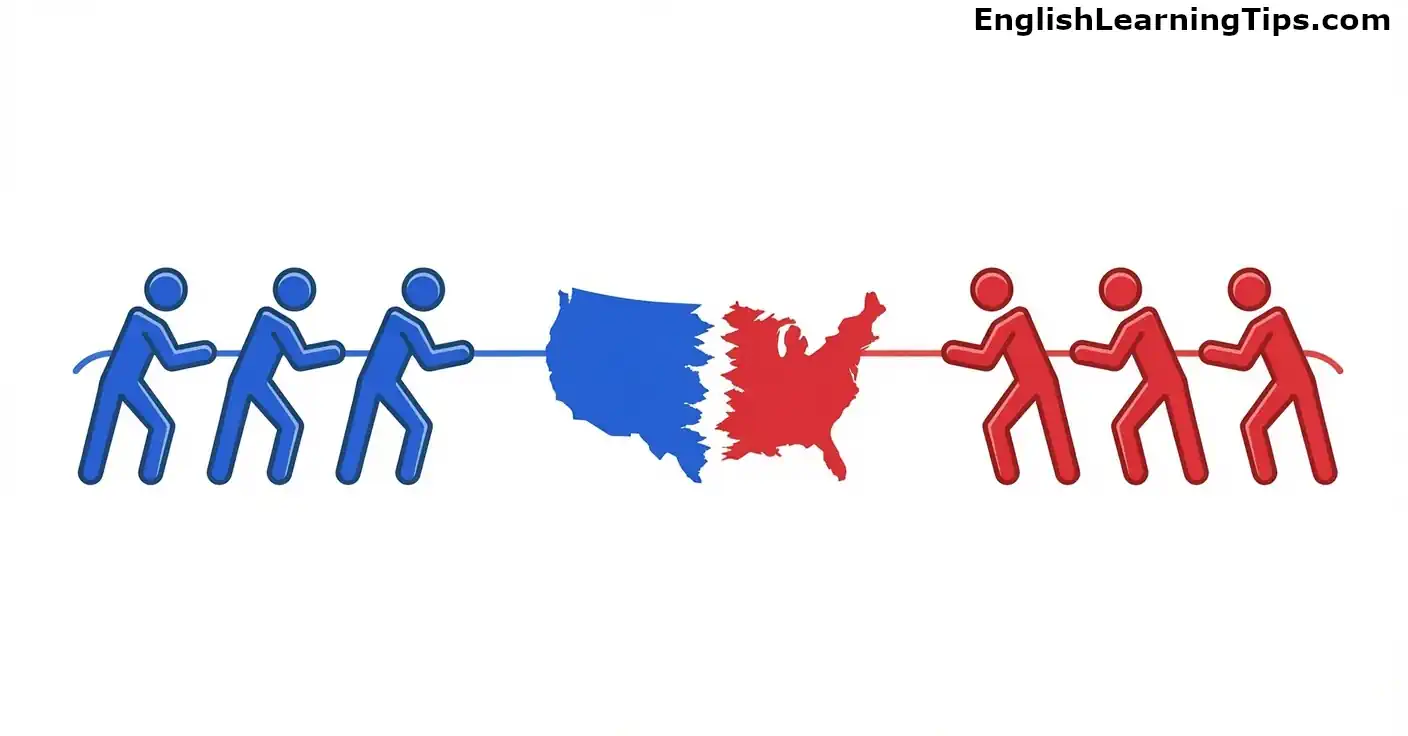
Navigating political polarization – an ESL lesson

Understanding current social issues and political shifts is essential for advanced ESL learners who want to participate in meaningful community discussions. This comprehensive lesson plan provides teachers with the tools to guide students through the complex topic of political division in the United States. By studying real-world perspectives on how social dynamics have evolved, students will build advanced vocabulary, master nuanced grammar structures, and develop the critical thinking skills required to debate deep cultural topics.
Lesson plan: Navigating political polarization in ESL classrooms
Level: Upper-intermediate and above (CEFR B2-C1)
Time: 45 minutes
Topic: Political polarization and institutional trust
Objectives: Students will learn to identify key historical factors contributing to political division, use targeted vocabulary to express abstract social concepts, and practice engaging in civilized debate on value-based issues.
Video: “The Rise of Political Polarization”
Background
Political polarization in America has reached levels not seen in over 150 years, drawing comparisons to the period immediately following the American Civil War. Historically, the primary dividing line between political parties during the post-New Deal era of the 1930s was centered on socioeconomic class, highlighting debates between big business and labor unions. Because these issues were fundamentally economic, they allowed room for legislative compromise through funding adjustments and targeted public programs.
In the late 20th century, the landscape shifted significantly as cultural, religious, and moral values became central to political identities. This transition created binary positions on societal issues such as civil rights, reproductive choices, and marriage equality, leaving little to no middle ground for political rivals. Today, this division extends past policy disagreements and deeply impacts public trust in foundational institutions, splitting perceptions of science, journalism, the military, and law enforcement along partisan lines.
Basic vocabulary
Introducing essential words related to political science, social research, and public policy helps students move past basic expressions and discuss complex societal dynamics with precision.
Vocabulary list
The following ten terms are taken directly from the study of modern political discourse and social science methodology.
- Polarize (verb)
- Other forms: Polarization (noun), polarized (adjective)
- Definition: To divide sharply into opposing factions, groups, or political opinions.
- Example: The controversial new law managed to polarize the local community right before the election.
- Compromise (noun)
- Other forms: Compromise (verb), compromising (adjective)
- Definition: An agreement reached by each side making concessions to meet in the middle.
- Example: After hours of heated debate, the committee members finally reached a compromise on the budget.
- Prognostication (noun)
- Other forms: Prognosticate (verb), prognosticator (noun)
- Definition: A prediction or statement about what is likely to happen in the future based on present data.
- Example: Economic prognostications suggest that the job market will stabilize over the next fiscal quarter.
- Evangelical (adjective)
- Other forms: Evangelism (noun), evangelicalism (noun)
- Definition: Relating to a movement within Protestant Christianity emphasizing Biblical authority and personal commitment.
- Example: The candidate spoke at an evangelical church to connect with religious voters in the region.
- Disconcerting (adjective)
- Other forms: Disconcert (verb), disconcertingly (adverb)
- Definition: Causing a person to feel unsettled, confused, anxious, or deeply worried.
- Example: The rapid decline in public trust toward objective journalism is disconcerting to many social scientists.
- Civics (noun)
- Other forms: Civic (adjective), civically (adverb)
- Definition: The study of the rights and duties of citizenship and the functions of democratic government.
- Example: High schools are reinstating comprehensive civics courses to help young people understand voting systems.
- Empirical (adjective)
- Other forms: Empiricism (noun), empirically (adverb)
- Definition: Verified by observation or direct experience rather than theory or pure logic.
- Example: The research team gathered empirical data through extensive door-to-door community surveys.
- Causal (adjective)
- Other forms: Cause (noun/verb), causality (noun), causally (adverb)
- Definition: Relating to or acting as a cause; showing a direct cause-and-effect relationship.
- Example: It is difficult to prove a causal connection between the new youth program and the drop in local crime.
- Ideology (noun)
- Other forms: Ideological (adjective), ideologically (adverb)
- Definition: A system of ideas, values, and ideals that forms the basis of economic or political theory.
- Example: Teachers should encourage open discussions that are not blinded by a strict political ideology.
- Assiduous (adjective)
- Other forms: Assiduously (adverb), assiduousness (noun)
- Definition: Showing great care, attention, and persistent effort in completing a task.
- Example: The university guards its academic reputation assiduously by verifying all research data before publication.
Vocabulary for extension
- Partisan (adjective) – Strongly supporting a single political party, cause, or faction without considering alternatives.
- Other forms: Partisan (noun), partisanship (noun)
- Adjoining (adjective) – Located next to or directly touching another property, geographical area, or room.
- Other forms: Adjoin (verb)
- Leverage (noun) – The power or strategic advantage to influence a situation, campaign, or political outcome.
- Other forms: Leverage (verb)
- Infer (verb) – To deduce or conclude information from evidence and reasoning rather than explicit statements.
- Other forms: Inference (noun), inferential (adjective)
- Welfare (noun) – Statutory procedure or social effort designed to promote the basic physical and material well-being of people in need.
- Other forms: Welfarism (noun)
- Confront (verb) – To face up to or deal with a problem, difficult situation, or opposing political adversary directly.
- Other forms: Confrontation (noun), confrontational (adjective)
- Societal (adjective) – Relating to the structure, organization, beliefs, and internal dynamics of a human society.
- Other forms: Society (noun), societally (adverb)
- Foundational (adjective) – Providing the essential basis, fundamental principles, or infrastructure on which something stands.
- Other forms: Foundation (noun)
- Discourse (noun) – Written or spoken communication, debate, or formal discussion on a specific cultural or political topic.
- Other forms: Discourse (verb)
- Faction (noun) – A small, organized, dissenting group within a larger political party, government, or organization.
- Other forms: Factional (adjective), factionalism (noun)
Teaching tips
A great pro-tip for introducing this vocabulary is to use structural semantic mapping. Have students place the core word (e.g., polarize) in the center of a page and draw branches out to its alternative parts of speech, noting where stress shifts occur in pronunciation (such as the shift from polarized to polarization). Teachers should also use context-clue matching games, where students guess the target vocabulary words using headlines stripped from current news publications. For upper-intermediate students, focus primarily on the base noun and adjective forms before pushing into the adverbs.
Grammar spotlight: Expressing nuance and cause in social discourse
Discussing complex societal topics like political polarization requires advanced grammatical structures. To move beyond basic descriptions, upper-intermediate language learners must master tools that allow them to concede points gracefully and establish clear cause-and-effect relationships.
Concessive clauses with subordinate conjunctions
Concessive clauses allow a speaker or writer to acknowledge a counterargument or a contrasting fact before presenting their main point. This structure is essential for maintaining a balanced, objective, and analytical tone in political and social discourse.
Conjunctions used to introduce these clauses include even though, although, while, and whereas.
- Structure: Subordinating Conjunction + Subject 1 + Verb 1, Subject 2 + Verb 2
- Example: Even though economic issues can deeply divide voters, they often allow more room for financial compromise than value-based disputes.
- Example: While older generations tended to vote based on socioeconomic class, modern voters are increasingly driven by cultural ideology.
Grammar note: When the concessive clause begins the sentence, use a comma at the end of that clause before starting the main clause. If the concessive clause comes at the end of the sentence, a comma is usually unnecessary (e.g., “Political rivals must find a way to cooperate although their core values clash completely”).
Advanced causal structures
In social science and public policy research, it is crucial to distinguish between simple correlation (two things happening at the same time) and true causation (one thing making another thing happen). Learners should replace basic words like because or so with precise causal verbs and phrases.
| Causal structure | Function | Contextual example |
| Give rise to | Explains the origin of a new social trend or phenomenon | The ideological shifts of the late 20th century gave rise to modern partisan divisions. |
| Stem from | Traces an existing problem back to its original source or root cause | Deep institutional distrust often stems from a lack of transparent communication. |
| Be attributed to | Assigns responsibility or cause to a specific factor (passive structure) | The rise in political polarization can be attributed to the fragmentation of modern news media. |
| Consequently | Serves as a transitional adverb to introduce a direct result | School systems cut funding for media literacy courses; consequently, students struggle to evaluate news sources. |
Common pitfalls to avoid
- Fragmented concessions: Avoid using although or even though as standalone transition words. They are subordinating conjunctions and must connect a dependent clause to a main independent clause.
- Incorrect: The town council proposed an excellent solution. Although, the citizens voted against it.
- Correct: Although the town council proposed an excellent solution, the citizens voted against it.
- Confusing causal prepositions: Remember that stem is followed by the preposition from, while attribute matches with to in passive sentences.
- Incorrect: The breakdown in civil discourse stems to a lack of shared facts.
- Correct: The breakdown in civil discourse stems from a lack of shared facts.
Useful phrases
Key phrases
- To find common cause (To discover shared goals or beliefs between differing groups)
- There is no middle ground (A situation where compromise or a halfway point is impossible)
- To guard assiduously against (To watch closely and protect something from a negative influence)
- To look for leverage (To seek a strategic advantage to understand or solve a problem)
- To be tough-minded about (To approach a situation with realistic, unsentimental, and analytical thinking)
Teaching tips
Encourage students to practice these phrases by using “sentence frames” during class activities. Write phrases on the board with blank spaces for societal topics (e.g., “When it comes to [Topic], many citizens feel there is no middle ground.”) Have students stand up and mingle, completing the frames with different topics every two minutes to build conversational muscle memory.
Example conversations
Conversation 1: Basic description
Speaker A: I was reading an article about how political parties interact today, and the level of polarization seems historically high.
Speaker B: It really is. It feels like citizens are drifting into two completely separate worlds based on their political choices.
Speaker A: Yes, the text mentions that people are even hesitant to let their children marry someone from the opposing party.
Speaker B: That shows how deeply strong political beliefs affect our everyday personal relationships now.
Conversation 2: Adding details
Speaker A: The shift in what causes this political division is what interests me the most.
Speaker B: Right, it used to be mostly about socioeconomic class and how public money was spent on social programs.
Speaker A: Now it stems from values, religion, and distinct ideas about what the world should look like.
Speaker B: Exactly, and because those values are deeply personal, finding any middle ground feels nearly impossible.
Conversation 3: More advanced
Speaker A: What worries me most is the total breakdown of trust in foundational institutions like science, journalism, and the military.
Speaker B: I agree, because when we stop sharing a common trust in facts and knowledge, civil discourse erodes entirely.
Speaker A: The article suggests that we could overcome some of these issues by implementing better civics courses in schools.
Speaker B: That could work, provided we focus on teaching students how to evaluate sources rather than just memorizing old documents.
Teaching tips
Use a “fishbowl” technique for these conversations. Invite two students to read a dialogue aloud in the center of the classroom while the rest of the students listen for target vocabulary and phrases. After the reading, have the listening students analyze the tone and suggest alternative, formal expressions the speakers could use to increase the professional quality of the conversation.
Teaching strategy
The ideal strategy for handling sensitive political and social topics in the ESL classroom is the Structured Academic Controversy (SAC) framework. Instead of hosting an open, adversarial debate that might make students uncomfortable, the SAC framework assigns pairs of students to research and present a specific perspective on a societal issue using empirical data. This minimizes personal conflict, reduces ideological bias, and forces students to focus on using precise academic language, concessive clauses, and historical facts to build their arguments.
Here’s a 45-minute lesson plan
Step 1: Warm-up (5 minutes)
Write the word polarization on the board. Ask students to share what physical objects polarize (like magnets or light filters) and use those literal definitions to create a figurative definition for society.
Step 2: Vocabulary introduction (10 minutes)
Distribute the vocabulary list. Pronounce each word clearly, highlighting syllable stress shifts, and have students read the example sentences aloud to understand the words in context.
Step 3: Phrase practice (10 minutes)
Introduce the key phrases section. Provide students with sentence frames and have them quickly draft three sentences applying the phrases to major public institutions or historical events.
Step 4: Conversation practice (15 minutes)
Divide the classroom into pairs. Have students practice reading the three example conversations, switching roles midway through, and then challenge them to extend Conversation 2 or 3 by generating original sentences.
Step 5: Wrap-up and personalization (5 minutes)
Bring the class together and ask two students to share one practical solution they discussed for restoring trust in local community institutions.
Discussion questions
- Question: Why was it easier for political parties to find a compromise when disputes were centered on socioeconomic class?
- Answer: Economic disputes generally involve money and program funding, which are quantifiable variables that can be split down the middle or adjusted over time to satisfy both sides.
- Question: What makes value-based disagreements harder to resolve than financial ones?
- Answer: Value-based issues involve deeply held moral, ethical, or religious convictions that are binary by nature, meaning individuals view them as inherently right or wrong with no acceptable middle ground.
- Question: How does a lack of trust in journalism and science threaten civil society?
- Answer: Journalism and science provide the objective facts and empirical data required to understand reality; without trust in these institutions, citizens cannot even agree on what is true or false.
- Question: What specific skills should a modern civics course focus on to reduce social division?
- Answer: Modern civics should teach media literacy, source verification, logic, and how to evaluate empirical data rather than relying on memorization.
- Question: Why should researchers look for natural experiments when studying the impact of social programs?
- Answer: Natural experiments allow researchers to compare highly similar groups under different conditions, helping them make accurate causal statements rather than simple correlations.
Additional tips
- Cultural sensitivity: Remind students that political structures vary worldwide; avoid criticizing specific international governments and keep the focus on general sociological patterns.
- Visual aids: Use simple line graphs illustrating the growing ideological gap between political parties over the last 50 years to make the data tangible.
- Adapt for level: For upper-intermediate students who struggle with abstract concepts, simplify the core terms to words like split, agreement, and proof before scaling up to polarize, compromise, and empirical data.
- Technology: Use live polling tools during class to gather anonymous data on student trust in various institutions, creating an instant chart for class analysis.
Common mistakes to address
- Grammar: Students often confuse the noun polarization with the adjective polarized; ensure they use the correct form after helper verbs (e.g., “The society became polarized,” not “The society became polarization”).
- Word choice: Learners frequently mix up causal (relating to a cause) and casual (informal); emphasize the spelling and pronunciation differences carefully.
Example activity
Provide pairs of students with brief, fictional descriptions of two adjoining towns: Town A implemented a new community recycling initiative, while Town B did not. Over three years, Town A saw a significant reduction in municipal waste management costs. Students must write a short paragraph using at least three vocabulary words, two key phrases, and one causal structure to explain whether this scenario qualifies as a successful natural experiment that proves a causal relationship.
Homework or follow-up
- Writing: Write an opinion essay of 200 to 250 words describing an institution you trust completely and explaining the empirical reasons behind your perspective.
- Speaking: Record a two-to-three-minute audio commentary summarizing a recent community debate, making sure to use at least two concessive clauses.
- Research: Investigate a successful historical compromise between two opposing factions and list the key factors that allowed them to find common cause.
FAQs
- What is the main cause of political polarization?
- Modern polarization is driven by a mix of media fragmentation, cultural sorting, geographical relocation, and political campaigns that emphasize value-based issues over economic ones.
- Can education alone fix institutional distrust?
- While media literacy and civics education help citizens evaluate facts, institutions must also practice transparency and maintain high ethical standards to earn back public trust.
- What is the difference between correlation and causation in social science?
- Correlation means two trends move together over time, whereas causation proves that one specific event directly brought about the occurrence of the second event.
- How can I discuss politics without starting an argument?
- Focus on sharing empirical data and objective facts rather than personal ideologies, and use concessive structures to show you understand your partner’s viewpoint.
Conclusion and call to action
Navigating social division is an ongoing challenge, but developing the vocabulary and analytical skills to discuss these shifts objectively is the first step toward progress. By bringing these conversations into upper-intermediate and advanced language classrooms, we build communities capable of media literacy and genuine understanding.
What strategies do you use to maintain productive conversations when discussing sensitive public topics? Have you noticed changes in public trust within your local community institutions? Please share your thoughts and experiences in the comments below, and share this lesson plan with fellow educators looking to inspire critical thinking!
Discover more from English Learning Tips
Subscribe to get the latest posts sent to your email.


