

Introduction to the Pygmalion effect and self-fulfilling prophecies — ESL lesson

Welcome to our comprehensive guide and lesson plan exploring the Pygmalion effect, a powerful psychological phenomenon where higher expectations lead to higher performance. In this article, we integrate essential keywords like self-fulfilling prophecy, psychology lesson plan, and Rosenthal experiment to help educators and students master this behavioral concept. Whether you are teaching English as a second language, psychology, or leadership, understanding how our beliefs shape the actions and success of others is an invaluable tool for personal and professional growth.
Lesson plan: Mastering the Pygmalion effect in daily communication
Level: Upper-intermediate (B2) to advanced (C1)
Time: 45 to 60 minutes
Topic: Psychology, expectations, and behavioral influence
Objectives: Define the Pygmalion effect, learn targeted vocabulary related to human behavior and expectations, practice realistic conversations demonstrating self-fulfilling prophecies, and apply these concepts through classroom discussions and role-play activities.
Background of the Pygmalion effect
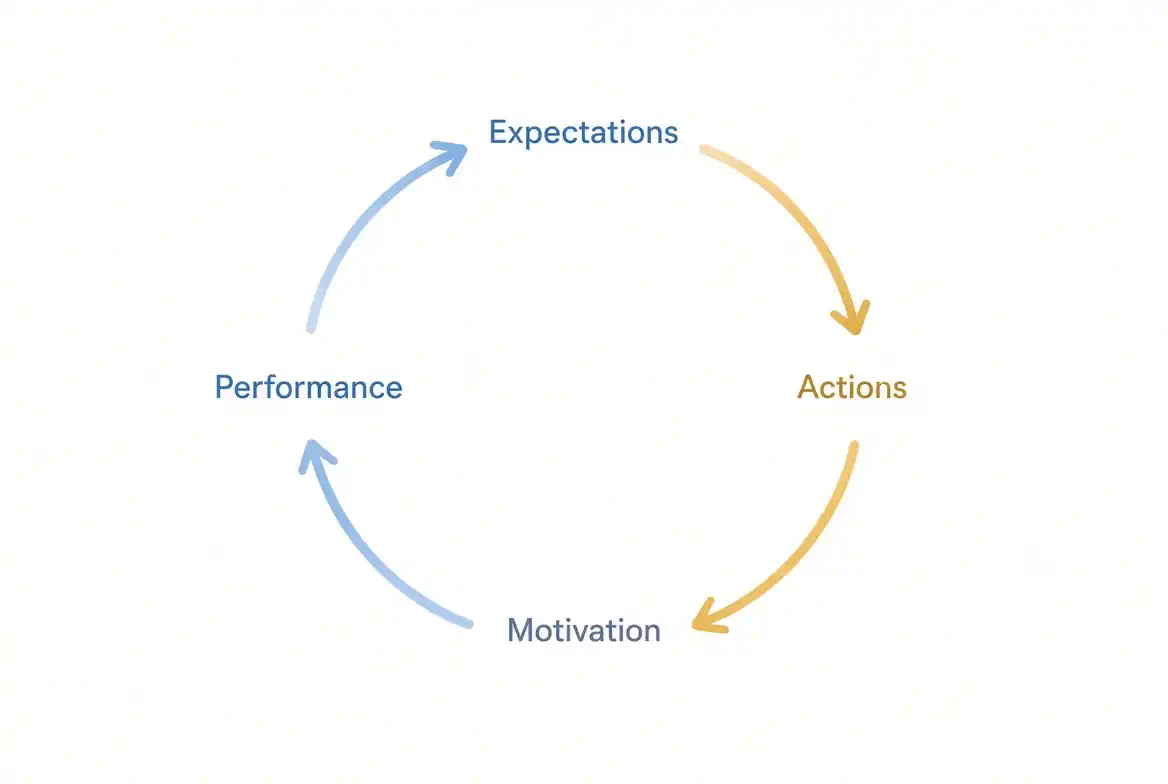
The Pygmalion effect is a psychological phenomenon whereby higher expectations lead to higher performance. It operates through a cyclical loop: our beliefs about another person’s abilities influence our actions toward them. These actions subsequently impact how the other person perceives themselves, which alters their behavior and ultimately reinforces our original beliefs. This concept highlights how powerful our internal assumptions can be in shaping reality.
The theory gained widespread recognition through groundbreaking psychological research, most notably the Rosenthal experiment conducted by Robert Rosenthal and Lenore Jacobson. In classroom and laboratory studies, researchers demonstrated that when teachers or coaches were led to expect superior performance from random subjects—whether human students or laboratory rats—those subjects actually achieved significantly better results. This underscores the profound responsibility we hold in shaping the potential of others through the expectations we project.
Basic vocabulary
To discuss psychological concepts like the Pygmalion effect effectively, learners need specialized terminology. Here are essential terms derived directly from our study material, complete with parts of speech, alternative word forms, definitions, and example sentences.
- Phenomenon (Noun) | Adjective: Phenomenal, Adverb: Phenomenally
- Definition: A remarkable fact or event that can be observed and studied.
- Example sentence: The Pygmalion effect is a fascinating psychological phenomenon.
- Expectation (Noun) | Verb: Expect, Adjective: Expectant, Adverb: Expectantly
- Definition: A strong belief that something will happen or be achieved.
- Example sentence: Higher expectations often lead to higher performance in students.
- Belief (Noun) | Verb: Believe, Adjective: Believable, Adverb: Believably
- Definition: An acceptance that a statement is true or that something exists.
- Example sentence: His belief in his own success drove him to practice harder.
- Influence (Noun/Verb) | Adjective: Influential, Adverb: Influentially
- Definition: The capacity to have an effect on the character, development, or behavior of someone.
- Example sentence: A teacher’s attitude can heavily influence a student’s motivation.
- Unconsciously (Adverb) | Adjective: Unconscious, Noun: Unconsciousness
- Definition: Without being aware; not consciously.
- Example sentence: The coach unconsciously formed biased expectations about the new players.
- Feedback (Noun) | Verb: Feed back
- Definition: Information about reactions to a product or a person’s performance used as a basis for improvement.
- Example sentence: Joe received very little constructive feedback from his coach.
- Motivation (Noun) | Verb: Motivate, Adjective: Motivational, Adverb: Motivationally
- Definition: The reason or reasons one has for acting or behaving in a particular way.
- Example sentence: Losing matches caused a noticeable drop in the player’s motivation.
- Reinforce (Verb) | Noun: Reinforcement, Adjective: Reinforced
- Definition: To strengthen or support an existing feeling, idea, or habit.
- Example sentence: The poor test results only served to reinforce the teacher’s initial doubts.
- Experiment (Noun/Verb) | Adjective: Experimental, Adverb: Experimentally
- Definition: A scientific procedure undertaken to make a discovery or test a hypothesis.
- Example sentence: Robert Rosenthal conducted a famous classroom experiment on expectations.
- Potential (Noun/Adjective) | Adverb: Potentially
- Definition: Having the capacity to develop into something in the future.
- Example sentence: The teachers were told that certain average students possessed extraordinary potential.
Vocabulary for extension
Expand your students’ lexical range with these additional related terms:
- Self-fulfilling prophecy (Noun): A prediction that directly or indirectly causes itself to become true.
- Bias (Noun): Prejudice in favor of or against one thing, person, or group compared with another.
- Assumption (Noun): A thing that is accepted as true or as certain to happen, without proof.
- Perception (Noun): The ability to see, hear, or become aware of something through the senses.
- Performance (Noun): The action or process of carrying out or accomplishing an action, task, or function.
- Subconscious (Adjective): Of or concerning the part of the mind of which one is not fully aware.
- Validate (Verb): To check or prove the validity or accuracy of something.
- Encouragement (Noun): The action of giving someone support, confidence, or hope.
- Neglect (Verb/Noun): To fail to care for properly; lack of proper care.
- Outcome (Noun): The way a thing turns out; a consequence.
Teaching tips for vocabulary
- Use contextual examples from sports or classroom settings to make abstract psychological terms concrete.
- Encourage students to practice word family charts (noun, verb, adjective, adverb) for words like influence and motivate.
- Incorporate pair-sharing where students use newly acquired terms to describe a personal experience of receiving high or low expectations.
Grammar integration
When discussing psychological theories and behavioral loops, students should master first and second conditionals as well as causal connectors.
- Conditional structures: Use first conditionals for likely real-world outcomes (“If we expect higher performance, we will act more supportive”) and second conditionals for hypothetical scenarios (“If teachers believed in every student equally, academic outcomes would improve”).
- Causal connectors: Utilize phrases such as whereby, thereby, as a result, and consequently to link beliefs to actions and actions to self-perception.
Useful phrases
Key phrases
- “Higher expectations lead to higher performance.”
- “Our beliefs influence our actions toward others.”
- “This creates a self-fulfilling prophecy.”
- “Unconsciously, we form biased assumptions about people.”
- “Constructive feedback builds confidence and motivation.”
- “Positive reinforcement changes individual behavior over time.”
Teaching tips
- Model sentence stress on modal verbs like can, should, and will when discussing behavioral outcomes.
- Have students practice linking clauses using causal connectors in spoken drills.
Example conversations
Conversation 1: Basic description
Student A: Have you ever heard of the Pygmalion effect? Student B: Yes, it is when higher expectations lead to better performance. Student A: Exactly, our beliefs about someone shape how we treat them. Student B: That makes a lot of sense in a classroom or sports team setting.
Conversation 2: Adding details
Student A: In the basketball example from the video, how did the coach treat Chris differently from Joe? Student B: The coach gave Chris extra practice time and detailed feedback because he expected him to succeed. Student A: And for Joe, the coach barely noticed his efforts and felt annoyed when he made mistakes. Student B: Right, which eventually caused Joe to lose motivation and skip training sessions.
Conversation 3: More advanced
Student A: The Rosenthal experiment really highlights how subtle biases can unintentionally create self-fulfilling prophecies. Student B: It is frightening to think that a teacher’s false assumptions about a student’s IQ could actually alter their test scores by the end of the year. Student A: It proves that we need to be extremely mindful of the labels we assign to others. Student B: Absolutely, fostering an environment of unconditional high expectations should be standard practice in education and leadership.
Teaching tips
- Assign roles dynamically and have students read dialogues aloud with correct intonation and emotional engagement.
- Ask students to identify where the causal chain of the Pygmalion effect appears within the dialogue lines.
Teaching strategy
Utilize an experiential and communicative approach. Begin by prompting students with a real-life reflection on a time someone believed in them, then transition to analyzing the mechanics of the Pygmalion effect through video or text. Encourage collaborative dialogue and peer feedback to reinforce conceptual understanding and language fluency.
Here is a 45-minute lesson plan
Step 1: Warm-up (5 minutes)
- Ask students to share a time when someone expected them to do well and how it made them feel.
- Introduce the term expectation and link it to everyday performance.
Step 2: Vocabulary introduction (10 minutes)
- Present the 10 core vocabulary words with parts of speech and definitions.
- Have students construct sentences using target words like phenomenon, unconsciously, and reinforce.
Step 3: Phrase practice (10 minutes)
- Introduce key phrases related to psychological loops and self-fulfilling prophecies.
- Conduct a quick-fire matching or gap-fill exercise to solidify usage.
Step 4: Conversation practice (15 minutes)
- Divide students into pairs to practice the provided dialogues.
- Circulate the room, assisting with pronunciation, pacing, and natural intonation.
Step 5: Wrap-up and personalization (5 minutes)
- Lead a brief plenary discussion on how students can apply positive expectations in their daily lives.
- Assign follow-up tasks for homework.
Discussion questions
- How do unconscious biases influence the way managers treat different employees in a workplace?
- Answer: Managers may invest more mentoring time and patience in employees they favor, creating an unequal growth trajectory.
- Can the Pygmalion effect work in reverse, and what is that called?
- Answer: Yes, negative expectations leading to poor performance are known as the Golem effect.
- How can teachers guard against forming unfair assumptions about their students at the start of a school year?
- Answer: By treating every student with a clean slate, using objective grading, and providing equal encouragement.
- In what ways can self-awareness help us break out of negative self-fulfilling prophecies?
- Answer: Recognizing limiting beliefs allows individuals to consciously change their actions and seek supportive environments.
- Why were the results of Robert Rosenthal’s rat experiment so surprising to the scientific community?
- Answer: Because the rats were genetically identical, proving that the human coaches’ beliefs alone altered the animals’ maze-running performance.
Additional tips
- Cultural sensitivity: Be mindful that expectations and praise styles vary across cultures; direct praise in some cultures may cause discomfort, while in others it is essential.
- Visual aids: Use a circular flowchart diagram on the board to illustrate the step-by-step cycle of beliefs, actions, self-perception, and reinforced outcomes.
- Adapt for level: For lower levels, focus purely on basic vocabulary and simple conditional sentences; for advanced learners, debate the replication crisis and ethical implications in psychological research.
- Technology: Play the educational video on the Pygmalion effect with subtitles enabled to support listening comprehension and note-taking.
Common mistakes to address
- Grammar: Students often confuse conditional clauses (e.g., writing “If the coach expected success, Joe will try harder” instead of “would try harder”).
- Word choice: Learners frequently confuse affect (verb) with effect (noun) when discussing how beliefs impact performance.
Example activity
Divide students into small groups and assign each group a hypothetical scenario (e.g., a new employee starting a job or a struggling musician joining an orchestra). Have them write a short 3-minute role-play demonstrating how a leader’s positive or negative expectations create a self-fulfilling prophecy. Groups then perform their sketches for the class.
Homework or follow-up
- Writing: Write a 150-word reflective paragraph describing a personal experience where someone’s high expectations helped you achieve a difficult goal.
- Speaking: Record a 2-minute voice note explaining the Rosenthal experiment in your own words using at least five target vocabulary words.
- Research: Look up one modern study on educational psychology or the Golem effect and prepare a brief 3-sentence summary for the next class.
FAQs
- What is the difference between the Pygmalion effect and the placebo effect? The Pygmalion effect involves expectations transferred from another person influencing performance, whereas the placebo effect relies on an individual’s own belief in a treatment or intervention.
- Who discovered the Pygmalion effect? Robert Rosenthal and Lenore Jacobson famously documented it in their 1968 school classroom study, though the concept originates from the Greek myth of Pygmalion.
- Can the Pygmalion effect be used positively in leadership? Yes, leaders who maintain high, supportive expectations for all team members regularly foster greater engagement, skill growth, and overall team success.
- Is the Pygmalion effect considered valid in modern psychology? While core principles remain influential in education and management, some modern replication studies suggest effect sizes can vary depending on context and blinding protocols.
Conclusion and call to action
Mastering the dynamics of the Pygmalion effect gives us profound insight into how our beliefs actively shape the world around us. By fostering positive expectations and conscious communication, we can empower those we lead, teach, and work with to reach their highest potential. What are your thoughts on using high expectations in education? Have you ever experienced a self-fulfilling prophecy in your own life? Please share your stories and insights in the comments below, and share this article with fellow educators and psychology enthusiasts!
Discover more from English Learning Tips
Subscribe to get the latest posts sent to your email.


