

Active vs. passive voice: Master verbs for clear writing

If your writing feels “clunky” or wordy, you likely have an issue with how you are using active and passive verbs. However, “fixing” your writing isn’t as simple as just cutting passive constructions. True authority comes from understanding how these voices function at a structural level. While most writers lean toward the active voice for its directness and vigor, the passive voice plays a critical role in formal and scientific contexts when you need to emphasize the action rather than the actor.
To master your prose, we will examine the definitions, verb structures, and practical examples of both voices. By the end of this guide, you will be able to decide exactly when to engage your reader with an active verb or when to maintain a professional distance using a passive construction.
What is active voice?
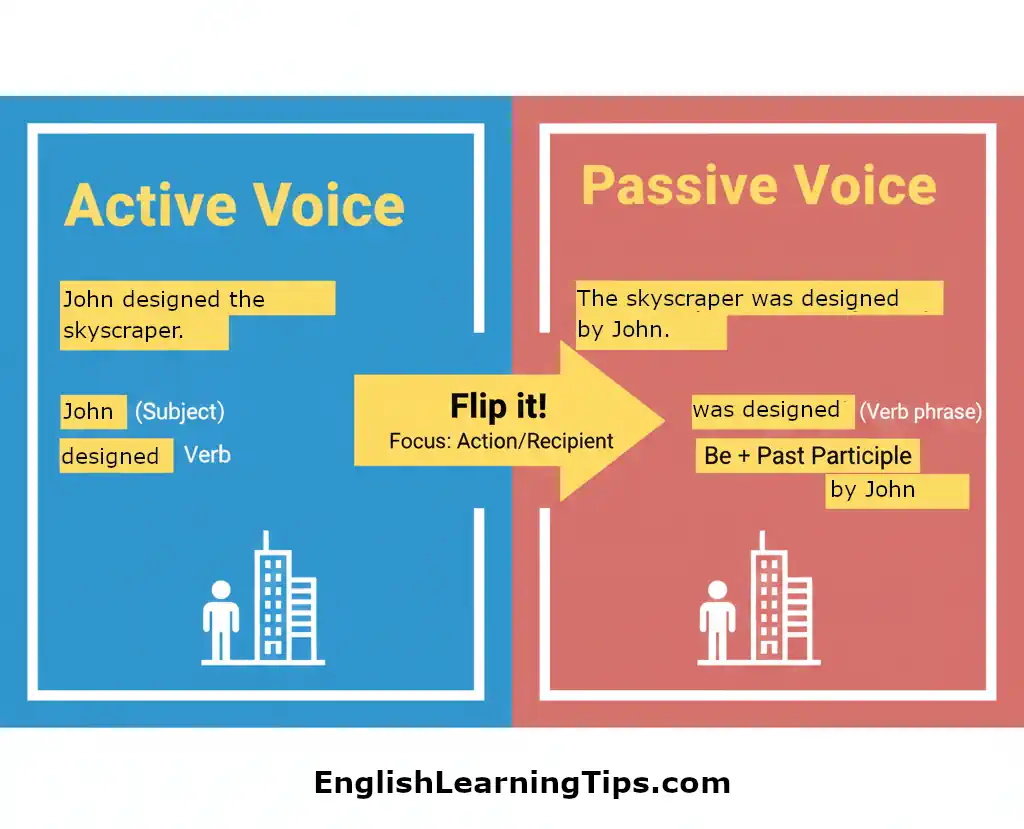
In an active voice sentence, the subject of the sentence performs the action. This structure is generally preferred in most forms of writing because it is concise, vigorous, and easy to understand.
- Sentence structure: Subject + Verb + Object
- Example: The architect designed the skyscraper.
- Why it works: It establishes a clear relationship between the “doer” (the architect) and the “action” (designed).
What is passive voice?
In the passive voice, the subject is the person or thing acted upon. The focus shifts from the performer of the action to the action itself or the recipient.
- Sentence structure: Subject + Auxiliary Verb (be) + Past Participle + (Optional: by + Agent)
- Example: The skyscraper was designed by the architect.
- Why it works: It emphasizes the result (the skyscraper) rather than the creator.
The anatomy of a verb: Spotting the difference between active and passive verbs
To master these voices, you must look closely at the verb phrase. The difference lies in how much “support” the verb needs to get the job done.
- Active verbs are independent. They typically consist of a single word or a direct tense construction that links the subject to the action.
- Example: “The researcher analyzed the data.” (Simple past, direct action).
- Passive verbs are dependent. They always require an auxiliary (or “helping”) verb—specifically a form of to be—paired with the past participle of the main verb. If you see a form of “to be” (am, is, are, was, were, be, being, been) + a past participle (a verb ending in -ed, -en, or irregular forms like seen or thrown), you are looking at a passive construction.
- Example: “The data was analyzed by the researcher.” (Auxiliary was + past participle analyzed).
Key differences at a glance
Use this table to quickly compare how these two grammatical voices impact your writing:
| Feature | Active voice | Passive voice |
| Primary focus | The performer (who did it) | The action/recipient (what happened) |
| Tone | Direct, authoritative, energetic | Formal, objective, or detached |
| Word count | Usually shorter and more concise | Often longer due to auxiliary verbs |
| Best for | Storytelling, emails, and blogging | Science, news reports, and diplomacy |
Verb transformation: A quick reference
Seeing how the verb changes across tenses can help you identify these patterns in your own drafts. Notice how the active verb remains a direct action, while the passive verb always gains that extra “helper” (the auxiliary verb).
| Tense | Active verb construction | Passive verb construction |
| Simple present | The team builds it. | It is built by the team. |
| Simple past | The team built it. | It was built by the team. |
| Future | The team will build it. | It will be built by the team. |
| Present perfect | The team has built it. | It has been built by the te |
When to use active vs. passive voice
Knowing when to switch between these styles is a hallmark of professional writing.
Use active voice for:
- Clarity and brevity: It gets straight to the point, making it ideal for web content and business communication.
- Stronger storytelling: It creates a sense of movement and helps readers visualize the action.
- Accountability: It clearly identifies who is responsible for a task or decision.
Use passive voice for:
- Scientific or technical writing: When the process or the result is more important than the researcher (e.g., “The solution was heated to 100°C”).
- Maintaining anonymity: When the actor is unknown or irrelevant (e.g., “The store was robbed”).
- Diplomatic phrasing: To soften a statement or avoid placing direct blame (e.g., “The invoice was not paid” instead of “You didn’t pay the invoice”).
The Quick flip: Converting passive to active
If you find a passive sentence that feels weak, follow these steps:
- Find the “By”: Look for the person doing the action (the agent).
- Move them to the front: Make them the first word.
- Cut the “Be” verb: Remove is, was, were.
- Passive: The report was finished by Sarah.
- Active: Sarah finished the report.
Frequently asked questions: Active vs. passive voice
The editor’s checklist: How to audit your voice
Use this four-step checklist to refine your writing before you hit publish:
- Identify the “be” verbs: Scan your draft for am, is, are, was, were, be, being, and been.
- Apply the “Zombies Test“: If you see a “be” verb, try adding “by zombies” after it. If the sentence makes sense, you’ve found a passive construction.
- Find the “doer”: If you find a passive sentence, ask: Who is doing the action? If that person or thing is important, move them to the front of the sentence.
- Check for wordiness: Does switching to active voice remove unnecessary words? (e.g., “The decision was made by the board” [7 words] vs. “The board decided” [3 words]).
A video to help explain for visual learners
Final thoughts: Mastering your writing voice
Whether you are drafting a technical report or a creative blog post, the choice between active and passive voice defines your authority as a writer. While the active voice is generally the “engine” of clear communication, the passive voice is a specialized tool for precision and diplomacy. Mastering the balance between the two will make your writing more versatile and professional.
Join the conversation
Do you struggle with the “passive voice” warnings in plugins like Grammarly, or do you think the passive voice gets an unfairly bad reputation?
Drop a comment below with your thoughts or share a sentence you’re trying to rewrite—we’ll help you flip it!
Discover more from English Learning Tips
Subscribe to get the latest posts sent to your email.


