
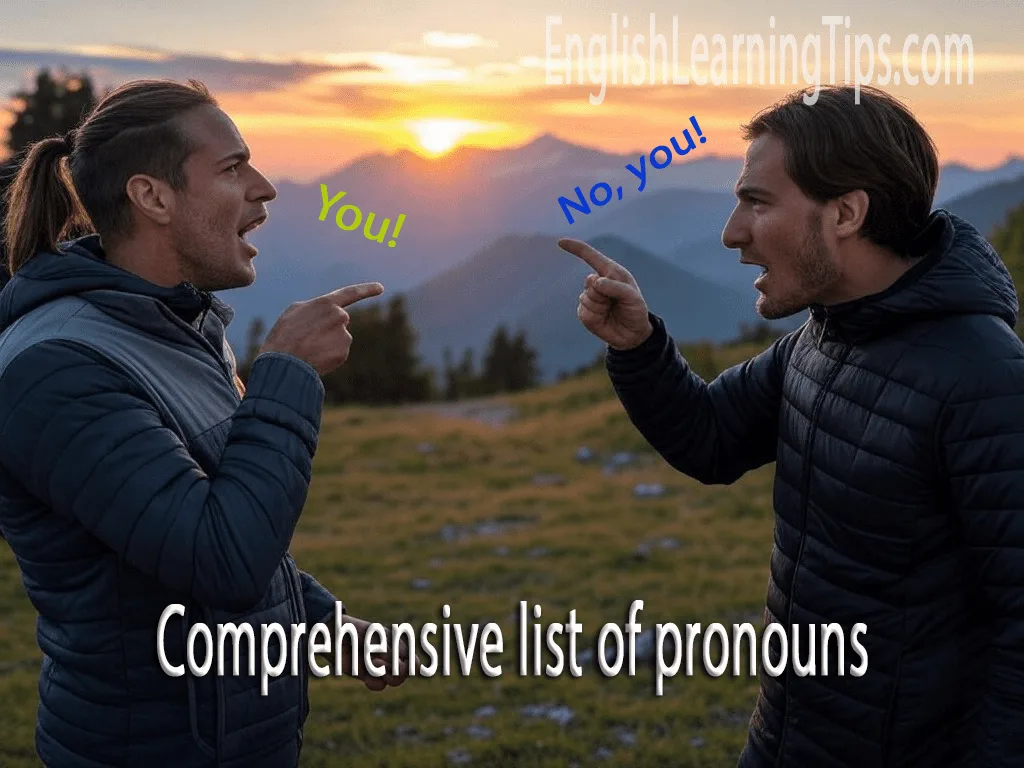
A comprehensive list of pronouns characterized by type

Pronouns are essential building blocks of the English language, serving as versatile substitutes for nouns or noun phrases. They help us communicate efficiently by avoiding repetition and adapting to various grammatical roles.
Whether you’re identifying a person, asking a question, or emphasizing a point, pronouns play a key role in everyday speech and writing. This guide provides a detailed overview of pronouns, organized by type, to help you understand their forms and functions. For a deeper dive into why we use pronouns, click here. Below, you’ll find a comprehensive list of pronouns categorized for clarity and ease of reference.
Personal pronouns
- Subject pronouns
- I, you, he, she, it, we, they
- Object pronouns
- me, you, him, her, it, us, them
- Possessive pronouns
- mine, yours, his, hers, its, ours, theirs
- Possessive adjectives (determiners)
- my, your, his, her, its, our, their
Reflexive pronouns
- myself, yourself, himself, herself, itself, ourselves, yourselves, themselves
Demonstrative pronouns
- this, that, these, those
Interrogative pronouns
- who, whom, whose, which, what
Relative pronouns
- who, whom, whose, which, that
- Note: “who” and “whom” refer to people; “which” for things or sometimes animals; “that” can refer to both people and things.
Indefinite pronouns
- Singular
- anybody, anyone, anything, everybody, everyone, everything, nobody, no one, nothing, somebody, someone, something, each, either, neither, one, another
- Plural
- both, few, many, several, others
- Singular or plural (depending on context)
- all, any, more, most, none, some
Reciprocal pronouns
- each other, one another
Archaic or less common pronouns
- thou, thee, thine (archaic forms of “you” in singular), ye (archaic plural of “you”)
Intensive pronouns
- These are actually the same as reflexive pronouns but are used for emphasis rather than to refer back to the subject:
- myself, yourself, himself, herself, itself, ourselves, yourselves, themselves
Pronoun-like words
- Pronominal adverbs
- here, there, where, when, why, how (used in questions or to replace prepositional phrases)
Keep in mind
- Some pronouns can serve multiple functions (e.g., “who” can be interrogative, relative, or in some contexts, a personal pronoun in questions).
- The usage of pronouns can vary based on dialect, formality, and context, including changes in modern English usage (like the increasing acceptance of “they/them” as singular pronouns for gender neutrality).
- Pronouns like “it” can have multiple uses, including as a placeholder subject for impersonal constructions (e.g., “It is raining”).
In summary: Master pronouns for better writing
Understanding pronouns is one of the quickest ways to elevate your writing from repetitive to professional. By mastering the different types of pronouns—from personal and possessive to relative and indefinite—you gain the flexibility to write sentences that are both concise and clear.
While the core rules of grammar remain steady, the English language continues to adapt, as seen with the growing standard of the singular “they” and more inclusive language practices. Keep this guide bookmarked as a quick reference for your future projects, essays, or daily communications.
Discover more from English Learning Tips
Subscribe to get the latest posts sent to your email.


