
Cooking vocabulary: The essential guide to kitchen terms and techniques

We’ve all been there: halfway through a recipe, you hit a term like ‘deglaze’ or ‘fold,’ and suddenly you’re second-guessing everything. Understanding these English cooking terms isn’t just about sounding fancy—it’s about preventing kitchen disasters like broken sauces or rubbery steak.
This guide breaks down the English cooking terms you actually need to know, from foundational heat methods to the knife skills that will save you time during prep.
Why kitchen terminology actually matters
If you’ve ever ended up with tough meat or soggy vegetables, it was likely a vocabulary mix-up.
- Better results: Knowing that a “simmer” stays between 185°F and 205°F prevents you from toughening proteins.
- Kitchen speed: Understanding mise en place (having everything ready) stops the frantic mid-cook scramble.
- Confidence: You’ll stop relying on “luck” and start relying on technique.
While recipes tell you what to do, food reviews often use the passive voice to describe how a dish was prepared.
Master the heat: Essential cooking methods
Understanding how heat moves through food is the core of cooking. Use this table as your quick-reference guide for basic cooking terms.
| Technique | What it actually means | Best for… |
| Bake | Dry heat in an oven; surrounds food with hot air. | Bread, cakes, and cookies. |
| Simmer | Small, lazy bubbles that break the surface occasionally. | Slow-cooked stews and sauces. |
| Boil | Aggressive, rolling bubbles (212°F) that don’t stop when stirred. | Dried pasta and root vegetables. |
| Sauté* | High heat, very little fat, and constant movement. | Thinly sliced meat and crisp-tender veggies. |
| Braise | A two-step process: sear the meat, then slow-cook in liquid. | Tougher cuts like chuck roast or shanks. |
| Poach | Submerging delicate food in barely-moving liquid. | Eggs, fish, and fruit. |
| Roast | High-heat oven cooking (400°F+) to create a browned crust. | Whole chickens and potatoes. |
Pro Tip: When you Roast or Sauté, you’re aiming for the Maillard Reaction—that’s the chemical reaction between amino acids and reducing sugars that gives browned food its distinctive flavor.
- Sauté comes from the French sauter (to jump), which is why the food must stay moving.
Knife skills: Preparation and cutting techniques
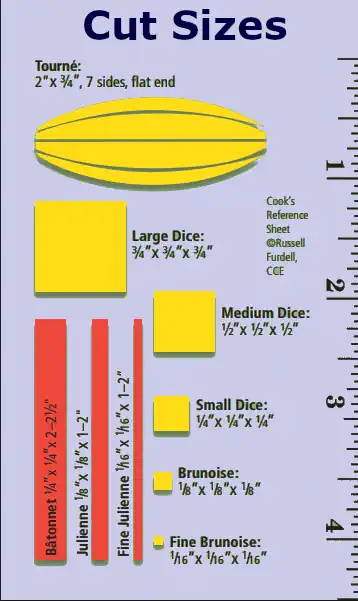
The shape of your food dictates how it cooks. If your pieces are different sizes, some will burn while others stay raw.
Standard knife cuts
- Chop: Rough, bite-sized pieces where uniform shape isn’t vital.
- Dice: Perfectly square cubes. (Small dice = 1/4 inch; Large dice = 3/4 inch).
- Julienne: Often called “matchsticks.” Long, thin strips are usually 2 inches long.
- Mince: The smallest possible cut. Use this for garlic or ginger so they “melt” into the dish.
- Chiffonade: To stack leafy greens or herbs, roll them tightly, and slice into thin ribbons.
When measuring, it’s important to distinguish between countable and uncountable nouns to ensure your grammar—and your measurements—are correct.
Specialized prep steps
- Zest: Scraping the colorful “flavedo” (outer skin) of citrus. Avoid the white pith, which is bitter.
- Deglaze: Adding cold liquid to a hot pan to lift the “fond”—those browned, caramelized bits stuck to the bottom. This is the secret to great pan sauces.
- Score: Cutting shallow lines into the surface of food (like duck breast or bread dough) to help fat render or allow for expansion.
- Blanch: A quick “dip and shock” method. Boil for a minute, then immediately drop into ice water to lock in color and texture.
Professional kitchen equipment you should know
You don’t need every gadget, but these essential kitchen utensils solve specific problems:
- Mandoline: Use this for paper-thin, identical slices of radish or cucumber. Always use the guard to protect your fingers.
- Whisk: Designed to incorporate air. Use it for whipped cream or emulsifying vinaigrettes.
- Sieve: A fine mesh for removing lumps from flour or straining solids out of a silky stock.
- Double boiler: A “gentle heat” setup. A bowl over simmering water keeps chocolate or hollandaise from breaking or burning.
The “bake” vs. “roast” distinction
These are both dry heat oven methods. The difference is structure vs. temperature. Baking is for things that solidify (cake), while roasting is for things that have structure already (carrots/meat) and usually involves higher heat (400°F+).
Cooking vocabulary FAQ: Pro tips for home cooks
For the visual learners: Learn while baking cookies
Bonus: Essential kitchen conversions cheat sheet
Understanding the vocabulary is half the battle; getting the measurements right is the other. Use this table for quick adjustments on the fly.
US customary vs. metric
| To get… | Use… | Or… |
| 1 Tablespoon | 3 Teaspoons | 15 ml |
| 1/4 Cup | 4 Tablespoons | 60 ml |
| 1/2 Cup | 8 Tablespoons | 120 ml |
| 1 Cup | 16 Tablespoons | 240 ml |
| 1 Pint | 2 Cups | 480 ml |
| 1 Quart | 4 Cups (2 Pints) | 950 ml |
| 1 Gallon | 4 Quarts | 3.8 Liters |
Conclusion: Practice makes the chef
Mastering English cooking terms is the fastest way to bridge the gap between “reading a recipe” and “knowing how to cook.” Start with the basics—learn to dice consistently and master the simmer—and you’ll find that even the most complex recipes become manageable.
What’s the one technique you’re still trying to master?
Is your julienne a bit wonky, or are you still nervous about deglazing a hot pan? Leave a comment below and let’s troubleshoot your kitchen questions together! We love hearing about your wins and your “happy accidents.”
Discover more from English Learning Tips
Subscribe to get the latest posts sent to your email.


