

Telling time in English: A complete guide to clocks and conversation

Checking your watch is easy, but telling someone the time in English can be surprisingly tricky. Even if you know your numbers, native speakers use phrases like ‘quarter til‘ or ‘half six‘ that don’t always show up on a digital clock. This guide will help you move past basic numbers so you can talk about time naturally, whether you’re catching a train or booking a meeting.
Understanding the basics: Hours, minutes, and seconds
Before we get into the tricky phrases, let’s look at the three basic building blocks of any time statement.
- Hours: Use numbers 1 through 12 (standard) or 1 through 24 (military/24-hour time).
- Minutes: Use numbers 1 through 59.
- Seconds: Use numbers 1 through 59 (usually reserved for sports, science, or precise countdowns).
Analog vs digital clocks
Before you can master the language of time, it helps to understand the two different “displays” you’ll encounter. In English, how we speak often depends on which one we are looking at.
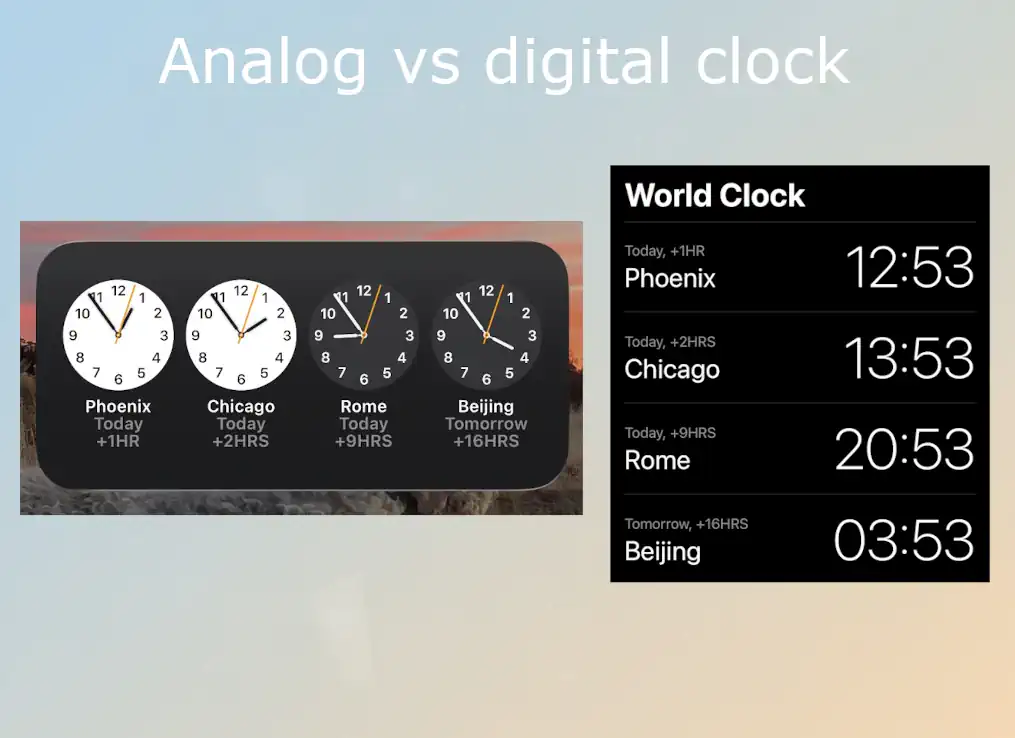
Digital clocks (The numbers only)
Digital clocks show time using digits—usually separated by a colon (e.g., 14:35). Because the numbers are right there in front of you, this is the foundation for the Digital Method. It is straightforward, fast, and common on smartphones, computers, and at train stations.
Analog clocks (The “face” of time)
An analog clock uses moving hands and a circular face numbered 1 through 12. Because this display is spatial, it is the root of the Classical Method.
- The long hand: Tracks the minutes.
- The short hand: Tracks the hours.
Native speakers often “visualize” an analog clock even when they aren’t looking at one. This is why we use phrases like “half past” or “quarter to”—we are literally describing the position of the hands on a circle.
Common ways to tell time in English
While most people just call it ‘telling the time,’ there are actually two ways to do it. We call them the Digital Method (reading the numbers as they appear) and the Classical Method (the traditional ‘past’ and ‘to’ style).
1. The digital method (The easiest way)
Simply say the hour followed by the minutes. This is the most common way to speak in modern, fast-paced environments.
- 6:10 – “Six ten”
- 8:25 – “Eight twenty-five”
- 11:45 – “Eleven forty-five”
The “Oh” factor
When the minutes are between 01 and 09, we don’t just say the number. We say “oh.”
- 4:05 – “Four-oh-five”
- 7:08 – “Seven-oh-eight” (Skipping this makes a learner sound like a robot; adding it signals your language understanding.)
Using “At” for specific times
When you are scheduling or talking about a specific point in time, always use the preposition at.
- “I’ll meet you at 5:00.”
- “The movie starts at quarter past seven.”
- Exception: Use in for periods of time (e.g., “in the morning,” “in ten minutes”).
Learn more by reading our article on the prepositions of time. But here are the basics:
- At: For specific clock times (at 5:00, at noon).
- In: For periods of time (in the morning, in 2026).
- On: For specific days (on Monday, on my birthday).
2. The classical method (Using “past” and “to”)
While saying “two-thirty” is perfectly fine, you’ll often hear native speakers use a more descriptive style. This is the “classical” way to tell time, and it relies on dividing the clock into two halves.
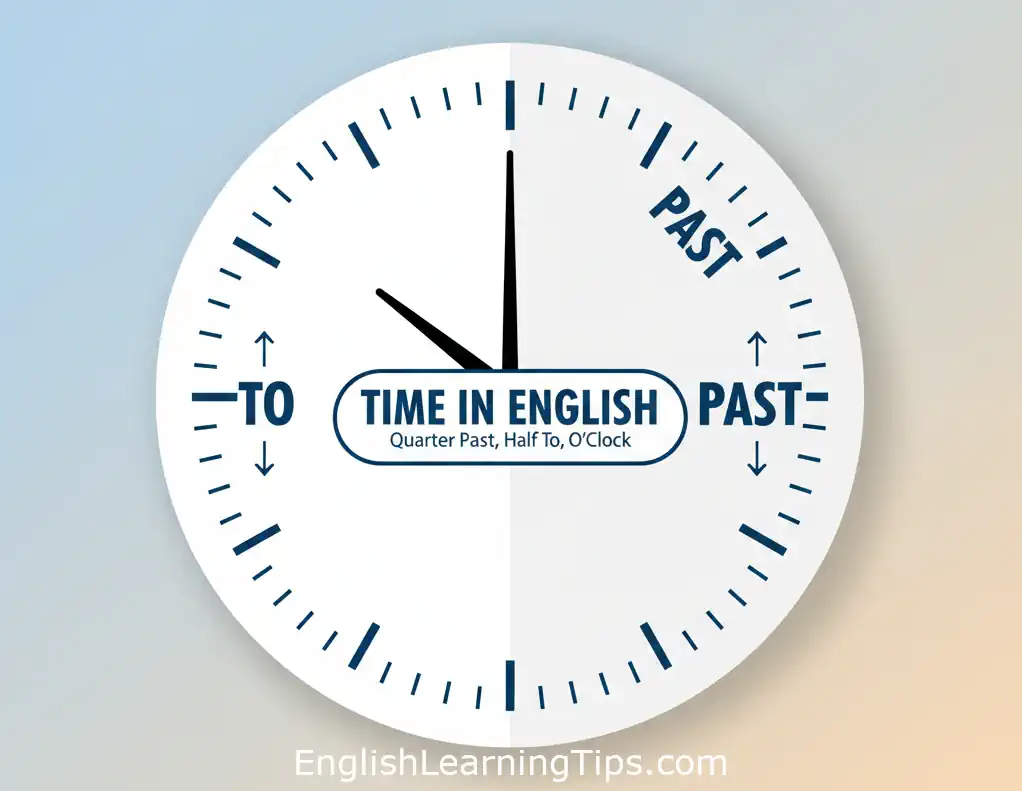
1. The “past” side (Minutes 1–30)
When the minute hand is on the right side of the clock, we talk about how many minutes have passed after the hour.
- 10:05 – “Five past ten” (or “Five after ten” in the US).
- 10:20 – “Twenty past ten.”
2. The “to” side (Minutes 31–59)
When the minute hand moves to the left side, we start looking forward. We count how many minutes are left until the next hour.
- 10:40 – “Twenty to eleven.”
- 10:55 – “Five to eleven” (or “Five ’til eleven”).
3. The “quarter” and “half” benchmarks
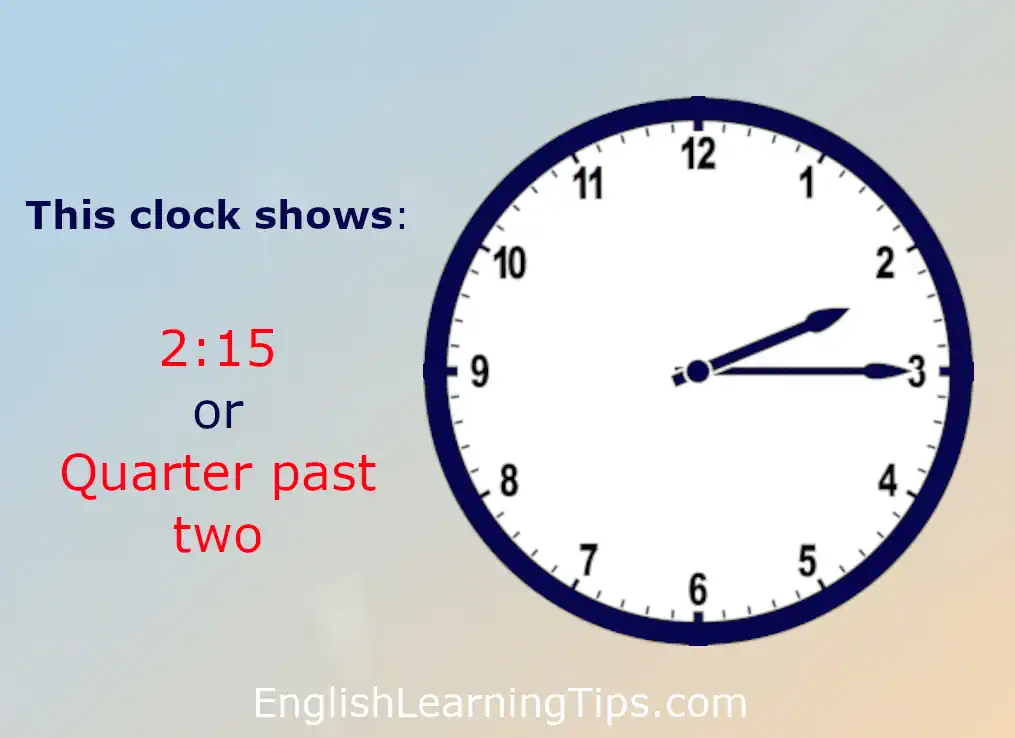
English speakers love shortcuts. Instead of saying “fifteen” or “thirty,” we use these common fractions:
| Minute Mark | Phrase to Use | Example |
| :15 | Quarter past | 8:15 – “Quarter past eight” |
| :30 | Half past | 8:30 – “Half past eight” |
| :45 | Quarter to | 8:45 – “Quarter to nine” |
A note on “Half past”
In casual conversation, especially in the UK, you might hear someone say, “I’ll be there at half four.”
Don’t let this trip you up! They aren’t talking about 3:30 or 4:00. They have just dropped the word “past.” In English, “half four” always means 4:30.
While knowing the numbers is essential, English speakers often use colorful expressions to describe being early or late. To really level up your conversation skills, explore our list of the most popular common time-related idioms.
Telling time: Does anyone actually say “seconds”?
Honestly? Rarely. Unless you are a NASA scientist or a track coach, you’ll almost never hear someone include seconds in a conversation. If someone asks for the time and it’s 2:10 and 15 seconds, just say “two-ten.” Keeping it simple is the most “native” thing you can do.
AM vs. PM: Telling day from night
Since the English-speaking world primarily uses the 12-hour clock, we use Latin abbreviations to specify the time of day according to international standards.
- AM (Ante Meridiem): From Midnight to 11:59 AM (Morning).
- PM (Post Meridiem): From Noon to 11:59 PM (Afternoon/Evening).
Pro-Tip: In casual conversation, people often swap AM/PM for phrases like “in the morning,” “in the afternoon,” or “at night.” For example: “I’ll see you at eight at night.”
How to ask for the time
Depending on who you are talking to, you should adjust your level of formality.
Formal situations (With strangers or in a workplace):
- “Excuse me, do you happen to know what time it is?”
- “Could you please tell me the time?”
- “I’m sorry, do you have the time?”
Informal situations (With friends or family):
- “What time is it?”
- “What’s the time?”
- “Got the time?”
FAQ: Common questions about telling time
Common mistakes to avoid when telling time
Even advanced learners make these slips. Avoiding them will instantly make you sound more like a native speaker.
- Don’t use “o’clock” with minutes: You can say “It’s four o’clock” or “It’s four-thirty,” but never “It’s four-thirty o’clock.”
- Don’t use “o’clock” with 24-hour time: You can say “It’s 15:00” or “It’s three o’clock,” but never “It’s 15 o’clock.”
- The “Half to” trap: Unlike many other languages, English does not have a “half to” expression. 6:30 is always “half past six,” never “half to seven.”
- Mixing up 12:00: To avoid being late for a flight or a meeting, try to avoid “12:00 PM.” Use “Noon” or “Midnight” instead—it’s much clearer.
Videos about telling time
Telling time in British English
Telling time in American English
Advanced time phrases
Summary table: Quick reference guide
| Digital | Classical | Casual/”Real life” |
| 2:00 | Two o’clock | Two |
| 2:05 | Five past two | Just after two |
| 2:15 | Quarter past two | Two-fifteen |
| 2:30 | Half past two | Two-thirty |
| 2:45 | Quarter to three | Quarter til three |
| 2:55 | Five to three | Almost three |
Test your knowledge: The telling time in English quiz
Think you’ve mastered the clock? Test your skills with these 10 questions. The answers are hidden at the bottom—no peeking!
Part 1: Digital vs. Classical
1. How would a native speaker say 4:05 using the “Digital Method”?
- A) Four-five
- B) Four-oh-five
- C) Five past four
2. In the “Classical Method,” how do you say 7:15?
- A) Fifteen past seven
- B) Seven-fifteen
- C) Quarter past seven
3. If someone says it is “Ten to nine,” what time is it on a digital clock?
- A) 9:10
- B) 8:50
- C) 8:10
Part 2: Tricky phrases and regionalisms
4. You are in London, and a friend says, “Let’s meet at half six.” What time should you arrive?
- A) 5:30
- B) 6:00
- C) 6:30
5. Which of these is the most common way to say 2:45 in the United States?
- A) Quarter to three
- B) Three minus fifteen
- C) Forty-five past two
6. When is it appropriate to use the word “o’clock”?
- A) At any time (e.g., 2:30 o’clock)
- B) Only on the exact hour (e.g., 2:00 o’clock)
- C) Only in military time (e.g., 14:00 o’clock)
Part 3: AM, PM, and grammar
7. You have a flight at 12:00 AM. When should you go to the airport?
- A) Midday (Noon)
- B) Midnight
- C) 12:00 in the afternoon
8. Which preposition is correct? “I’ll see you ____ quarter past five.”
- A) In
- B) On
- C) At
9. How do you say 11:55 in the Classical Method?
- A) Five to twelve
- B) Fifty-five past eleven
- C) Eleven-fifty-five
10. Which of these is a “common mistake” that native speakers avoid?
- A) Saying “noon” instead of 12:00 PM
- B) Saying “half to eight” for 7:30
- C) Saying “ten after four” for 4:10
Answer key
- B (The “Oh” factor is key for 01–09 minutes).
- C (Native speakers almost always use “quarter” instead of “fifteen”).
- B (Ten minutes until it becomes nine o’clock).
- C (In the UK, “half six” is short for “half past six”).
- A (Quarter to three).
- B (Never use o’clock with minutes or 24-hour time).
- B (12:00 AM is midnight).
- C (Always use at for specific clock times).
- A (Counting down to the next hour).
- B (English does not use “half to”; it’s always “half past”).
What’s the “time” in your part of the world?
Telling time can change a lot depending on where you live or what dialect you’re speaking. In your hometown, do people say “quarter of,” “quarter til,” or “quarter to”? Have you ever been confused by a “half four” meeting invite?
Drop a comment below and let us know:
- One time-related phrase that always confuses you.
- If you prefer the Digital or Classical method!
Continue learning about time:
Discover more from English Learning Tips
Subscribe to get the latest posts sent to your email.


