
A complete guide to be verbs: Conjugation, rules, and examples

The verb to be is the foundation of the English language. Unlike regular verbs that follow a predictable pattern, “to be” is highly irregular—meaning it changes shape entirely depending on the tense, the person, and whether the subject is singular or plural.
Whether you are a student mastering grammar or a writer tightening your prose, understanding these linking verbs is the first step toward clear, professional communication.
What are be verbs?
In English, the verb “to be” functions as a linking verb, connecting the subject of a sentence to a description, a state of being, or a location. It does not always show action; instead, it tells us what something is.
The primary functions of be verbs
- Linking subjects to descriptions: “I am hungry” or “The sunset is beautiful.”
- Indicating location: “The keys are on the counter.”
- Forming continuous tenses: “They are studying for the exam.”
- Creating passive voice: “The letter was sent yesterday.”
- Existential statements: “There is a solution to this problem.”
Be verbs conjugation table: Simple present, past, and future
Most mistakes happen in the simple present and past tenses. Use this quick-reference table to make sure your subject-verb agreement is always correct.
| Subject | Present simple | Past simple | Future simple |
| I | am | was | will be |
| You | are | were | will be |
| He/She/It | is | was | will be |
| We | are | were | will be |
| They | are | were | will be |
Mastering the complex tenses of to be
Once you move past the basics, “to be” acts as an auxiliary verb (a helping verb) to build continuous and perfect tenses.
The continuous tenses
Continuous tenses describe ongoing actions. In these cases, we use a form of “be” combined with a present participle (the -ing form).
- Present continuous: “I am being honest with you.”
- Past continuous: “They were being very helpful during the move.”
- Future continuous: “This time tomorrow, we will be flying to London.”
If you are a visual learner, using visual grammar flip charts or dry erase tabletop easels can help you keep these complex tense structures in view while you write.
The perfect tenses
The perfect tenses use the past participle form: been.
- Present perfect: “She has been a teacher for ten years.”
- Past perfect: “I had been asleep for an hour when the phone rang.”
- Future perfect: “By next month, they will have been married for a decade.”
The perfect continuous tenses
These tenses emphasize how long an action has been going on.
- Present perfect continuous: “I have been working on this project since Monday.”
- Past perfect continuous: “He had been waiting for two hours before the bus arrived.”
- Future perfect continuous: “In June, I will have been living in Chicago for five years.”
The conjugation of “to be” cheat sheet
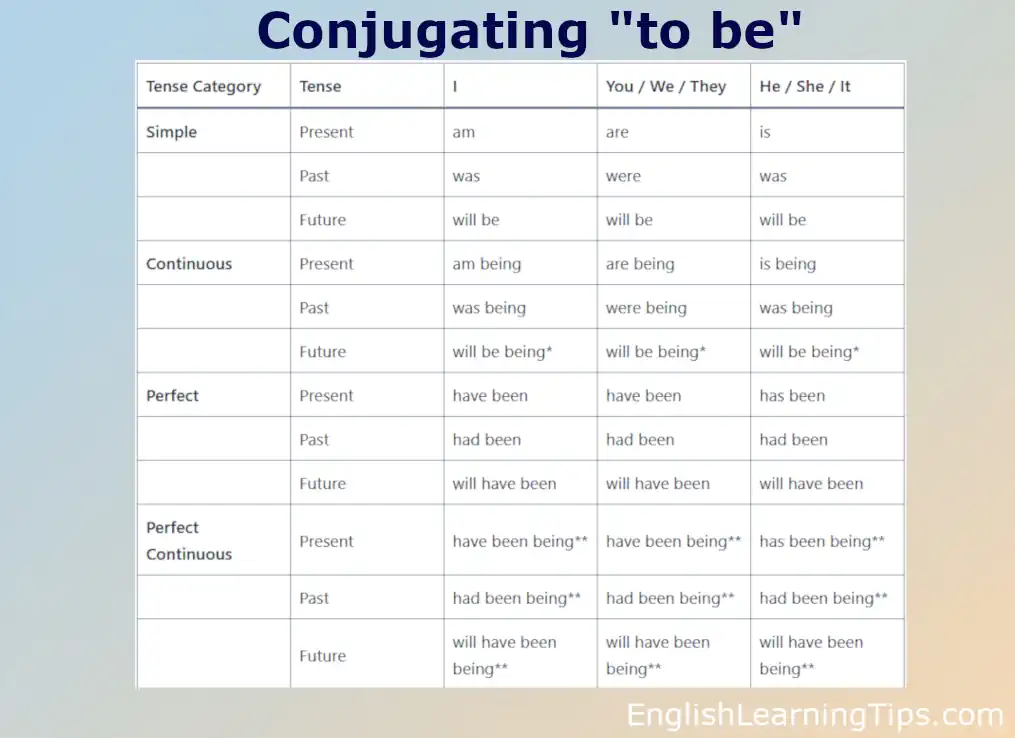
Expert tip: While the table above shows every possible form, native speakers rarely use the continuous and perfect continuous versions of “to be” in everyday speech. For example, instead of saying “I will be being,” most people simply say “I will be.” Use this chart as a technical reference for high-level academic writing.
Frequently asked questions about be verbs
Video to help you learn “to be”
Using “to be” in the imperative form
Conjugating and using “to be”
Recommended tools for mastering English
To help you apply these rules in your daily writing, here are a few tools our community swears by:
- The Blue Book of Grammar and Punctuation: An easy-to-read guide for clear, concise rules.
- Merriam-Webster’s Collegiate Dictionary: The essential desk reference for every writer.
- Kindle Paperwhite: Perfect for downloading ESL workbooks and reading on the go.
Summary of be verb usage
The verb to be is more than just a grammar rule; it is how we define our world. From a simple “I am” to a complex “they will have been,” these eight forms allow for infinite expression. They can be tricky, especially with the “was vs. were” subjunctive mood, but they become second nature with practice.
By understanding how be verbs function as both linking and auxiliary verbs, you gain the tools to write with greater precision and grammatical authority.
Join the conversation: What is your biggest grammar hurdle?
Grammar can be a bit of a maze, and we want to hear from you! Is there a specific “be” verb tense that always trips you up? Or perhaps you have a shortcut for remembering when to use “been” versus “being”?
Drop a comment below with your questions or share a sentence you’re working on. Our community of language learners and experts is here to help you get it right!
Ready to dive deeper into grammar? Read our guide on English verb conjugation.
Discover more from English Learning Tips
Subscribe to get the latest posts sent to your email.


