

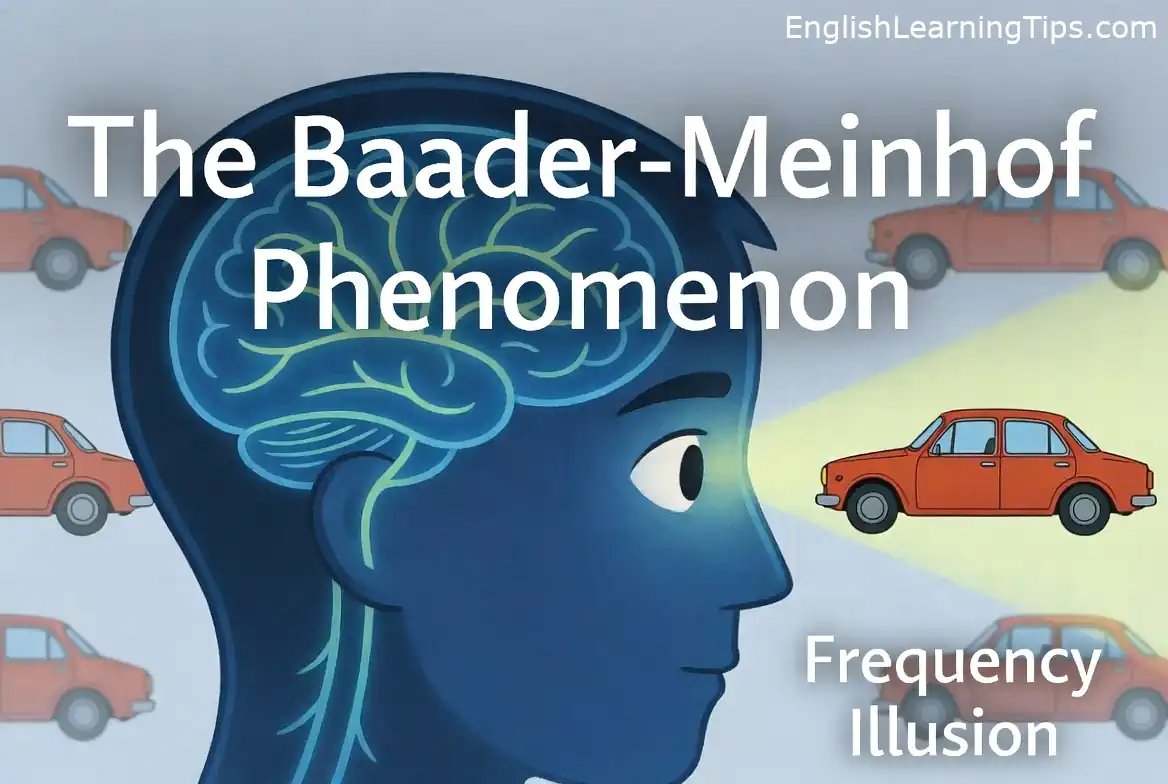
Exploring cognitive biases and the frequency illusion

Welcome to an exploration of the fascinating mechanisms behind human perception, cognitive bias, and the frequency illusion, commonly known as the Baader-Meinhof phenomenon.
Have you ever noticed a newly learned word or object appear multiple times shortly after discovering it?
This lesson plan breaks down the psychology, vocabulary, and practical applications of this mental quirk to help language learners and psychology enthusiasts master advanced concepts.
Lesson plan: Exploring cognitive biases and the frequency illusion
Level: Advanced (C1-C2)
Time: 45 minutes
Topic: The Baader-Meinhof phenomenon and cognitive psychology
Objectives: Understand the definition and psychological origins of the Baader-Meinhof phenomenon, learn essential vocabulary related to cognitive biases, practice discussing psychological concepts, and apply critical thinking to everyday perception patterns.
Video: “The Baader-Meinhof Phenomenon”
Background
The Baader-Meinhof phenomenon, more formally known as the frequency illusion, occurs when a newly noticed piece of information—such as a rare word, a specific car model, or a random fact—suddenly appears everywhere shortly after its initial discovery. Although it feels like a striking cosmic coincidence or a glitch in reality, it is actually the result of selective attention and our brain’s extraordinary pattern-recognition capabilities. When something catches our attention for the first time, our reticular activating system and cognitive filters flag it as important, causing us to unconsciously register subsequent occurrences that we might have previously ignored.
This perceptual trick is heavily augmented by two related psychological concepts: the recency effect and confirmation bias. The recency effect inflates the importance of recent observations, while confirmation bias convinces us that a genuine pattern or increased frequency is happening when our brain is merely paying closer attention. Understanding these cognitive shortcuts offers a compelling window into the machinery of the human mind, highlighting how our daily reality is shaped heavily by what we actively choose to look out for.
Basic vocabulary
This section introduces essential terms related to cognitive biases, perception, and the frequency illusion.
Vocabulary list
- Phenomenon (noun) | Verb: phenomenize, Adjective: phenomenal, Adverb: phenomenally | Definition: An observable fact or event, often one that is remarkable or puzzling. | Example sentence: The sudden popularity of the vintage toy was an interesting social phenomenon.
- Illusion (noun) | Verb: illude, Adjective: illusory, Adverb: illusorily | Definition: A false idea or belief; a deceptive appearance or impression. | Example sentence: The mirage in the desert created an illusion of water on the road.
- Coincidence (noun) | Verb: coincide, Adjective: coincidental, Adverb: coincidentally | Definition: A striking occurrence of two or more events at one time by mere chance. | Example sentence: Running into my old friend in a foreign country felt like an incredible coincidence.
- Bias (noun) | Verb: bias, Adjective: biased, Adverb: biasedly | Definition: Prejudice in favor of or against one thing, person, or group compared with another. | Example sentence: The researcher tried to eliminate any personal bias from the scientific study.
- Synchronicity (noun) | Verb: synchronize, Adjective: synchronous, Adverb: synchronously | Definition: The simultaneous occurrence of events which appear significantly related but have no discernible causal connection. | Example sentence: They experienced a strange synchronicity when they both called each other at the exact same second.
- Determinism (noun) | Verb: determine, Adjective: deterministic, Adverb: deterministically | Definition: The philosophical doctrine that all events, including human actions, are ultimately determined by causes external to the will. | Example sentence: The debate between free will and determinism has occupied philosophers for centuries.
- Stimulus (noun) | Verb: stimulate, Adjective: stimulative, Adverb: stimulatively | Definition: A thing or event that evokes a specific functional reaction in an organ or tissue. | Example sentence: Bright lights and loud noises served as a strong sensory stimulus for the audience.
- Recency (noun) | Verb: recent, Adjective: recent, Adverb: recently | Definition: The state or quality of having happened, been done, or appeared only a short time ago. | Example sentence: The recency of the report made its data extremely reliable for current market trends.
- Confirmation (noun) | Verb: confirm, Adjective: confirmative, Adverb: confirmatively | Definition: The action of establishing the truth or correctness of something. | Example sentence: She received confirmation of her flight reservation via email this morning.
- Ignorance (noun) | Verb: ignore, Adjective: ignorant, Adverb: ignorantly | Definition: Lack of knowledge or information. | Example sentence: His ignorance of local traffic laws led to an accidental violation.
Vocabulary for extension
- Perception (noun) | Verb: perceive, Adjective: perceptive, Adverb: perceptively | Definition: The ability to see, hear, or become aware of something through the senses.
- Cognition (noun) | Verb: cognize, Adjective: cognitive, Adverb: cognitively | Definition: The mental action or process of acquiring knowledge and understanding through thought, experience, and the senses.
- Pattern (noun) | Verb: pattern, Adjective: patterned, Adverb: patterned | Definition: A repeated decorative design or a regular and intelligible form or sequence.
- Awareness (noun) | Verb: aware, Adjective: aware, Adverb: awarely | Definition: Knowledge or perception of a situation or fact.
- Attention (noun) | Verb: attend, Adjective: attentive, Adverb: attentively | Definition: Notice taken of someone or something; the regard of special care or consideration.
- Observation (noun) | Verb: observe, Adjective: observant, Adverb: observantly | Definition: The action or process of observing something or someone carefully or in order to gain information.
- Intuition (noun) | Verb: intuit, Adjective: intuitive, Adverb: intuitively | Definition: The ability to understand something instinctively, without the need for conscious reasoning.
- Mechanism (noun) | Verb: mechanize, Adjective: mechanical, Adverb: mechanically | Definition: A system of parts working together in a machine or a natural process.
- Delusion (noun) | Verb: delude, Adjective: delusional, Adverb: delusionally | Definition: An idiosyncratic belief or impression that is firmly maintained despite being contradicted by what is generally accepted as reality.
- Ruse (noun) | Verb: ruse (rare), Adjective: ruse-like, Adverb: rusely | Definition: An action intended to deceive someone; a trick.
Teaching tips
- Connect abstract psychological terms like confirmation bias to real-world examples that students experience daily, such as seeing a new brand of shoes everywhere after considering buying them.
- Use visual mapping on a whiteboard to connect root words to their different parts of speech (e.g., perceive to perception and perceptive).
- Encourage students to create personal example sentences rather than memorizing dry dictionary definitions to improve long-term retention.
Grammar spotlight: Modals of deduction and speculation
This lesson integrates advanced conditional structures and modal verbs used to express probability, speculation, and cognitive deductions. When discussing psychological phenomena, speakers frequently utilize modals of deduction (e.g., must have seen, could lead to, might not register) and conditional clauses to describe hypothetical reasoning. For instance, explaining cause-and-effect cognitive loops relies heavily on structures like: “If we see something for the first time, it can lead us to believe that a greater synchronicity is at work.”
Additionally, students will practice using passive voice constructions to describe objective psychological processes, such as how stimuli are processed and augmented by cognitive biases.
Understanding modal verbs of probability
When discussing psychological phenomena and cognitive biases, speakers frequently utilize modal verbs of deduction (such as must have seen, could lead to, and might not register) to express degrees of certainty and speculation about past and present events. Mastering these structures allows advanced ESL learners to articulate complex hypotheses rather than simply stating facts.
Conditional clauses in psychological contexts
Explaining cause-and-effect cognitive loops relies heavily on conditional structures. Students must practice using conditional clauses to describe hypothetical reasoning, such as: “If we see something for the first time, it can lead us to believe that a greater synchronicity is at work.”
Passive voice in objective processes
Describing scientific and mental processes requires the use of passive voice constructions. Learners will examine how stimuli are processed, filtered, and augmented by cognitive biases, shifting the focus from the doer of the action to the objective psychological mechanism itself.
Useful phrases
Key phrases
- At work
- To play a role in
- All over the place
- To catch one’s attention
- Day-to-day life
- To look out for
- To prime the mind
- As a ruse
Teaching tips
- Have students practice substituting phrases like all over the place with more formal academic equivalents during roleplay exercises.
- Emphasize the natural rhythm and linking sounds in conversational chunks such as at work and look out for.
Example conversations
Conversation 1: Basic description
Student A: Have you ever noticed how you buy a new car and suddenly see the exact same model everywhere? Student B: Yes, absolutely! It feels like everyone decided to buy the same car on the exact same day. Student A: It turns out there is actually a scientific name for that strange feeling of coincidence. Student B: Really? What is it called? Student A: People usually refer to it as the Baader-Meinhof phenomenon or the frequency illusion.
Conversation 2: Adding details
Student A: I was reading about why our brains do that, and it comes down to pattern recognition. Student B: Makes sense since our brains are constantly processing millions of bits of data around us. Student A: Exactly. Once a new stimulus catches your attention, your brain sits in wait for similar stimuli to identify a pattern. Student B: So we aren’t actually seeing it more often; we are just noticing it because our filter changed. Student A: Precisely, and two other cognitive biases like recency and confirmation bias amplify that illusion.
Conversation 3: More advanced
Student A: What fascinates me most isn’t just the coincidences we think we spot, but all the unseen patterns zipping by in our day-to-day life. Student B: That implies our reality is heavily curated by what we actively prime our minds to look out for. Student A: Spot on. If we lack active learning or curiosity, our ignorance is maintained simply because our cognitive blind spots filter everything else out. Student B: It really shows how our perception is both a superpower and a self-imposed limitation governed by cognitive biases.
Teaching tips
- Instruct students to read the dialogues aloud in pairs, focusing on natural intonation shifts when expressing surprise or realization.
- Ask advanced learners to rewrite Conversation 3 using higher-level academic vocabulary terms from the extension list.
Teaching strategy
Employ a discovery-based learning approach where students first experience the target concept organically through a guided discussion or video clip before formal terminology is introduced. This mirrors the very nature of the Baader-Meinhof phenomenon itself, allowing learners to experience a pattern before identifying its structure. Scaffold the lesson by moving from concrete personal anecdotes about strange coincidences to abstract psychological explanations, ensuring high student engagement through collaborative dialogue practice and contextualized vocabulary exercises.
Here’s a 45-minute lesson plan.
Step 1: Warm-up (5 minutes)
Begin by asking students if they have ever experienced learning a new word or noticing a strange item, only to encounter it multiple times immediately afterward. Invite two or three students to share quick personal anecdotes to prime the classroom environment for the topic.
Step 2: Vocabulary introduction (10 minutes)
Introduce the core vocabulary list, highlighting parts of speech, derivatives, and definitions. Write example sentences on the board and have students identify how words like phenomenon, bias, and synchronicity function within sentences about human psychology.
Step 3: Phrase practice (10 minutes)
Introduce key idiomatic phrases such as at work, all over the place, and to look out for. Have students work in pairs to construct mini-dialogues incorporating at least two of these phrases in a natural context.
Step 4: Conversation practice (15 minutes)
Distribute the example conversations or display them on a screen. Have students read through the basic, detailed, and advanced dialogues in pairs, swapping roles, and then encourage them to improvise their own fourth conversation following the same thematic structure.
Step 5: Wrap-up and personalization (5 minutes)
Conclude the lesson by asking students to summarize the main takeaway regarding how active learning and cognitive biases shape our perception of reality. Collect any final questions and preview the homework assignment.
Discussion questions
- How does the human brain’s ability to recognize patterns act as both a survival mechanism and a cognitive trap?
- Can you share a personal experience where you felt the frequency illusion strongly influenced your perception of coincidence?
- In what ways do confirmation bias and the recency effect distort our understanding of objective probability?
- Why might a lack of active learning and reading cause people to remain ignorant of the complex patterns surrounding them?
- How can becoming aware of cognitive biases change the way we interpret everyday events and information?
Additional tips
- Cultural sensitivity: Acknowledge that the primary name of the phenomenon originates from a historical West German militant group, which can occasionally invoke sensitive political history, though the term itself is used purely in modern psychological contexts.
- Visual aids: Utilize diagrams illustrating selective attention filters and information processing loops to help visual learners grasp abstract cognitive biases.
- Adapt for level: For intermediate learners, focus primarily on basic vocabulary and Conversation 1; for advanced C2 learners, dive deep into the philosophical implications of determinism and cognitive architecture in Conversation 3.
- Technology: Play the source educational video clip in class with subtitles enabled to allow students to map auditory pronunciation directly to written psychological terms.
Common mistakes to address
- Grammar: Students often misuse modal verbs of deduction by saying “It must happen for a reason” instead of “It must have happened for a reason” when speculating about past events. Remind learners to adjust tense structures when talking about past psychological triggers.
- Word choice: Learners frequently confuse coincidence with synchronicity. Clarify that coincidence simply denotes chance occurrence without causal connection, whereas synchronicity often carries a psychological impression of meaningful relatedness.
Example activity
Divide students into small groups and give each group a newly introduced vocabulary word or phrase (e.g., confirmation bias or to sit in wait). Instruct them to design a 2-minute roleplay scenario depicting a character experiencing this cognitive bias in a real-world setting, such as shopping for a new gadget or studying for an exam. Groups then perform their sketches for the class, and the audience must identify which psychological principle or vocabulary term is being demonstrated.
Homework or follow-up
- Writing: Write a short 200-word reflective paragraph describing a recent instance where you experienced the frequency illusion, correctly using at least four words from the basic vocabulary list and sudo nano the draft into your local practice directory.
- Speaking: Record a 60-second voice memo explaining the difference between coincidence and the frequency illusion to a friend, ensuring proper usage of key phrases like at work and to look out for.
- Research: Research another common cognitive bias (such as the Dunning-Kruger effect or anchoring bias) and prepare three bullet points to share with the class during the next session.
FAQs
- What is the difference between the Baader-Meinhof phenomenon and confirmation bias? The Baader-Meinhof phenomenon (frequency illusion) is the initial perceptual trigger where you notice something new and subsequently see it more often. Confirmation bias is the active mental filter that reinforces your belief that this item is unusually common because you are now actively looking for it.
- Why is it called the Baader-Meinhof phenomenon? The name was coined in 1994 by a reader who wrote into a newspaper column after repeatedly encountering references to the Baader-Meinhof group (a 1970s West German militant organization) shortly after first learning about them. The name stuck due to its catchy nature, even though it has no historical connection to the group itself.
- Is the frequency illusion considered a true psychological disorder? No, it is not a disorder at all. It is a completely normal byproduct of healthy human cognitive functioning, selective attention, and pattern recognition.
- How can I stop experiencing the frequency illusion? You cannot entirely stop it because pattern recognition is an automatic function of the human brain. However, being aware of cognitive biases helps you rationally evaluate whether an event is a genuine statistical anomaly or simply your selective attention at work.
- Can reading and writing help reduce the negative effects of cognitive biases? Yes. Actively engaging in diverse reading and writing habits primes your mind to process a wider array of data, helping you break out of rigid perceptual loops and reduce narrow confirmation biases.
Conclusion and call to action
Mastering the complexities of human perception and cognitive biases opens up a deeper understanding of how our minds construct reality. By expanding your vocabulary and analyzing these mental frameworks, you empower yourself to think more critically and observe the world with sharper clarity. What unexpected words or patterns have you caught your brain noticing lately? Drop a comment below to share your experiences, and be sure to share this article with fellow language learners and psychology enthusiasts!
Discover more from English Learning Tips
Subscribe to get the latest posts sent to your email.


