

Semantics vs pragmatics: Understanding the layers of meaning in English

Why do we sometimes understand every word someone says, yet still miss the point? The answer lies in the tug-of-war between semantics and pragmatics. Knowing the difference between semantics and pragmatics is essential for anyone learning, teaching, or mastering the English language. While both branches of linguistics explore how meaning is constructed, they approach communication from different perspectives.
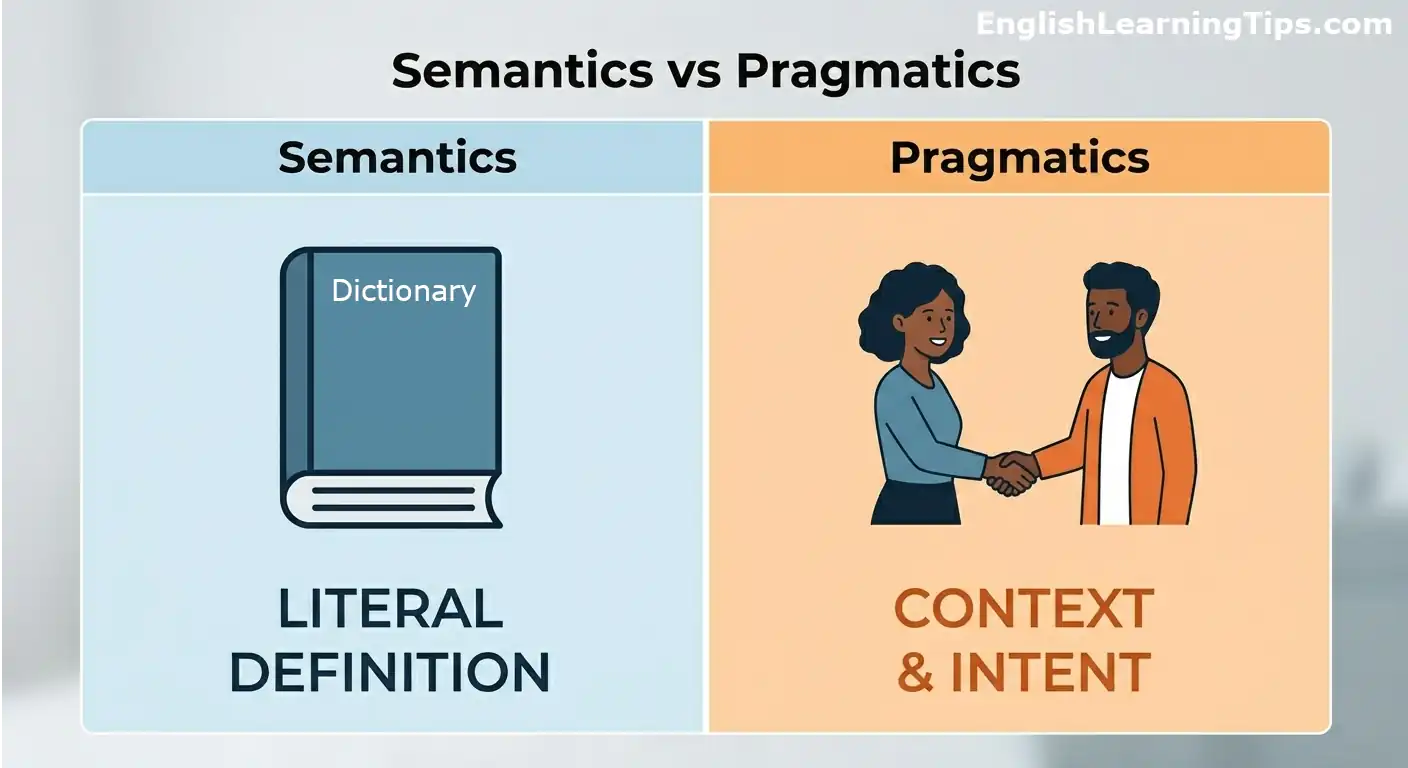
In short, semantics focuses on the literal, dictionary-based meaning of words and sentences. In contrast, pragmatics examines how context, speaker intent, and social factors shape what people actually mean in real-world conversation.
What is semantics: The literal foundation
Semantics is the study of the inherent meaning of words and phrases independent of specific situations. It relies on the conventional rules of grammar and vocabulary to determine what a sentence says on paper.
Key components of semantic analysis include:
- Lexical semantics: The study of individual word meanings (e.g., understanding polysemy, such as how “bank” can mean a financial institution or a river’s edge).
- Compositional semantics: How meanings combine to form complex ideas. For example, “the cat sat on the mat” derives its meaning from the relationship between the subject, verb, and prepositional phrase.
- Semantic relations: This includes synonyms (happy vs. glad), antonyms (hot vs. cold), and hyponyms (a “poodle” is a hyponym of “dog”).
What is pragmatics: The power of context
Pragmatics explores how people use language in real-life social interactions. It accounts for the “invisible” meaning that listeners must infer based on tone, shared knowledge, and environmental cues.
Core elements of pragmatic competence include:
- Speech acts: Using language to perform an action. For example, asking “could you open the door?” is pragmatically a request, even though semantically it is a question about physical ability.
- Implicature: Meaning that is implied but not explicitly stated.
- Deixis: Words like “here,” “there,” “this,” or “that” require physical or situational context to be understood.
- Social norms: The unwritten rules of politeness and turn-taking that vary across cultures.
Comparison of semantics and pragmatics: Key differences at a glance
The following table highlights the primary distinctions between these two linguistic fields to help you differentiate them quickly.
| Feature | Semantics | Pragmatics |
| Primary focus | Literal word meaning | Intended meaning in context |
| Context | Independent (decontextualized) | Dependent (relies on situation) |
| Meaning source | Dictionaries and grammar | Inference and social cues |
| Core question | What does this sentence mean? | What does the speaker mean by this? |
| Requirement | Knowledge of vocabulary | Knowledge of the world/culture |
Real-life examples: How meaning shifts in English
To see the semantics vs pragmatics distinction in action, look at these common English expressions:
1. “It is getting late.”
- Semantic meaning: The current time is approaching the end of the day or a specific deadline.
- Pragmatic meaning: Depending on the setting, this could mean “we should leave the party,” “please finish your work,” or “I am tired and want to go to bed.”
2. “Do you have a watch?”
- Semantic meaning: A literal inquiry regarding the listener’s ownership of a time-keeping device.
- Pragmatic meaning: Typically, a polite way of asking “what time is it?”
3. “Thanks a lot!”
- Semantic meaning: An expression of high-level gratitude.
- Pragmatic meaning: If said with a specific falling intonation after someone makes a mistake, it functions as sarcasm, meaning the opposite of the literal words.
Why pragmatic competence matters for English learners
For those studying English as a second language (ESL), mastering semantics is often the first step. You learn the definitions (semantics) and the structure (syntax). However, many learners encounter a “pragmatic gap” where they understand every word in a sentence but miss the speaker’s intent.
Common challenges include:
- Idiomatic expressions: Phrases like “piece of cake” have a semantic meaning (food) that differs entirely from their pragmatic use (ease of task).
- Indirectness: Many English speakers use indirect requests to stay polite. A learner might take “it’s a bit loud in here” as a statement of fact rather than a request to lower the volume.
- Cultural nuance: The level of directness expected in a New York office may differ significantly from a London boardroom, requiring different pragmatic approaches.
Recommended books: Deepen your understanding of semantics and pragmatics
If you want to move from basic concepts to advanced mastery, these are the top-rated resources available on Amazon:
- The Study of Language by George Yule: This is a fantastic starting point for beginners. It explains complex linguistic concepts in a way that is easy to digest.
- Pragmatics (Oxford Introduction to Language Study) by George Yule: A concise guide specifically focused on how context shapes meaning.
- Semantics: A Coursebook by James R. Hurford: Perfect for those who want interactive exercises to practice literal meaning and logic.
- How to Do Things with Words by J.L. Austin: A classic text for anyone interested in the philosophy of speech acts and intended meaning.
Frequently asked questions about semantics and pragmatics
Conclusion: Improving your English communication skills
To become a more effective communicator, focus on developing both areas:
- Expand your semantic range: Use a thesaurus to find precise synonyms and study how prefixes and suffixes change word roots.
- Observe pragmatic cues: Watch English-language movies or podcasts to see how native speakers use body language, intonation, and situational context to layer meaning onto their words.
- Practice active listening: Ask yourself, “What is this person trying to achieve with this statement?” rather than just “What do these words mean?”
By balancing these two linguistic pillars, you will move beyond mere translation and toward true fluency in English.
Join the conversation: How do you use semantics and pragmatics?
Mastering the balance between literal and implied meaning is a lifelong journey. We want to hear about your experiences navigating these linguistic layers.
- Have you ever had a “pragmatic failure”? Share a funny or confusing story in the comments where you understood the words but missed the intent.
- Are you a teacher? Tell us which concept—semantics or pragmatics—your students find more challenging to grasp.
- Found this helpful? If this guide cleared up your confusion, please share it with your fellow English learners or linguistics enthusiasts. Your shares help us create more in-depth content like this.
Discover more from English Learning Tips
Subscribe to get the latest posts sent to your email.


