

Simple present tense: A complete guide to rules and usage

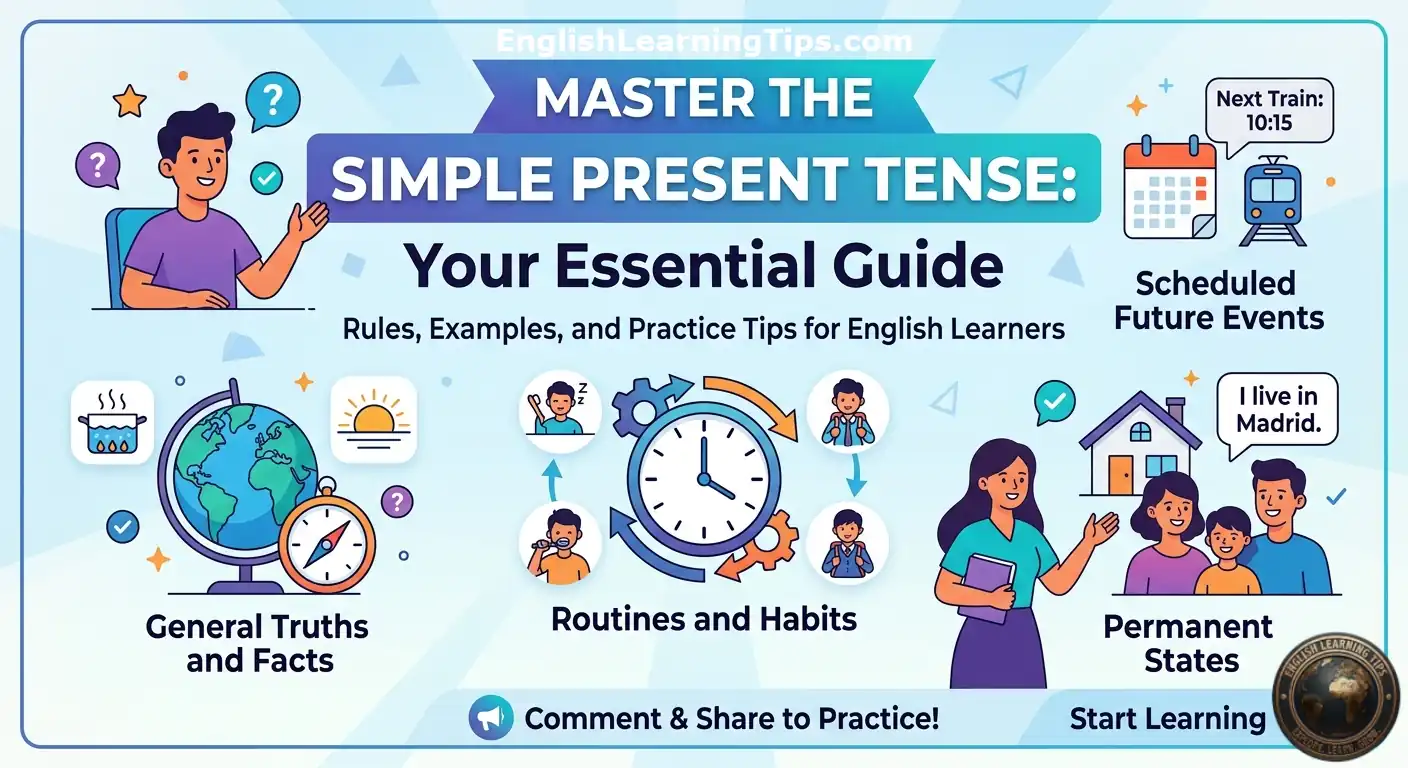
The simple present tense (also known as the present simple) is one of the most essential building blocks of the English language. We use it to describe habits, unchanging facts, routines, and permanent situations.
Whether you are a beginner learner or refreshing your grammar, understanding the simple present tense rules is the first step toward speaking English naturally.
When to use the simple present tense
Using the correct tense depends on the “nature” of the action. It is important to distinguish between “state” and “action.” Here are the primary functions of the present simple:
- Habits and routines: Actions that happen repeatedly (e.g., “I wake up at 7 a.m.”).
- General truths and facts: Laws of nature or things that are always true (e.g., “The sun rises in the east”).
- Permanent states: Feelings, beliefs, or conditions that don’t change quickly (e.g., “She lives in London”).
- Fixed schedules: Future events on a timetable (e.g., “The flight departs at midnight”).
- Instructions: Giving directions or explaining a process (e.g., “First, you pour the milk into the bowl”).
How to form the simple present tense: Formula and examples
Forming the simple present is straightforward for most subjects, but it requires a specific change for the third-person singular (he, she, it).
| Sentence type | Formula | Example |
| Affirmative | Subject + Base Verb (+ -s/-es) | They work here. / He works here. |
| Negative | Subject + Do/Does not + Base Verb | I do not eat meat. / She doesn’t eat meat. |
| Interrogative | Do/Does + Subject + Base Verb? | Do you know him? / Does it rain often? |
Conjugation of the verb “to play”
| Subject | Affirmative | Negative (Contraction) | Question |
| I | I play | I do not play (don’t) | Do I play? |
| You | You play | You do not play (don’t) | Do you play? |
| He / She / It | He plays | He does not play (doesn’t) | Does he play? |
| We | We play | We do not play (don’t) | Do we play? |
| They | They play | They do not play (don’t) | Do they play? |
Recommended resources for practice
To master these tenses, we recommend using a dedicated workbook for hands-on exercises. Here are the top-rated tools for English learners:
- English Grammar in Use with Answers: The world’s best-selling grammar book for intermediate learners.
- The English Grammar Workbook for Adults: Excellent for practical, real-world grammar applications.
Spelling rules for third-person singular
When the subject is he, she, or it, the verb changes slightly. Use these spelling rules to avoid common writing errors:
- Standard verbs: Simply add -s (walk → walks, eat → eats).
- Ending in -ch, -sh, -ss, -x, or -o: Add -es (match → matches, wash → washes, fix → fixes, go → goes).
- Consonant + y: Change the y to i and add -es (study → studies, fly → flies).
- Vowel + y: Just add -s (play → plays, enjoy → enjoys).
Adverbs of frequency and signal words
To clarify how often an action happens, we use adverbs of frequency. These words are “signals” that tell the reader you are using the simple present tense.
- Common adverbs: Always, usually, often, sometimes, rarely, never.
- Word order: These usually come before the main verb but after the verb “to be.”
- Correct: “He never eats breakfast.”
- Correct: “They are often late.”
Stative verbs: Why they stay in the simple present
Certain verbs describe a state of being rather than a physical action. These are called stative verbs and are rarely used in the “-ing” form (present continuous).
- Emotions: Like, love, hate, want, need.
- Mental states: Know, believe, remember, understand, suppose.
- Possession: Have, own, belong, possess.
- Senses: See, hear, smell, taste, seem.
Grammar tip: Even if you are feeling “love” right now, you say “I love this song,” not “I am loving this song.”
Simple present vs. present continuous: What is the difference?
Distinguishing between these two tenses is essential for English fluency.
| Feature | Simple present | Present continuous |
| Duration | Permanent or long-term | Temporary or in-progress |
| Focus | Routine and frequency | The moment of speaking |
| Example | I live in New York (My home). | I am living in New York (Just for a month). |
| Signal words | Every day, usually, on Mondays | Now, at the moment, this week |
Common mistakes to avoid
- The missing -s: “She study every night” is incorrect. Remember to use “She studies.”
- Double negatives: When using “doesn’t,” the main verb stays in the base form. Use “He doesn’t like coffee,” not “He doesn’t likes coffee.”
- Confusing habits with current actions: Use the simple present for your job (“I work at a bank”) and the continuous for what you are doing this second (“I am typing an email”).
Frequently asked questions (FAQ)
Wrap up: Mastering the simple present tense
Mastering the simple present tense is a major milestone in your English language journey. By understanding when to use it—for habits, facts, and schedules—you build a strong foundation for more complex grammar. Remember that the most common hurdle for learners is the third-person singular “-s,” so keep practicing those “he, she, and it” forms until they become second nature.
Consistent practice is the fastest way to achieve fluency. Try writing out your daily schedule or describing your favorite hobby using the rules we covered today.
Share your thoughts and practice
We want to hear from you! To practice what you just learned, leave a comment below with one sentence about your daily routine or a fun fact about your hometown using the present simple.
If you found this guide helpful, please share it with a friend or a classmate who is also learning English. Your support helps us create more free grammar resources for learners everywhere!
Discover more from English Learning Tips
Subscribe to get the latest posts sent to your email.


